
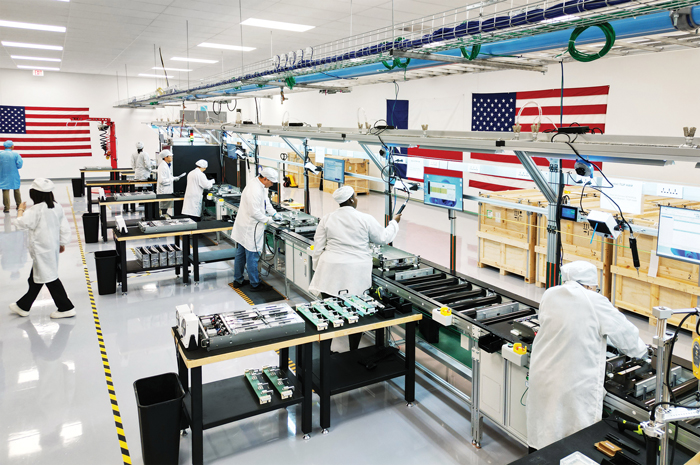
A new facility in Houston will support production of advanced Apple servers. (Photo courtesy Apple Inc.)
The company is increasing its work with component manufacturers across the country while incentivizing global firms to expand their production of critical components in the U.S.
CUPERTINO, Calif.—When Apple announced a new $100 billion commitment to America in August, it signaled the company’s resolve to bring more of its supply chain and advanced manufacturing to the United States. It also marked a 20 percent increase in its planned U.S. investment over the next four years, now totaling $600 billion, the company said in a release.
Apple’s commitment includes a new American Manufacturing Program (AMP), through which the company plans to work with more suppliers and partners across America while incentivizing global companies to manufacture more critical components in the United States.
“Today, we’re proud to increase our investments across the United States to $600 billion over four years and launch our new American Manufacturing Program,” said Apple CEO Tim Cook, in a statement. “This includes new and expanded work with 10 companies across America. They produce components that are used in Apple products sold all over the world, and we’re grateful to the President for his support.”
Apple parts and components that are manufactured in the United States are shipped to customers around the world. About two-thirds of the components made in the U.S. are exported to customers outside the country, according to Apple.
The company said that by partnering with “thousands of suppliers across all 50 states,” it supports more than 450,000 jobs at its suppliers and partners. “In the next four years, Apple plans to directly hire 20,000 people in the U.S.—the vast majority focused on R&D, silicon engineering, software development, and AI and machine learning,” the release stated.
Early Goals of Apple’s American Manufacturing Program
In the release, Apple said it is working with its suppliers to accelerate manufacturing in the U.S. through the new American Manufacturing Program. Early partners in the program include Corning, Coherent, GlobalWafers America (GWA), Applied Materials, Texas Instruments (TI), Samsung, GlobalFoundries, Amkor, and Broadcom. Apple’s work with these companies builds on the company’s commitment, announced in July, to buy American-made rare earth magnets from MP Materials.
Apple said the American Manufacturing Program will help fund a major expansion of its long-standing partnership with Corning, creating what the company called “the world’s largest and most advanced smartphone glass production line” at a factory in Harrodsburg, Kentucky. As a result of the expansion, “every iPhone® and Apple Watch® sold around the world will be built with Kentucky-made cover glass.” The two companies are also slated to open a new Apple-Corning Innovation Center in Kentucky.
Apple also entered into a new multiyear agreement with Coherent, an established partner that produces vertical-cavity surface-emitting lasers (VCSELs) for Apple at Coherent’s Sherman, Texas, facility. These lasers enable multiple features, including Face ID, on iPhone and iPad devices shipped around the world.
Apple’s commitment to buying American-made rare earth magnets from MP Materials is expected to significantly expand production capacity at MP Materials’ flagship Independence facility in Fort Worth, Texas. Magnets produced by MP Materials, reportedly the only fully integrated, rare-earth producer in the United States, will become part of Apple devices shipped around the world. The two companies also plan to establish a cutting-edge rare earth recycling line in Mountain Pass, California.
Building an End-to-End American Silicon Supply Chain
These new partnerships are positioning Apple to lead what it described as “the creation of an end-to-end silicon supply chain in the United States, with partners in every key aspect of silicon production.” This U.S. silicon supply chain is on track to produce more than 19 billion chips for Apple products in 2025, the company said.
The supply chain includes TSMC Arizona, reported to be producing tens of millions of chips for Apple using one of the most advanced process technologies in America. Apple is the factory’s first and largest customer.
“Apple engineers work closely with suppliers across the United States to create silicon chips that are on the leading edge of innovation,” said Sabih Khan, Apple’s chief operating officer, in a statement. “We’re committed to supporting U.S. suppliers involved in every key stage of the chip-making process—from the earliest stages of research and development to final fabrication and packaging. We want America to lead in this critical industry, and we’re expanding our efforts to grow a silicon manufacturing ecosystem that will benefit innovators across America.”
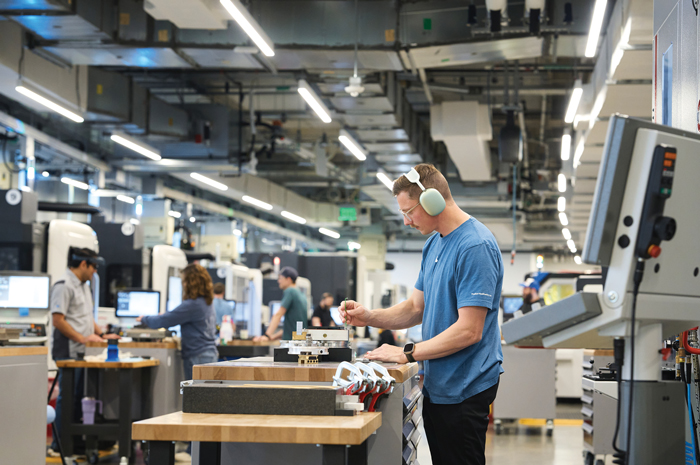
Apple’s second campus in Austin includes a new R&D lab for its hardware engineering, hardware technology, and software engineering teams. (Photo courtesy Apple Inc.)
Wafers are the building block of any silicon chip. Apple is partnering with GlobalWafers America in Sherman, Texas, to produce advanced wafers for use in U.S.-based semiconductor fabs for the first time. American chip fabs—such as TSMC (Phoenix) and Texas Instruments (Sherman, Texas)—will use GWA’s 300mm wafers to produce chips for iPhone and iPad devices sold in the U.S. and around the world. GlobalWafers America uses silicon from U.S. sources, including from Corning’s Hemlock Semiconductor, to produce what are described as “the world’s most advanced silicon wafers.”
Apple said it is also partnering directly with Applied Materials to boost the production of semiconductor manufacturing equipment in the United States. The Applied site in Austin, Texas, is considered a pivotal hub for manufacturing cutting-edge chip equipment.
Fabs take bare wafers and turn them into chips. Apple and Texas Instruments are expanding their partnership to increase future product collaboration and critical U.S. capacity for this work, the release said.
Apple is making a new commitment with TI, which will support additional tool installations at its facility in Lehi, Utah, and a new facility in Sherman, Texas. These facilities are home to TI’s most advanced process technologies and use American-made chip manufacturing equipment from Applied Materials’ factory in Austin, as well as advanced silicon wafers from GlobalWafers America.
“These facilities will manufacture critical foundational semiconductors used for Apple products, including iPhone devices shipped in the U.S. and around the world,” the release stated.
Apple is also working with Samsung at its fab in Austin, Texas, to launch an innovative new technology for making chips. According to Apple, the technology has never been used before at any facility in the world. Samsung will bring this technology to the U.S. first, supplying chips from its Austin facility that optimize power and performance of Apple products, including iPhone devices shipped across the globe.
GlobalFoundries and Apple have also entered an agreement to bring more semiconductor manufacturing to the United States. Production will focus on manufacturing cutting-edge wireless technologies and advanced power management—critical technologies that enable longer battery life and enhanced connectivity in Apple devices. The partnership is expected to bring new capabilities, jobs, and technology to the GlobalFoundries semiconductor facility in Malta, New York.
Packaging is the final critical step in manufacturing silicon chips. Apple said it is investing in Amkor’s new advanced chip packaging and test facility in Arizona, and it will be the Amkor facility’s first and largest customer.
“This will accelerate the development of packaging capabilities in America, meaningfully strengthening the semiconductor supply chain in the U.S.,” the release stated. “This facility will package, and test Apple silicon manufactured at the nearby TSMC fab, and create chips used in iPhone devices shipped around the world.”
Apple is also working with Broadcom and GlobalFoundries to develop and manufacture additional cellular semiconductor components in the United States. These components are said to be “crucial for 5G communications in Apple products.”
New Facility to Support Production of Advanced Servers
Earlier this year, construction of a new factory that will support production of advanced Apple servers began in Houston. In July, the facility produced its first test unit. The 250,000-square-foot server manufacturing facility is slated to begin mass production in 2026, Apple said in the release.
The servers produced in Houston were previously manufactured outside the United States. Expected to play a key role in powering Apple Intelligence, they are the foundation of Private Cloud Compute, which is said to combine “powerful AI processing with the most advanced security architecture ever deployed at scale for AI cloud computing.” The culmination of years of R&D by Apple engineers, the servers are reported to provide “the industry-leading security and performance of Apple silicon to the data center.”
“Apple’s American-made advanced servers are now shipping from our new Houston facility to Apple data centers!” said Cook in statement posted on X and the Apple Newsroom on October 23. “These servers will help power Private Cloud Compute and Apple Intelligence, as part of our $600 billion U.S. commitment.”
New Manufacturing Academy to Support American Businesses, Innovation
The new Apple Manufacturing Academy opened in Detroit in August, offering free programming to train and support American businesses, innovators, and manufacturers. In partnership with Michigan State University, the academy provides consultations and courses to small and medium-sized businesses from across the country. According to Apple, these courses are designed to help American companies transition to advanced manufacturing by implementing artificial intelligence and smart manufacturing techniques into their operations.
“Apple works with suppliers in all 50 states because we know advanced manufacturing is vital to American innovation and leadership,” said Khan. “With this new programming, we’re thrilled to help even more businesses implement smart manufacturing so they can unlock amazing opportunities for their companies and our country.”
Sessions will focus on machine learning and deep learning in manufacturing; automation in the product manufacturing industry; leveraging manufacturing data to improve product quality; applying digital technologies to enhance operations; and more, the company said.
Construction of Apple’s second campus in Austin is also in progress. The company said it employs more than 13,000 team members across Texas, including thousands already working from three completed office buildings that exceed 1 million square feet. The three buildings currently under construction include an expansive new R&D lab space for Apple’s hardware engineering, hardware technology, and software engineering teams, the company said.
Source: