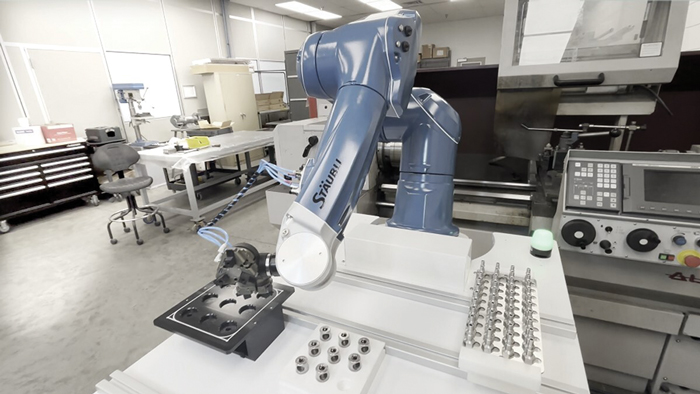
A machine tending cart by Stäubli Robotics. (Image courtesy Staubli/PRNewswire)
The new cart from Stäubli Robotics is said to offer manufacturers a fast track to collaborative automation.
DUNCAN, S.C.—A new machine tending cart introduced by Stäubli Robotics is described by the company as a “next-generation plug-and-play automation solution engineered to enhance productivity, safety, and flexibility across a wide range of industrial applications.”
According to a release from Stäubli Robotics, the MTC-900 Machine Tending Cart is designed for high-demand environments, such as metalworking, plastic injection molding, and precision assembly. Reported to offer manufacturers “a fast track to collaborative automation,” the MTC-900 enables smooth integration with injection molding machines (IMMs) via the Euromap 67 standard, enabling plug-and-play connectivity, reducing setup time, and simplifying deployment in molding operations.
“The MTC-900 is a game-changer for facilities looking to automate machine tending without the complexity,” said Stäubli North America Division Director for Robotics Chris Clark, in the release. “Its compatibility with IMM protocols and compact design make it ideal for injection molding environments where uptime and safety are paramount.”
Key features and benefits of the MTC-900 are reported to include multi-model compatibility with Stäubli TX2-60 and TX2-60L robots, and a compact footprint optimized for confined workspaces. It also offers advanced interface support, including EtherCat, ProfiNet, and Ethernet IP, built-in laser scanning for enhanced safety and compliance, and modular design for easy reconfiguration and scalability, the company said in the release.
“The MTC-900 is built to support continuous operation in harsh industrial settings, offering a robust and flexible solution for manufacturers seeking to improve throughput without compromising safety,” the release stated. “Its modular architecture allows for quick adaptation to changing production needs, while its advanced communication protocols ensure seamless integration with existing systems.”
Stäubli said in the release that it offers a broad range of 4- and 6-axis robots, including robotic arms designed specifically for sensitive environments; autonomous mobile robots; driverless transport systems (AGVs); and cobots for human-robot collaboration.