
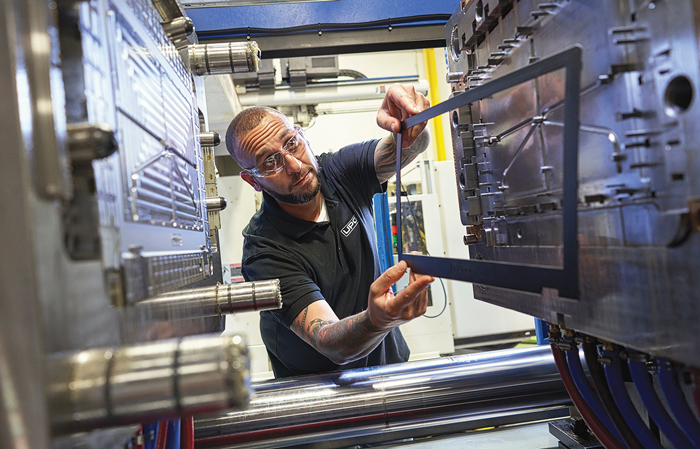
A manufacturing team member at one of UPG’s injection molding machines. The company combines tooling excellence with expert processing to yield high-quality, repeatable parts. (Photo courtesy UPG)
The company offers a wide range of precision production options to customers in sectors from data centers to medical and energy.
By Mark Shortt
UPG Company LLC is a Houston-based manufacturer that specializes in precision injection-molded plastics. According to UPG Business Unit Director Gary Ahlschlager, the company’s expertise in processing high-performance engineering resins, along with its history of working as a collaborative, solutions-oriented partner, are keys to its success as a manufacturer of high quality, precision parts.
Since first opening its doors as an injection molding company in 1954, UPG has grown significantly beyond its roots as a parts manufacturer. Today, the company is a “global ODM (original design manufacturer) and manufacturer of complex assemblies,” according to its website, as well as a diversified maker of complex plastic parts and components.
Besides adding facilities in Cardiff, Wales; and Suzhou, China, the company has complemented its injection molding expertise with capabilities in precision machining, sheet metal fabrication, powder coating, assembly, packaging, and supply chain management. By acquiring these capabilities, UPG has positioned itself to provide comprehensive manufacturing services, differentiating itself from molders with narrower offerings.
“Customers choose UPG for its combination of engineering depth, global scale, and customer service,” Ahlschlager said in an emailed response to Design-2-Part.
The manufacturer is one of 11 companies that constitute The Partner Companies (TPC), a large, U.S.-based manufacturing ecosystem with a variety of specialty niches in processes like photochemical etching, electroforming, and ceramic metallization. The Partner Companies also offers core manufacturing capabilities in injection molding, sheet metal fabrication, precision machining, and finishing.
Operating as a global network of collaborative, integrated manufacturing firms, TPC produces mission-critical parts, components, and assemblies for essential industries, from medical, aerospace, and defense, to energy, telecommunications, and semiconductors.
“TPC combines entrepreneurial agility with the strength of an integrated manufacturing ecosystem,” said TPC Group President Roy Barnes, in an emailed response. “From the smallest component to full integration in complex assemblies, TPC’s operational agility enables customers to move from concept to implementation with consistent quality, precision, and efficiency across its companies.”
As part of TPC, UPG has a global footprint through which it supports high-volume programs and highly engineered, mission-critical components across multiple markets, including the data center, medical, automotive, energy, industrial, and consumer sectors, according to Ahlschlager.
“UPG has access to complementary engineering and manufacturing solutions that combine multiple processes to meet customers’ exact requirements,” Ahlschlager said. “The TPC business model also provides geographic diversity, offering flexibility to customers while maintaining the same level of quality.”
UPG employs more than 300 people and has approximately 165,000 square feet of workspace across its three facilities in Houston, Wales, and China, according to Ahlschlager. In addition, “TPC has over 900 employees and 459,000 square feet across all its sites,” he said. The company’s sizeable manufacturing capacity enables it to provide quick-turn production of parts.
“We offer a variety of injection molding capabilities and can accommodate part sizes that range from 1 gram to 15 pounds,” UPG said on its website. “We offer customers a wide range of production options, including micro-molding, thin wall molding, two-shot injection molding, and vertical injection molding.”
Focusing on Engineering, Quality Assurance, and Customer Support
Critical to UPG’s capabilities as a manufacturer is its company-wide focus on engineering and quality assurance. The company’s teams leverage advanced simulation software, scientific molding practices, robotic automation, and precision machining to achieve repeatability and efficiency.
“Skilled engineers and technicians apply expertise in materials science, tooling optimization, and process validation to meet the most challenging specifications,” Ahlschlager said.
Depending on the process, Ahlschlager noted, UPG achieves tight tolerances on plastic parts from ±0.0005 to ±0.003 inch and maintains precision machining tolerances of ±0.0005 inch. In sheet metal fabrication, its team consistently meets tolerances of ±0.005 to ±0.010 inch, supported by advanced inspection and validation processes to ensure full compliance with customer requirements.
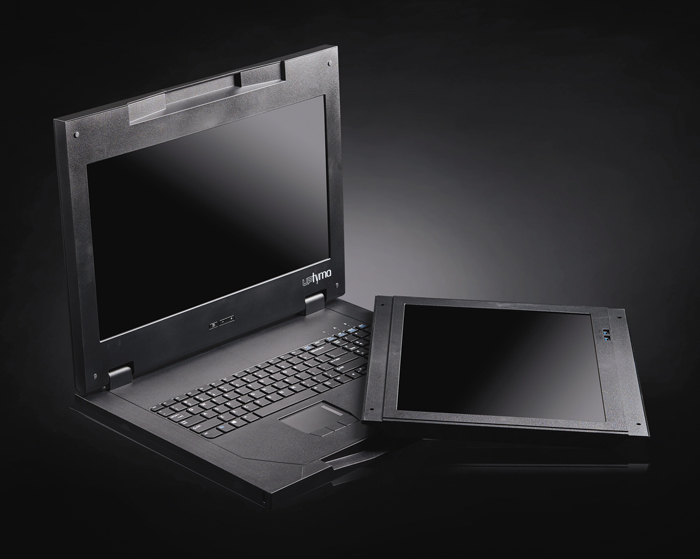
Products designed and built in-house by UPG include the UPtyma KVM Rackmount Console Kit and a display-only Rackmount LCD monitor. (Photo courtesy UPG)
At its facility in Houston, UPG is expanding its machining and metal capabilities while continuously investing in new equipment to optimize customer output. This includes injection molding presses, automation systems, and secondary operations to support growth in the medical and industrial markets, along with new precision CNC and sheet metal fabrication equipment, Ahlschlager said.
Beyond molding and fabrication, UPG provides turnkey assembly, cleanroom manufacturing, supply chain and logistics management, and global program oversight. These integrated services enable OEMs to simplify vendor management, reduce complexity, and count on UPG as a single-source partner for end-to-end solutions, he explained.
“UPG provides full-service support from concept to production, including design-for-manufacturability (DFM), prototyping, engineering, including electrical [and] mechanical engineering; tooling design and fabrication, and injection molding—including overmolding, insert molding, and multi-cavity molding tools,” Ahlschlager said.
The company supports its customers with a strong quality management system (QMS) that strives to ensure customer satisfaction by delivering high quality products and outstanding service.
“Throughout every step of the program, we apply quality control measures to ensure that production parts meet our clients’ stringent standards,” the company’s website stated. “Our quality assurance starts with our manufacturing processes that adhere to the principles of a Lean/Six Sigma environment and a culture of continuous improvement.”
UPG holds certifications to ISO 9001, the international standard for quality management systems that helps organizations ensure they consistently meet customer and regulatory requirements; AS9100D, the QMS standard for the aerospace and defense industries; and ISO 13485, the internationally recognized QMS standard for the medical device industry.
The company also supports its customers with a dedicated program manager, who oversees all steps of the process while serving as the single point of contact throughout the life of the program. “Our goal is to create and maintain successful, mutually beneficial long-term business relationships by providing the best customer support in the industry,” the website said.
Manufacturing Solutions for Data Centers
Through the years, UPG honed its expertise in designing precision injection molded products for data centers. More recently, demand for high-density data centers has skyrocketed due to explosive growth of AI and machine learning. During this period, manufacturers of servers and other data center infrastructure have relied on UPG to develop high-quality components for hard drive enclosures, blanks, and rack-mounted video console units.
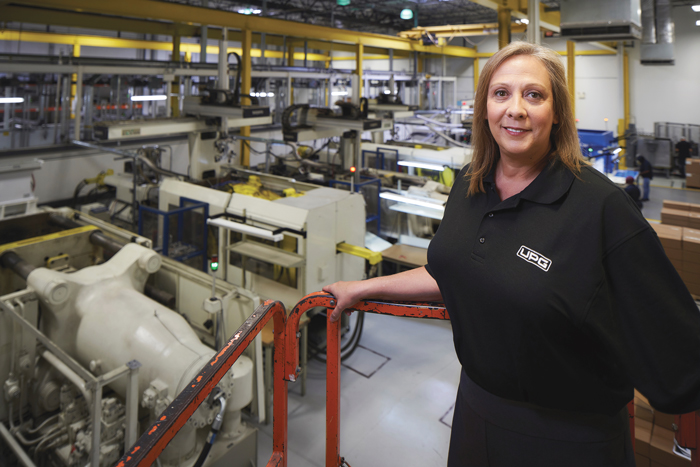
UPG General Manager Sandy Cook, shown here at UPG Houston, has devoted more than three decades to exceeding customer expectations. (Photo courtesy UPG)
“UPG has a proud 70-plus year history of engineering some of the most complex injection-molded products in the world,” Ahlschlager said. “As electronics advance toward smaller, more powerful designs, UPG leverages expertise in plastic injection molding to achieve tight tolerances and complex geometries. [Our] rapid prototyping, fast ramp-up, and end-to-end solutions accelerate time-to-market.”
Ahlschlager said the company’s development of a Rackmount KVM (keyboard, video, mouse) Solution for Data Centers highlights UPG’s ability to deliver a fully integrated system that combines plastics, metal, and electronics. It also reinforces the company’s “reputation as a collaborative partner to OEMs in high-growth industries like data centers and cloud computing,” he added.
“A leading data center OEM required a fully integrated rack-mounted KVM solution that combined durability, serviceability, and compliance with global safety standards,” he explained. “The product needed to meet demanding reliability requirements for 24/7 use in enterprise environments.”
The main technical challenge involved delivering a turnkey design that integrated multiple disciplines—plastics, precision sheet metal, and printed circuit assemblies (PCAs)—while meeting strict requirements for performance, safety, and thermal management. Certification by UL and CSA added another layer of complexity to the design and validation process.
“UPG served as the full-system design partner, taking the product from concept through production. Our team designed the injection-molded plastics, sheet metal chassis, and integrated PCAs to ensure mechanical and electronic performance,” Ahlschlager noted.
Materials used by UPG’s team included high-strength engineering plastics for front bezels and housings; precision-formed sheet metal for the rackmount frame; and custom PCAs designed for reliability and ease of assembly. For tooling, the team employed precision plastic injection molds, progressive sheet metal tooling, and PCB assembly fixtures. The manufacturing processes were injection molding, CNC sheet metal fabrication, PCB assembly and integration, and final system-level assembly with rigorous functional testing.
“The completed unit was successfully certified by UL and CSA, ensuring compliance with international safety standards,” he said.
By combining its design and engineering services with a global manufacturing footprint, UPG has developed an exclusive line of UPtyma products that are reported to “deliver outstanding uptime to data centers.” The product line includes the UPtyma KVM Rackmount Console Kit, described as “a high-performance KVM (keyboard, video, mouse) console that combines a full HD 17.3-inch LCD monitor with keyboard and touchpad in a dense 1U form factor.”
Additional UPtyma products designed and built in-house by UPG include a Rackmount LCD monitor, a display-only product for enterprise applications that features a 15-inch industrial panel and custom front bezel for mounting; and 19-inch Rack Blanking Panels that are designed to fit in a 1U or 2U space on a 19-inch enterprise rack. The panels snap into place for quick assembly and disassembly, according to the company’s website.
Supporting High-Growth Sectors
Ahlschlager said the unique design demands of medical-grade parts and equipment require a fabrication process that can handle the complex designs and medical cleanliness requirements of the healthcare sector. For this critical market, UPG focuses on aortic stent graft products and medical diagnostics, as well as orthopedic soft goods and medical equipment.
Of particular relevance to the healthcare sector is UPG’s certification to ISO 13485, the internationally recognized QMS standard for the medical device industry. The standard establishes requirements for organizations involved in the design, development, production, distribution and servicing of medical devices.
In addition, UPG meets the requirements for IQ/OQ/PQ (Installation Qualification, Operational Qualification, and Performance Qualification) protocols. The company is also compliant with Current Good Manufacturing Practice (CGMP) regulations, ensuring that its products are “safe, pure, and effective, as regulated by the FDA and ISO 13485,” according to its website.
“We offer clean room molding and medical device assembly capabilities in an ISO Class 7 environment,” the company’s website said. “Automation and robotics are heavily integrated throughout our injection molding processes, giving our customers an advantage by increased throughput and overall time, as well as cost-savings.”
For automotive markets around the world, UPG has engineered and manufactured a wide range of high-quality parts, components, and sub-assemblies. Ahlschlager said this includes parts for pressure monitoring systems, interior and exterior trim, lighting, fuel delivery, venting systems, thermal management, electronics, and speaker housings.
For the energy sector, UPG provides services across the supply chain spectrum, including design, manufacturing, automation, assembly, decorating, packaging, and distribution.
“UPG excels in producing quality downhole components, including perforation components, as well as power metering and energy instrumentation components,” Ahlschlager said.
He described the company’s development of one particular energy tool component as a demonstration of “UPG’s ability to combine advanced materials, overmolding, and automation to deliver a cost-effective, yet highly reliable solution for energy sector applications.”
The customer needed a ruggedized component that could withstand the extreme heat, pressure, and chemical exposure of downhole energy applications. The part also required precise integration of metal inserts and sealing features to ensure long-term reliability in harsh environments, he said.
The technical challenge was to combine high-heat thermoplastic with stainless steel and brass inserts in a geometry that required both strength and dimensional stability. The design also called for O-ring installation and secondary sealing features, all while keeping costs manageable for high-volume production.
UPG’s team partnered with the customer early to optimize part design for manufacturability, focusing on flow analysis, gate location, and reinforcement strategy. High-heat, glass-fiber-reinforced thermoplastics were selected for mechanical strength, temperature resistance, and chemical compatibility. For tooling, the team used a “high-precision multi-cavity injection mold with provisions for overmolding inserts and automated part handling,” Ahlschlager said.
The job involved multiple manufacturing processes, including overmolding stainless steel and brass components, automated assembly of O-rings, and robotic handling to reduce labor cost and improve consistency. It also required rigorous inspection to ensure dimensional accuracy, he noted.
UPG also provides design and manufacturing services for a broad range of industrial components and consumer lifestyle products. Ahlschlager said these are diverse and can range from pumps, LED fixtures, and electrical housings to vital parts—such as gears—for industrial applications.