
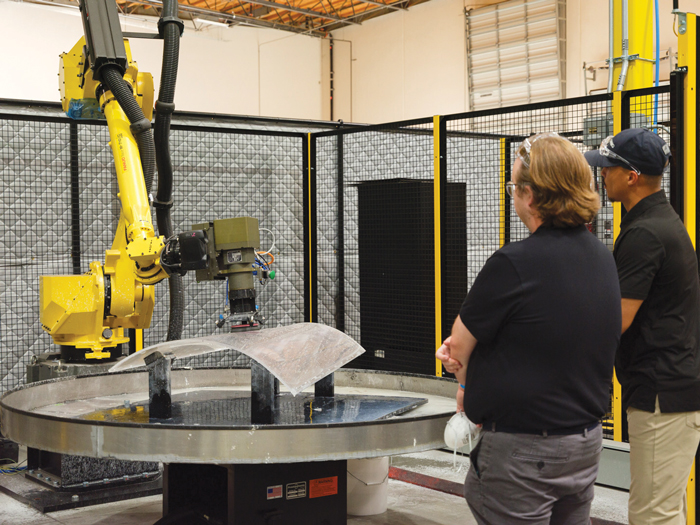
GrayMatter Robotics has positioned itself on the leading edge of the robotic finishing field with advanced AI-powered robot systems that can autonomously sand, polish, and grind surfaces. (Image courtesy GrayMatter Robotics/PRNewswire)
GrayMatter Robotics to Develop AI-powered Robotic Finishing System to Fix Defects on Transparent Materials
The company was awarded an SBIR Direct-to-Phase II Contract by the Department of Air Force innovation arm to develop the system.
CARSON, Calif.—In aerospace component manufacturing, the development of transparent structures is a demanding high-mix, low-volume application due to the unique geometries of the structures and the need for precision manufacturing, inspection, maintenance, and repair. Anything less than clear visibility through these structures is unacceptable and must be addressed.
AFWERX, the innovation arm of the United States Department of the Air Force, is meeting the challenge head-on. In October, AFWERX awarded Carson, California-based GrayMatter Robotics a Small Business Innovation Research (SBIR) Direct-to-Phase II (D2P2) contract to develop robotic technology intended to reduce optical distortion and defects on acrylic and polycarbonate structures, according to a release from GrayMatter Robotics.
GrayMatter Robotics designs physics-informed, AI-driven robotic cells that empower high-mix manufacturers to tackle complex, ergonomically challenging surface finishing tasks. The autonomous robotic technology that it will develop for AFWERX is expected to build upon GrayMatter’s existing system, which reportedly detects and corrects optical distortions to provide consistent, clear visibility through the transparent structures.
“Sanding and polishing transparent components are a tremendously challenging and time-consuming part of aerospace component manufacturing while also representing the root cause of most defects associated with rework,” said Ariyan Kabir, CEO and co-founder of GrayMatter Robotics, in a statement. “Final products must be free of optical distortion and no visible scratches on the interior or exterior of the structure. GrayMatter Robotics will build upon its existing AI-powered robotic solution to solve this problem.”
Autonomous physical AI
GrayMatter Robotics positioned itself on the leading edge of the robotic finishing field by developing advanced AI-powered robot systems that can autonomously sand, polish, and grind surfaces for manufacturers. The company’s proprietary GMR-AI™ technology employs physical AI, incorporating “established physics-based models that help the system understand forces, materials, geometries, and tool behaviors,” according to the release. This is said to remove the need for manual programming while guaranteeing safe and accurate operation, even with parts the system has not encountered.
“Our physical AI is designed to give robots intelligence and autonomy in a wide range of manufacturing applications,” said GrayMatter Robotics CTO and co-founder Brual Shah, in a statement. “Whether it’s sanding complex shapes like guitars, or intricate parts for ships, trucks, or heavy equipment, or precision surface finishing for highly contoured transparent structures for aerospace applications, our technology enables smart robotic cells to empower businesses and teams with unprecedented reliability, speed, and consistency.”
Conquering complex manufacturing challenges
GrayMatter Robotics aims to make the deployment, operation, and troubleshooting of its systems simpler by offering intuitive technologies and 24/7 support. It’s all part of the company’s mission to solve one the biggest challenges of automating surface finishing and treatment in high-mix production environments, the release said.
“GrayMatter Robotics’s physical AI-powered systems allow companies to scan parts and autonomously program themselves, adapt to part variations without human intervention, and deploy in two-to-four months,” said Satyandra K. Gupta, chief scientist and co-founder of GrayMatter Robotics, in a statement. “With our solutions, people can bring a part to a cell, put it in front of a 3D camera, and task the system to go, and it will autonomously begin the operation.”
The company also opened its new 100,000-square-foot headquarters and innovation center in October. Located in Carson, the robotics innovation center is expected to create more than 100 high-skill jobs in engineering, AI and machine learning, robotics integration, and beyond. It will also provide a venue for workforce development initiatives and advanced technology demonstrations, the company said.
New Robotics Innovation Center Provides Interactive Experience with AI-powered Manufacturing Automation
GrayMatter Robotics’s new facility brings advanced manufacturing jobs and working, physical AI robotic cells to Southern California.
CARSON, Calif.—When GrayMatter Robotics officially opened its new 100,000-square-foot headquarters and innovation center in October, it celebrated more than a significant expansion. It also marked the establishment of what the company called “the nation’s most advanced interactive robotics experience center for AI-powered manufacturing automation.”
According to a company release, the state-of-the-art facility at 2226 E. 223rd St. in Carson includes substantial investment in facility buildout, advanced manufacturing equipment, and more than 25 active robotic cells to facilitate customer experience. While creating more than 100 high-skilled jobs in advanced AI, robotics, multidisciplinary engineering, manufacturing operations, and technical support, GrayMatter Robotics said it is planning to add “hundreds more positions over the next few years.” The expansion follows $85 million in venture funding and growing demand for the company’s “physical AI–powered factories of the future.”
“This facility represents more than just a headquarters—it is our commitment to bringing advanced manufacturing back to American soil and to the South Bay region, specifically,” said Ariyan Kabir, CEO and co-founder of GrayMatter Robotics, in a statement. “We chose Carson for its proximity to aerospace, marine, and other manufacturing clusters, access to world-class port infrastructure, and most importantly, its skilled workforce. This is where the factories of the future are being built.”
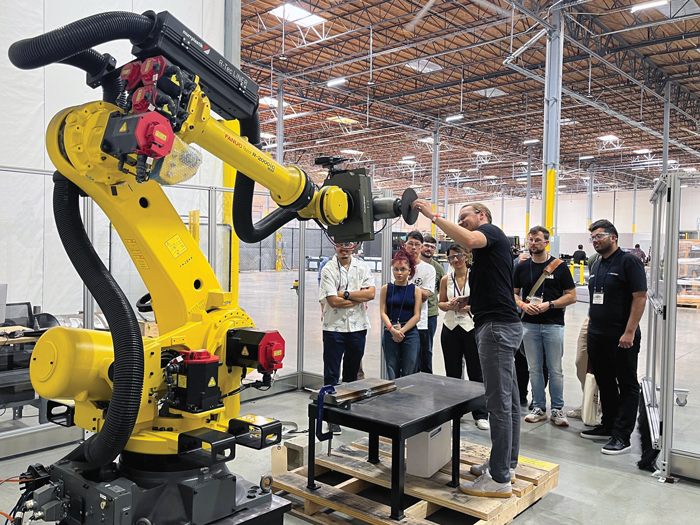
GrayMatter Robotics’ new headquarters features more than 25 robotic cells actively performing real manufacturing operations on current and prospective customer and partner parts. (Photo courtesy GrayMatter Robotics/PRNewswire)
An interactive robotics experience
Unlike traditional corporate facilities, GrayMatter Robotics’s new headquarters features more than 25 robotic cells actively performing real manufacturing operations on their current and prospective customers’ and partners’ parts.
An interactive experience center enables visitors—from potential customers to students—to witness firsthand how AI-powered robots autonomously sand, grind, polish, buff, spray, blast, and inspect parts across diverse materials and geometries. According to the company, it offers a look at factories of the future with an optimal teaming of humans, robots, and AI.
“We wanted to demystify industrial robotics,” said GrayMatter Robotics CTO and co-founder Brual Shah, in a statement. “Visitors can literally watch a robot scan a part it’s never seen before, autonomously program itself in under a minute, and begin processing that part with precision that exceeds human capability. It’s manufacturing intelligence in action.”
Physical AI: the next frontier beyond digital intelligence
While much of the AI revolution has focused on digital intelligence—chatbots, image generation, and data analysis—GrayMatter Robotics said it is pioneering what industry experts are calling “physical AI”: artificial intelligence that interacts with and manipulates the physical world through robotic systems.
The company’s proprietary GMR-AI™ technology is said to represent an approach that is fundamentally different from traditional industrial automation. Using physics-informed AI, the robots don’t require manual programming. Instead, they incorporate established physics models—understanding forces, materials, geometries, and tool behaviors—to guarantee safe, accurate operation even with parts they’ve never encountered, the company said in the release.
“Physical AI is a different kind of AI. It significantly expands upon digital AI we’ve seen explode over the past few years. Physical AI focuses on AI to make decisions in physical applications,” explained Satyandra K. Gupta, chief scientist and co-founder, in the release. “While a language model can write you an essay, our physical AI can autonomously figure out how to finish a never-before-seen aerospace component to aerospace-grade specifications. That’s AI operating in the physical realm with real-world consequences.”
This approach has earned recognition from leading innovation observers. Fast Company named GrayMatter Robotics one of the Most Innovative Companies in Robotics and Engineering for 2025, highlighting how the company is “tackling one of manufacturing’s toughest challenges: automating tasks in environments where every product is different,” the release stated.
The recognition underscores the company’s role in advancing physical AI as “the next wave of AI,” as GrayMatter Robotics described it—one that could transform how products are actually made, not just designed or marketed.
According to the company, the implications extend beyond manufacturing efficiency. Physical AI systems must account for real-world variability in materials and part dimensions, safety constraints when operating near humans, and force feedback and tactile sensing. They must also account for continuous learning from physical tool-part interactions, as well as guarantees of performance in a wide variety of conditions.
Solving a persistent manufacturing challenge
The Carson facility serves as both headquarters and proof-of-concept for solving what GrayMatter Robotics called “one of American manufacturing’s most intractable problems: automating surface finishing and treatment in high-mix production environments, where products vary constantly.”
“Traditional robotic automation requires extensive manual programming—often 80-plus hours per unique part—and works only when producing identical items repeatedly. This limitation has left thousands of U.S. manufacturers unable to automate critical finishing operations, forcing continued reliance on manual labor for sanding, grinding, and polishing tasks that are ergonomically punishing and increasingly difficult to staff,” the release said.
GrayMatter Robotics said its physical AI-powered systems eliminate this barrier. The company’s systems scan and autonomously program themselves, adapt to part variations without human intervention, and are reported to operate 1.5-to-4 times faster than manual operations while improving quality. They are also said to deploy in 2–4 months, versus 12–24 months for traditional automation, and they require no coding expertise. Operators simply press a button.
The technology is reportedly delivering results at scale. Pierce Manufacturing (Oshkosh Corporation), a prominent North American fire apparatus manufacturer, has integrated GrayMatter Robotics’s systems into its production operations and is expanding the deployment.
“Our early results with GrayMatter Robotics convinced us to expand the deployment,” said Bob Schulz, t of Pierce Manufacturing Inc., in the release. “Visiting their Carson facility reinforced we’re collaborating with a company that has the vision and capability to scale alongside us,”
Investor backing validates market opportunity
The company’s rapid growth attracted significant backing from investment management firm Wellington Management, which led GrayMatter Robotics’ $45 million Series B round in June 2024.
“High-mix manufacturing represents a significant portion of U.S. production, yet it’s been largely inaccessible to automation,” said Sean Petersen, sector lead for private climate investing, Wellington Management, in a statement. “GrayMatter Robotics has cracked the code and is building the infrastructure for more advanced automated factories. This represents a promising and potentially category-defining opportunity.”
Strategic partnerships accelerate growth
GrayMatter Robotics said its technology platform is supported by partnerships with leading companies in robotics hardware and materials science. While industrial robotics manufacturer FANUC provides the robotic platforms that GrayMatter’s physical AI brings to life, 3M’s advanced abrasives technology integrates seamlessly with the company’s intelligent systems.
“GrayMatter Robotics combines deep expertise in AI-driven automation solutions with a strong understanding of the challenges manufacturers face on the shop floor,” said FANUC America President and CEO Mike Cicco, in a statement. “We’ve seen how their technologies—built on FANUC’s innovative and reliable robotic platforms—can significantly improve productivity, enhance ergonomics, and streamline operations. The opening of GrayMatter Robotics’ new headquarters reflects their growth and demonstrates their commitment to reshaping industrial automation.”
“We are excited to continue and expand our collaboration with GrayMatter Robotics, a partnership that highlights 3M’s commitment to empowering customers with user-friendly automated abrasive processing systems,” said 3M Abrasives Systems Division President Alejandro Martinez, in a statement. “By combining 3M’s expertise in abrasive products and processes with GrayMatter’s intelligent automation solutions, we can deliver enhanced value through consistent and quality results to our shared customers.”
What’s next: expanding physical AI applications
GrayMatter Robotics’s goals include broadening the application range of its technology by extending physical AI to additional manufacturing processes beyond surface finishing. Scaling production is also high on the list, as it works to increase manufacturing capacity to meet growing demand. While growing its customer base, the company plans to continue pushing the boundaries of physics-informed AI and launch training and certification programs for next-generation manufacturing operators.
The company also said it plans to use the facility as a venue for workforce development initiatives, hosting student tours, technical workshops, and industry conferences to advance physical AI and intelligent manufacturing.
“Five years ago, what we’re doing was considered impossible,” said Kabir. “Today, it’s transforming manufacturing. Five years from now, physical AI will be as fundamental to production as digital automation is today. This facility is where we’re building that future.”
Physics-informed Machine Learning Technology Empowers Manufacturers to Optimize Surfaces, Improve Product Performance
New funding will support Surface Design Solutions’ launch of new software and
development of tools that empower new manufacturing workers with surface expertise.
PITTSBURGH—Surface quality and texture play a critical role across many manufacturing industries. Beyond influencing the look and feel of products, surface condition affects their performance.
In automotive and aerospace components, for example, surfaces determine the efficiency of cars and planes. The surface condition of the manufacturing equipment also controls the amount of scrap and downtime that manufacturers face, according to a release from Surface Design Solutions, a developer of next-generation manufacturing software.
“The surface quality of production tooling is poorly controlled and degrades over time, contributing significantly to equipment downtime, which drives up costs and cuts into profits,” the release stated.
Surface Design Solutions uses advanced, physics-informed machine learning (PIML) technology to predict how a surface will perform, helping manufacturers avoid costly problems and boost their bottom line. This approach is said to enable Surface Design Solutions to deliver actionable predictions “with just a fraction of the data required by conventional AI systems.” The result, the company said, is “interpretable and impactful insights even in complex, small-data manufacturing environments.”
“Surface finish has long been treated as an afterthought, measured only to check a box,” said Surface Design Solutions President and co-founder Tevis Jacobs, Ph.D., in a statement. “Our platform shifts that thinking, empowering manufacturers to see surface quality as a powerful lever that can be precisely refined to improve performance and profitability.”
Surface Design Solutions is working to transform the manufacturing industry with its physics-informed machine learning (PIML) technology. The company’s technology is reported to empower manufacturers to optimize surfaces to increase production yield, improve product performance, and enhance production efficiency while realizing significant cost savings. Its Surface Designer platform guides engineers through the design of tooling surfaces and the creation of manufacturing specifications, the company said in the release.
Surface Design Solutions recently secured $365,000 in funding from the Richard King Mellon Foundation (RKMF) to support the next generation of skilled manufacturing workers while advancing its mission to modernize surface engineering. The investment will support Surface Design Solutions’ efforts to scale its newly developed software—especially to manufacturers with aging workforce challenges—and to co-develop effective training materials with both experienced and newer employees. It will also support the company’s efforts to build intuitive software interfaces tailored to the needs of production workers, the release said.
“With the rise of retirements in manufacturing and a clear need to train new talent faster, Surface Builder is designed to bridge that gap,” said Jacobs. “Thanks to the Richard King Mellon Foundation’s support, we’re not just building smarter tools; we’re helping ensure the knowledge of today’s experts becomes the foundation for tomorrow’s workforce. The funding allows us to preserve critical shop-floor knowledge, reduce onboarding time, and drive long-term manufacturing resilience.”
The funding from RKMF will accelerate the rollout of Surface Builder, Surface Design Solutions’ new shop-floor software that is said to give production workers real-time feedback on surface performance and eliminate the need for slow or destructive testing.
As part of the rollout, Surface Design Solutions said it is working directly with experienced machinists and technicians to create training materials that help new hires ramp up quickly and work more effectively. By capturing and passing on expert insights, the company said, it helps preserve critical skills that would otherwise be lost to an aging workforce, reducing disruptions and speeding up onboarding for new hires.
According to the company, early partners using its software have already seen significant results.
“One customer, a global high-volume manufacturer, reported a 35 percent increase in production efficiency by using its software to optimize the surface finish of tooling,” the release stated. “With its strong focus on training, Surface Design Solutions is prioritizing new partnerships with manufacturers where knowledge transfer and workforce development are critical.”