
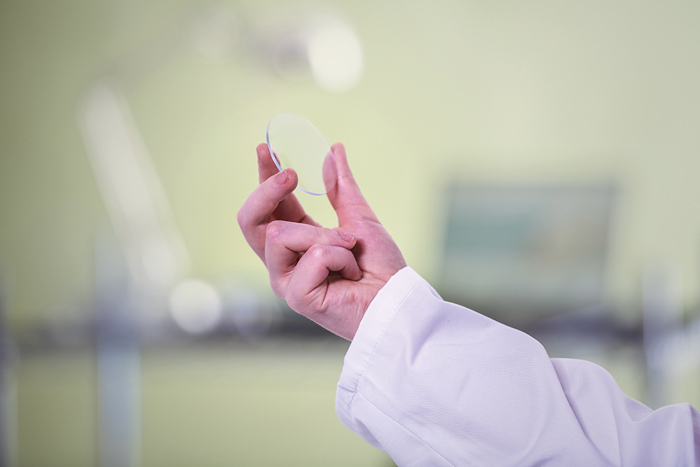
Recent data is reported to show that HOYA PHOENIX® lenses made with PPG TRIVEX® lens material exhibited less damage during impact testing. They are also said to be lighter weight and to provide higher optical clarity and better chemical resistance than polycarbonate lenses. (Image: Hoya Corp./Business Wire)
HOYA lenses made from PPG’s material were reported to show less damage in impact testing.
PITTSBURGH—PPG recently announced the results of tests carried out in collaboration with HOYA Vision Care to compare the performance of PPG TRIVEX® lens material to polycarbonate across multiple optical and durability categories.
The data reportedly showed that HOYA PHOENIX® lenses made with PPG Trivex lens material exhibited less damage during impact testing. In addition to being lighter in weight, the lenses also exhibited higher optical clarity and better chemical resistance than comparable polycarbonate lenses, according to a joint release by PPG and HOYA Vision Care.
The research was designed to test the impact performance of PPG Trivex lens material against polycarbonate, a popular lens material used in prescription eyeglasses. Data on other attributes, including weight, chemical resistance, and key optical data such as Abbe value and birefringence, was compiled from earlier research.
The findings are said to provide “a scientific basis for eye care professionals to recommend HOYA Phoenix lenses made with PPG Trivex lens material as a high-performing alternative to polycarbonate.”
“Today’s patients have high expectations for their eyewear,” said Raymond Hudack, PPG global business director, optical monomers and coatings, Specialty Products, in the release. “Lenses must be able to offer lightweight comfort, exceptional optical clarity, and protection from everyday wear and tear. PPG Trivex lens material sets the bar for high-performance lenses, giving eyecare professionals an opportunity to differentiate their practice with a proven solution.”
Polycarbonate and PPG Trivex lens materials are both classified as high-impact materials under key ANSI Z87.1 and FDA industry standards. However, standard Gardner impact tests showed that polycarbonate received irreversible dimpling damage under high impact forces. The HOYA Phoenix lenses made with PPG Trivex lens material showed minimal surface blemishes at the same impact, demonstrating improved performance for demanding environments such as sports and industrial eyewear, the release stated.
PPG Trivex lens material is said to demonstrate exceptional optical clarity due to its high Abbe value, a measure of the optical quality of a lens and how well it controls color distortion. This reduces the “rainbow blur” that can appear around the edges of lenses, ensuring consistent sharpness across the entire lens.
“The cast-molding production process further enhances clarity by reducing birefringence, a phenomenon where stress inside the lens bends light in different directions, causing blurriness or distortion. Together, these properties ensure uniform clarity across the lens surface,” according to the release.
In chemical resistance testing, PPG Trivex lens material is reported to have remained stable under prolonged exposure to lab solvents, while polycarbonate lenses showed visible surface damage and whitening. These advantages translate to crisp, clear optics, lightweight comfort, and enhanced durability for long-lasting performance and improved patient satisfaction,” the release said.
“For more than two decades, PPG and HOYA Vision Care have worked together to bring best-in-class optical materials to market,” said HOYA Vice President of Strategic Marketing Samy Lauriette, in the release. “The latest testing underscores our shared commitment to innovation and evidence-based design. As optical materials advance, practitioners have more choices to select materials that optimize patient outcomes and improve lens durability. For eye care professionals, this means access to lenses that not only meet the highest standards of durability and clarity but also support better patient outcomes and offer a compelling way to differentiate their practice.”
HOYA, founded in 1941 in Tokyo, Japan, is a global technology and med-tech company. The company is active in the fields of healthcare and information technology, providing eyeglasses, medical endoscopes, intraocular lenses, and optical lenses, as well as key components for semiconductor devices, LCD panels and HDDs.
HOYA Vision Care, active in the eyeglass lens industry for more than 60 years, is dedicated to “providing innovative vision care products for every stage of a patient’s life.” The company stated that it has “a leading position in myopia management category and a proven expertise in advanced lens designs, high performance photochromic technologies, and high-quality AR coatings.”