
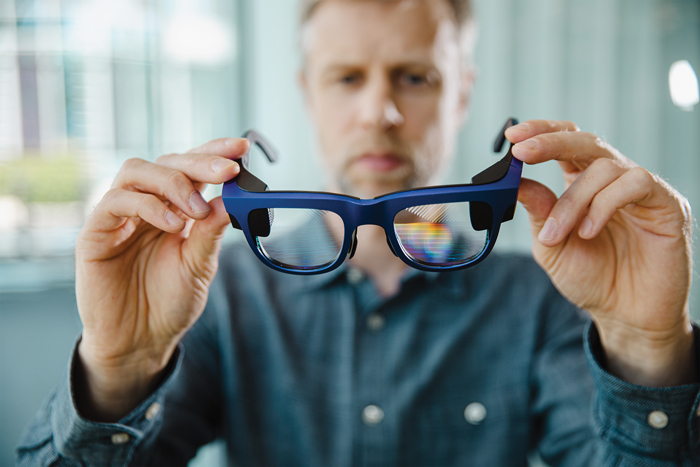
SCHOTT Geometric Reflective Waveguides are now available at scale. (Image courtesy of SCHOTT)
SCHOTT said it has become the first company capable of handling geometric reflective waveguide manufacturing in serial production volumes.
RYE BROOK, N.Y.—International technology group SCHOTT, a provider of high-performance materials and optics, recently achieved “a breakthrough in high-volume production of geometric reflective waveguides,” the company said in a release. The achievement is said to mark a key advancement for augmented reality (AR) devices, such as smart glasses.
By leveraging its pioneering position in developing ultra-precise production processes for these high-end optical elements, SCHOTT said, it is the first company to be scaling geometric reflective waveguides to serial production. The company’s fully integrated supply chain uses its global production network, ranging from optical glass production to waveguide component assembly. This ensures product quality and scalability at the volumes needed to support major commercial deployments, the company said in the release.
Geometric reflective waveguides are an optical technology used in the eyepieces of AR wearables. They are reported to deliver digital overlays in the user’s field of vision with pristine image quality and unparalleled power efficiency, enabling miniaturized and fashionable AR glasses.
These waveguides are said to transform the user experience with immersive viewing capabilities. After years of dedicated R&D and global production infrastructure investment, SCHOTT said it has become the first company capable of handling geometric reflective waveguide manufacturing in serial production volumes.
The company’s end-to-end setup includes producing high-quality optical glass, processing of ultra-flat wafers, optical vacuum coating, and waveguide processing with the tightest geometric tolerances. “By mastering the integrated manufacturing processes of geometric reflective waveguides, SCHOTT has proven mass market readiness regarding scalability,” the release stated.
“This breakthrough in industrial production of Geometric Reflective Waveguides means nothing less than adding a crucial missing puzzle piece to the AR technology landscape,” said SCHOTT Senior Vice President-Augmented Reality Ruediger Sprengard, Ph.D., in the release. “For years, the promise of lightweight and powerful smart glasses available at scale has been out of reach. Today, we are changing that. By offering Geometric Reflective Waveguides at scale, we’re helping our partners cross the threshold into truly wearable products, providing an immersive experience.”
A technology platform for a wide field-of-view range
SCHOTT® Geometric Reflective Waveguides, co-created with its long-term partner Lumus, are said to support a wide field of view (FOV) range that enables immersive experiences. This enables device manufacturers to push visual boundaries and seamlessly integrate digital content into the real world while keeping smart glasses and other immersive devices lightweight, the release stated.
“Compared to competing optical technologies in AR, geometric reflective waveguides stand out in light and energy efficiency, enabling device designers to create fashionable glasses for all-day use,” the release stated. “These attributes make geometric reflective waveguides the best option for small FoVs, and the only available option for wide FOVs.”
SCHOTT stated that it produces high-quality components and advanced materials, including specialty glass, glass-ceramics, and polymers. Many of the company’s products have high-tech applications that push technological boundaries, such as flexible glass in foldable smartphones, glass-ceramic mirror substrates in the world’s largest telescopes, and laser glass in nuclear fusion. The company said its heritage in specialty glass making, combined with a pioneering role in material innovation, brings together its material science, optical engineering, and global manufacturing capabilities to support the evolution of wearable technology.