
New 3D-printing and Manufacturing Techniques Grant More Control Over Energetic Material Behavior, Improving Safety
By Lindsey Macdonald
WEST LAFAYETTE, Ind.—Much like baking the perfect cake involves following a list of ingredients and instructions, manufacturing energetic materials—explosives, pyrotechnics, and propellants—requires precise formulations, conditions, and procedures to ensure they are safe and perform as intended.
Because any small tweaks or environmental changes can dramatically alter how energetic materials function, Purdue University engineer Monique McClain is developing state-of-the-art tools and methods to control these materials’ behavior throughout the manufacturing process and down to the particle level.
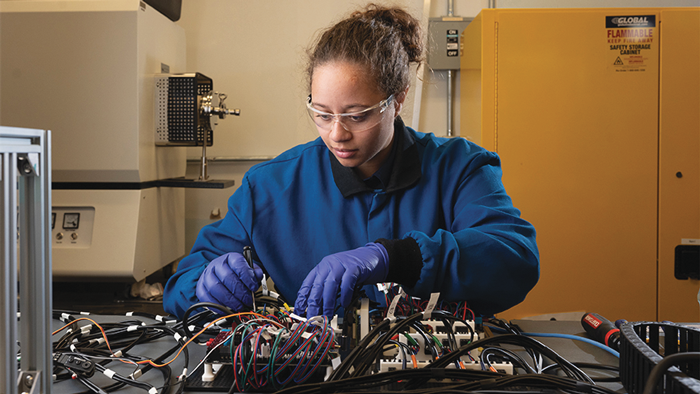
Monique McClain, assistant professor of mechanical engineering at Purdue University, adjusts circuits that power her state-of-the-art 3D printers. (Purdue University photo/John Underwood)
McClain, a Purdue assistant professor of mechanical engineering, specializes in the “upstream” or earlier manufacturing stages, such as selecting binders with unique properties to hold energetic particles together and determining how they are mixed to create the final formulation. She focuses on how manufacturing alters the structure and mechanical properties of an energetic material and, in turn, how those changes affect performance and sensitivity.
“An energetic material’s manufacturing history, from beginning to end, strongly determines how it behaves during combustion or detonation,” McClain said. “We want to ensure that each step is catered toward the material and its intended use so that we’re getting a final product that functions in the way we expect.”
Much of McClain’s body of work focuses on additive manufacturing, or 3D printing, of energetics. Traditionally, energetic materials have been manufactured using processes such as casting or milling, which prioritize efficiency and scalability. But while these methods are ideal for large batch production, customization is difficult, thereby limiting innovation and compromising on optimal performance.
Additive manufacturing, on the other hand, gives researchers the freedom to experiment with complex geometries and tune specific properties, such as burn rate and blast shape.
For instance, McClain and her research team design intentional defects—referred to as pores—to either increase or decrease the likelihood of ignition when materials are subjected to various conditions such as friction, impact, or extreme temperatures. Additive manufacturing makes this possible because researchers can customize a 3D printer’s nozzles and program it to print specific shapes and patterns.
“Pores and defects are often inevitable, but we can control how and where they show up,” McClain said. “When we focus on the microstructure of these materials, we can deliberately select particle sizes or compaction schemes to produce preferred pore distributions that enable the behaviors that we want to see.”
Additive manufacturing also makes it easier to experiment with multiple types of materials. In addition to her work with pores, McClain explores how energetic particles adhere to various binders through the 3D-printing process and how to print propellant materials made of multiple materials with disparate characteristics.
In a study published last spring, McClain and her team looked at adhesion between two polymers with different mechanical properties—a stiff thermoplastic and a soft elastomer—that have been combined into one structure. They found that the 3D-printed surface texture and type of thermoplastic greatly affected how well the two materials blended and held together.
“This study provides a framework and method for studying adhesion of dissimilar materials. This is important because no such guide—and, in turn, little data—on this topic previously existed,” McClain said. “The ability to print energetics made of multiple materials gives us even more options for controlling behavior and improving safety.”
Although 3D printing is a major part of McClain’s work, she also explores how to improve more traditional manufacturing methods.
McClain developed a patent-pending method for manufacturing a polymer-bonded explosive (PBX) molding powder that saves time, eliminates potential hazards, and reduces manufacturing waste. McClain disclosed this technology to the Purdue Innovates Office of Technology Commercialization, which has applied for a patent through the U.S. Patent and Trademark Office to protect the intellectual property.
The method involves mixing energetics with a binder that’s been partially cured or hardened prior to compaction within a mold. McClain found a sweet spot of time—approximately eight hours—where the binder becomes solid enough to prevent leakage during compaction, but not so hardened that it becomes brittle and prone to cracking.
“We aimed to provide a repeatable, tunable method for fabricating solid energetic composites, like PBX, with uniform mechanical and chemical properties,” McClain said. “We succeeded in developing a streamlined set of steps where researchers can make slight adjustments based on their goals for the final product.”
While following the proper steps of the energetics manufacturing process helps to ensure a safe, well-designed final product, external conditions also influence its performance.
According to McClain, factors such as room temperature can dramatically affect a material’s printability and behavior.
“Environmental control matters much more than many people expect,” McClain said. “You could print the same mixture twice in the same day and they might behave in completely different ways if something like the temperature or humidity level in the room changed.”
Ultimately, McClain advocates for a holistic approach to manufacturing rather than one driven by technology advancement. She wants researchers to avoid “force fitting” materials into a particular machine or method and instead consider which geometries and properties are required to create the desired effect.
“If you need a complex internal structure, additive wins. If you need a highly dense mixture or a large batch of material, conventional methods are often more appropriate. To get the best of both worlds, we can also incorporate molding and milling alongside 3D printing,” McClain said. “As long as we understand every aspect of the process, from selecting material all the way to packaging and storing them, we’ll be able to make the best and safest choice.”
McClain’s research is sponsored by the U.S. Air Force Office of Scientific Research’s Young Investigator Research Program and the Army Research Office Energetic Materials Basic Research Center. McClain conducts her research at Maurice J. Zucrow Laboratories, the largest academic propulsion lab in the world.
Lindsey Macdonald is a writer for Purdue University.
Light-based 3D Printing Lets Scientists Program Plastic Properties at the Microscale
A new technique enables microscopic control over how plastic molecules arrange themselves as an object is printed.
By Jeremy Thomas | Lawrence Livermore National Laboratory
LIVERMORE, Calif.—Researchers at Lawrence Livermore National Laboratory (LLNL) have co-developed a new way to precisely control the internal structure of common plastics during 3D printing, allowing a single printed object to seamlessly shift from rigid to flexible, using only light.
In a paper published [January 29, 2026] in Science, the researchers describe a technique called crystallinity regulation in additive fabrication of thermoplastics (CRAFT) that enables microscopic control over how plastic molecules arrange themselves as an object is printed. The work opens new possibilities for advanced manufacturing, soft robotics, national defense, energy damping, and information storage, according to the researchers. The team includes collaborators from Sandia National Laboratories, the University of Texas at Austin, Oregon State University, Arizona State University, and Savannah River National Laboratory.
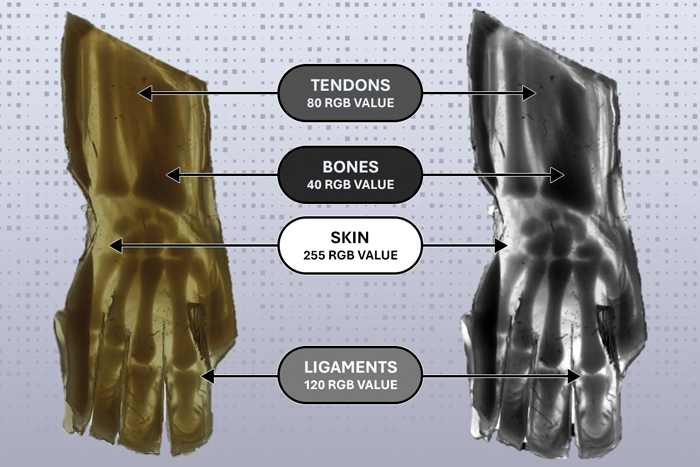
In a paper published in Science, a multi-institutional team of researchers describe a technique called crystallinity regulation in additive fabrication of thermoplastics (CRAFT) that enables microscopic control over how plastic molecules arrange themselves as an object is printed. The work opens new possibilities for advanced manufacturing, soft robotics, national defense, energy damping, and information storage. (Images: Sandia National Laboratories)
The team demonstrated that by carefully tuning light intensity during printing, they could dictate how crystalline or amorphous a thermoplastic becomes at specific locations within a part. That molecular arrangement determines whether a material behaves more stiffly and rigidly, or as a softer, more flexible plastic—without changing the base material. CRAFT builds on that principle by allowing researchers to control crystallinity spatially during printing, rather than uniformly throughout a part.
“A classic example of crystallinity is the difference between high-density polyethylene—picture a milk jug—and low-density polyethylene, like squeeze bottles and plastic bags. The bulk property difference in these two forms of polyethylene stems largely from differences in crystallinity,” said LLNL staff scientist Johanna Schwartz. “Our CRAFT effort is exciting in that we are controlling the crystallinity within a thermoplastic spatially with variations in light intensity, making areas of increased and decreased crystallinity to produce parts with control over material properties throughout the whole geometry.”
A key challenge, however, was translating this new materials capability into practical manufacturing instructions that could be used on real 3D printers, according to LLNL engineer Hernán Villanueva. Villanueva joined the project after early discussions with Schwartz and Sandia scientists Samuel Leguizamon and Alex Commisso identified a missing link: a way to convert any three-dimensional computer-aided design (CAD) into the detailed light patterns needed to print parts using the CRAFT method.
Villanueva said he drew on prior work in a multi-institutional team focused on lattice structures and advanced manufacturing workflows. In that effort, he developed software that rapidly converted complex, topology-optimized designs into printing instructions by parallelizing the process on LLNL’s high-performance computing (HPC) systems—reducing turnaround times from days to hours or minutes.
Applying that same computational approach to CRAFT, Villanueva adapted the workflow to encode “changes in light” rather than changes in material. He was soon able to convert 3D CAD geometries directly into CRAFT printing instructions, cutting instruction-generation time from hours—or even a full day—down to seconds, making rapid design iteration and demonstration of the method practical.
“This work is a natural extension of the Lab’s strengths in advanced manufacturing and materials by design,” Villanueva said. “As part of the CRAFT effort, we have evolved a tool that connects materials science with computational workflows and advanced printing, enabling us to move directly from a 3D design to a part with spatially varying properties.”
The team’s method relies on a light-activated polymerization process in which exposure level governs the stereochemistry of growing polymer chains, researchers said. Lower light intensities favor more ordered crystalline regions, while higher intensities suppress crystallization, yielding softer, more transparent material. By projecting grayscale patterns during printing, the team produced parts with smoothly varying mechanical and optical properties.
The demonstrated ability to tune properties by changing a light’s intensity rather than swapping materials could significantly simplify additive manufacturing (3D printing), Schwartz explained.
“If you can get many different properties from one vat of material, printing complex multi-material or multi-modulus structures becomes much easier,” she said.
The researchers demonstrated the CRAFT technique on commercial 3D printers, fabricating objects that combine multiple mechanical behaviors in a single print.
Examples included bio-inspired structures that mimic bones, tendons, and soft tissue; reproductions of famous paintings; as well as materials designed to absorb or redirect vibrational energy without adding weight or complexity. Among the most striking demonstrations was the ability to encode crystallinity through transparency differences, according to Schwartz.
“Being able to visualize the differences easily spatially, to the point of generating the Mona Lisa out of only one material, was incredibly cool,” Schwartz said.
LLNL’s Villanueva said the work reflects the Lab’s long-standing investments in HPC and in integrating modeling, design tools, and novel manufacturing processes. He added that future work could integrate topology optimization directly into the CRAFT framework, enabling researchers to optimize light patterns themselves—rather than material layouts—to achieve desired performance.
Because the process works with thermoplastics—materials that can be melted and reshaped—printed parts remain recyclable and reprocessable, an important advantage for manufacturing sustainability. The findings suggest a future where 3D-printed plastic components can be tailored at the molecular level for specific functions, bridging the gap between material science and digital manufacturing.
From an applications standpoint, Schwartz said the technology could have broad and near-term impact.
“Energy dampening and metamaterial design are the most exciting use cases to me,” she said. “From space to fusion to electronics, there are so many industries that rely on energy and vibrational dampening control. This CRAFT printing process can access all of them.”
Jeremy Thomas is a writer for Lawrence Livermore National Laboratory.
Source:
3D-Printing Platform Rapidly Produces Complex Electric Machines
Overcoming challenges of 3D printing with multiple functional materials, MIT researchers fabricated an electric linear motor in hours.
Adam Zewe | MIT News
CAMBRIDGE, Mass.—A broken motor in an automated machine can bring production on a busy factory floor to a halt. If engineers can’t find a replacement part, they may have to order one from a distributor hundreds of miles away, leading to costly production delays.
It would be easier, faster, and cheaper to make a new motor onsite, but fabricating electric machines typically requires specialized equipment and complicated processes, which restricts production to a few manufacturing centers.
In an effort to democratize the manufacturing of complex devices, MIT researchers have developed a multi-material 3D-printing platform that could be used to fully print electric machines in a single step.
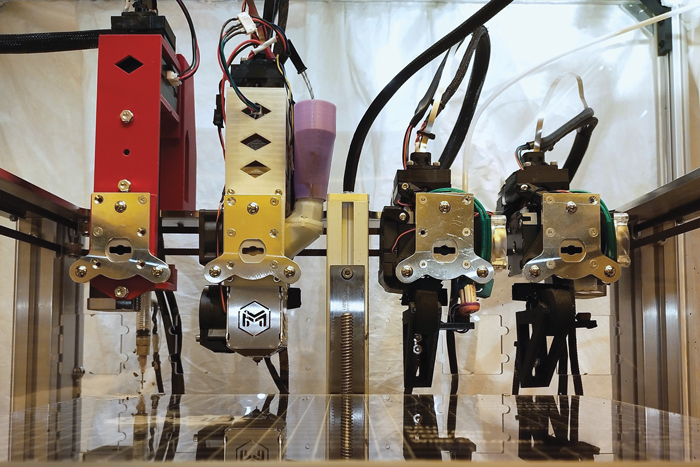
MIT researchers developed a 3D-printing platform that can utilize multiple functional materials to fully print a complex electronic device, like an electric linear motor, in a matter of hours. (Image courtesy of the researchers)
They designed their system to process multiple functional materials, including electrically conductive materials and magnetic materials, using four extrusion tools that can handle varied forms of printable material. The printer switches between extruders, which deposit material by squeezing it through a nozzle as it fabricates a device one layer at a time.
The researchers used this system to produce a fully 3D-printed electric linear motor in a matter of hours using five materials. They only needed to perform one post-processing step for the motor to be fully functional.
The assembled device performed as well or better than similar motors that require more complex fabrication methods or additional post-processing steps.
In the long run, this 3D printing platform could be used to rapidly fabricate customizable electronic components for robots, vehicles, or medical equipment with much less waste.
“This is a great feat, but it is just the beginning. We have an opportunity to fundamentally change the way things are made by making hardware onsite in one step, rather than relying on a global supply chain. With this demonstration, we’ve shown that this is feasible,” said Luis Fernando Velásquez-García, a principal research scientist in MIT’s Microsystems Technology Laboratories (MTL) and senior author of a paper describing the 3D-printing platform, which appears [February 18, 2026] in Virtual and Physical Prototyping.
He is joined on the paper by electrical engineering and computer science (EECS) graduate students Jorge Cañada, who is the lead author, and Zoey Bigelow.
More materials
The researchers focused on extrusion 3D printing, a tried-and-true method that involves squirting material through a nozzle to fabricate an object one layer at a time.
To fabricate an electric machine, the researchers needed to be able to switch between multiple materials that offer different functionalities. For instance, the device would need an electrically conductive material to carry electric current and hard magnetic materials to generate magnetic fields for efficient energy conversion.
Most multi-material extrusion 3D printing systems can only switch between two materials that come in the same form, such as filament or pellets, so the researchers had to design their own. They retrofit an existing printer with four extruders that can each handle a different form of feedstock.
They carefully designed each extruder to balance the requirements and limitations of the material. For instance, the electrically conductive material must be able to harden without the use of too much heat or UV light because this can degrade the dielectric material.
At the same time, the best-performing electrically conductive materials come in the form of inks which are extruded using a pressure system. This process has vastly different requirements than standard extruders that use heated nozzles to squirt melted filament or pellets.
“There were significant engineering challenges. We had to figure out how to marry together many different expressions of the same printing method—extrusion—seamlessly into one platform,” Velásquez-García said.
The researchers utilized strategically placed sensors and a novel control framework so each tool is picked up and put down consistently by the platform’s robotic arms, and so each nozzle moves precisely and predictably.
This ensures each layer of material lines up properly—even a slight misalignment can derail the performance of the finished machine.
Making a motor
After perfecting the printing platform, the researchers fabricated a linear motor, which generates straight-line motion (as opposed to a rotating motor, like the one in a car). Linear motors are used in applications like pick-and-place robotics, optical systems, and baggage conveyors.
They fabricated the motor in about three hours and only needed to magnetize the hard magnetic materials after printing to enable full functionality. The researchers estimate total material costs would be about 50 cents per device. Their 3D-printed motor was able to generate several times more actuation than a common type of linear engine that relies on complex hydraulic amplifiers.
“Even though we are excited by this engine and its performance, we are equally inspired because this is just an example of so many other things to come that could dramatically change how electronics are manufactured,” said Velásquez-García.
In the future, the researchers want to integrate the magnetization step into the multi-material extrusion process, demonstrate the fabrication of fully 3D-printed rotary electrical motors, and add more tools to the platform to enable monolithic fabrication of more complex electronic devices.
This research is funded, in part, by Empiriko Corporation and the La Caixa Foundation.
This article is republished with permission of MIT News. (http://news.mit.edu/)
Industrial-Rate Additive Manufacturing Is Key to Providing Prototype Fuselages for Vehicle Integration, Flight Testing
Saab and Divergent Technologies jointly designed and manufactured the initial fuselages for an aircraft concept, using an end-to-end process that also included AI-driven design and universal robotic assembly.
LINKOPING, Sweden and LOS ANGELES—In December, Divergent Technologies, Inc., and Saab announced the delivery of initial fuselages for a Saab autonomous aircraft product concept.
The fuselage, jointly designed and manufactured by Saab and Divergent, was developed and realized with no unique tooling or fixturing. Instead, Divergent Technologies’ fully digital, software-defined manufacturing assets were used, according to a release by Divergent.
“The Divergent Adaptive Production System (DAPS™) is an end-to-end structural engineering design and manufacturing system leveraging AI-driven design, industrial-rate additive manufacturing, and universal robotic assembly,” the release stated. The system is said to deliver “structures that are faster to develop, higher performance, and lower cost than their conventionally designed and manufactured alternatives.”
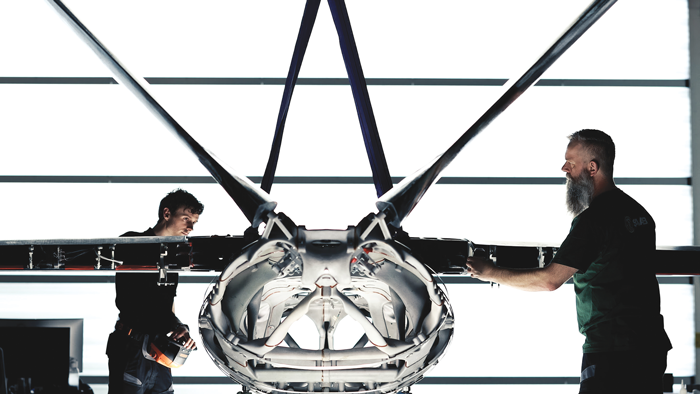
The fuselages, jointly designed and manufactured by Saab and Divergent, were recently delivered for vehicle integration and flight testing. (Photo courtesy Divergent/Saab)
The structure is expected to be among the largest laser powder bed fusion (LPBF) structures to ever undergo powered flight. According to Divergent, it marks a significant technical achievement in demonstrating the absolute scale of its fixtureless assembly technology while highlighting the continued expansion of the company’s capabilities to ever more demanding applications. The full structure stretched 15 feet in length and comprised 26 unique printed parts, each joined and bonded in the company’s fixtureless robotic assembly cell.
“This collaboration with Saab highlights what becomes possible when ambitious aircraft concepts are paired with an end-to-end, software-defined manufacturing platform,” said Lukas Czinger, co-founder and CEO of Divergent, in a statement. “By tightly integrating digital design, additive manufacturing, and automated assembly, our teams were able to realize a large-scale fuselage structure aligned with Saab’s vision, while moving with a level of speed, flexibility, and structural integration that traditional approaches cannot match.”
“Adopting Divergent’s additively manufactured and digitally designed structures in this effort has given our joint team unparalleled flexibility in this development process,” said Axel Bååthe, head of Saab’s Rainforest, in the release. The Rainforest is Saab’s internal startup for transformative innovation. “We see digital design and advanced manufacturing as a key enabler of our collaborative success in this project.”
Divergent describes the Divergent Adaptive Production System as “the world’s first end-to-end software-hardware production system for industrial digital manufacturing.” The system is reported to enable customers to design, additively manufacture, and automatically assemble complex structures for automotive, aerospace, and defense applications.
“DAPS transforms the economics, speed, and scalability of defense vehicle manufacturing by optimizing designs, dematerializing structures, and eliminating upfront capex,” the release stated.
Dental Industry Veteran Develops Patented Multi-Material 3D-printing Technology
The new methodology addresses the inability of traditional 3D printing to seamlessly print multiple materials in a single automated cycle.
LOS ANGELES—After more than 25 years owning and operating dental laboratories, Mart Goldberg saw what others in the industry had long accepted as an unavoidable limitation: the inability to seamlessly 3D-print multiple materials in a single automated cycle.
But rather than accept the status quo, Goldberg set out to solve the problem himself. He patented a methodology that addresses what has plagued the dental prosthetics industry for years.
Traditional 3D printing methods require sequential fabrication—stopping the print to change materials, flushing chambers, repositioning parts between material applications. These interruptions introduce handling errors, extend production time, and compromise precision. Goldberg’s technology is reported to eliminate these limitations through intelligent functional region mapping, automated deposition sequencing, and seamless material transitions—all within a single print cycle.
“I spent decades watching skilled technicians perform the same manual interventions over and over—changing materials, cleaning equipment, repositioning parts,” Goldberg said in a release describing his technology. “The automation we’ve achieved can reduce manual labor in a printing cycle by approximately 90 percent. But it’s not just about efficiency. The stable chemical bonding between dissimilar polymers and natural-appearing material transitions—that’s what will change patient outcomes.”
Goldberg developed his methodology specifically for integration with FUGO Precision 3D’s centrifugal vat-photopolymerization system—reportedly the first and only 3D printer of its kind. The combination is said to achieve sub-30 micron repeatability and throughput up to 10 times faster than traditional systems, with integrated printing, washing, drying, and curing in a single automated machine (see article, “Centrifugal 3D Printing Technology Reported to Provide Up To 10 Times Faster Throughput than Conventional AM Systems.”)
“Mart brought something we couldn’t develop internally—decades of hands-on experience, understanding exactly what dental laboratories need,” said Alexander Meseonznik, CEO of FUGO Precision 3D, in the release. “His methodology transforms our hardware into a complete solution for multi-material manufacturing. The combination creates capabilities that simply don’t exist anywhere else in the market.”
The technology was demonstrated at LMT Lab Day 2026, a dental laboratory technology event held in Chicago in February. The event featured live demonstrations of complete print cycles producing production-ready, multi- color denture components through a single automated workflow.
“There are 120 million Americans suffering from tooth loss,” Goldberg noted in the release. “This isn’t a prototype or a concept; we’re showing production-ready technology that dental laboratories can implement today. The methodology works, and we’re ready to help manufacturers transform their operations.”
Goldberg is founder and CEO of BH Printelligence. His deep expertise in dental prosthetics manufacturing, material science, and clinical workflow requirements were crucial to his development of the patented multi-material 3D printing methodology. Today, he remains “dedicated to transforming additive manufacturing by enabling true multi- material 3D printing that eliminates manual post-processing, reduces production costs, and delivers superior quality for precision applications,” the release stated.
Centrifugal 3D-printing Technology Reported to Provide Up To 10 Times Faster Throughput than Conventional AM Systems
FUGO Precision 3D’s patented system integrates printing, washing, drying, and curing in a single automated cycle
GARDENA, Calif.—FUGO Precision 3D is the developer of a patented centrifugal 3D-printing platform that the company calls “the world’s first all-in-one centrifugal 3D printing system.” The 3D printing platform is considered an “all-in-one” system because it consolidates printing, washing, drying, and curing into a single automated cycle.
FUGO Precision 3D is working to leverage the technology to enable scalable, next-generation manufacturing for dental labs, medical device companies, hearing health, aerospace, and high-output industries. The centrifugal 3D printing platform achieves sub-30 micron repeatability, with up to 10 times faster throughput than conventional additive manufacturing (AM) systems, according to a company release.
According to FUGO, its system is unlike conventional resin printers that use mechanical means to apply layers. Instead, it creates artificial gravity through centrifugal forces, generating up to 2,000 G’s of force.
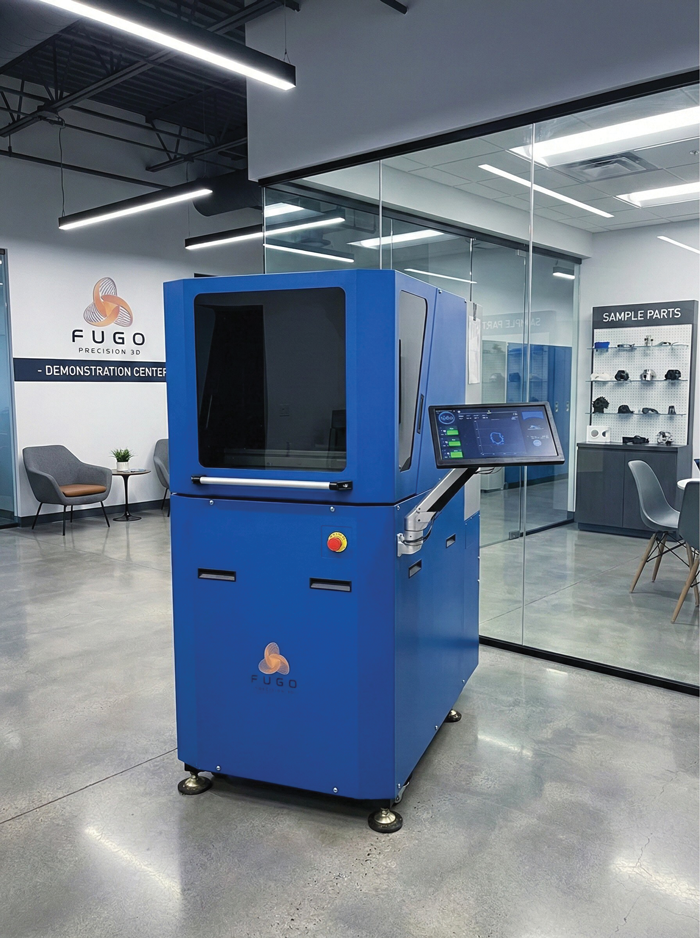
FUGO Precision 3D’s Centrifugal 3D-printing system is shown in the company’s Demonstration Center. (Image: FUGO Precision 3D/PRNewswire)
“This allows parts to form while fully submerged in material that acts as its own support structure, producing surfaces with minimal layer lines,” the release stated. The system’s intelligent capillary generation creates microscopic drainage channels that material passes through under centrifugal force, then seals automatically, eliminating trapped volumes that challenge traditional SLA printing.”
FUGO’s multi-material capability is said to enable printing with multiple resins in the same automated cycle, creating new possibilities for manufacturing dentures and other multi-component dental appliances, the company said in the release.
The company debuted the technology in February at LMT Lab Day 2026, a dental laboratory technology event in Chicago, where company representatives conducted live, in-person demonstrations in collaboration with its partner, Graphy Inc.
The live demonstrations paired FUGO’s technology with Graphy’s high-performance photopolymer materials, including its Shape Memory Aligner (SMA) materials and clinically validated dental resins. These resins are reported to provide exceptional mechanical strength, dimensional stability, and biocompatibility.
The FUGO-Graphy partnership, announced earlier this year, is said to combine “FUGO’s hardware innovation with Graphy’s advanced material science to deliver production-ready parts with minimal post-processing labor.”
“LMT LAB DAY represents the perfect stage to introduce what we believe is a paradigm shift in dental manufacturing,” said Alexandr (Sasha) Shkolnik, CTO of FUGO Precision 3D, in a release before the event. “We’re inviting industry leaders to see the technology perform in real-time: not simulation, not video, but actual production cycles from start to finish. This is the future of scalable precision manufacturing.”