
Argonne AI Tools Power Safer, Faster Aerospace Inspections
Collaboration between Spirit AeroSystems, Argonne, Northern Illinois University and Texas Research Institute Austin, Inc. advances AI for industrial safety.
AI developed at Argonne is now streamlining aircraft inspections—cutting time, conserving energy, and pointing the way to smarter manufacturing across industries.
A worker stands on the floor of a large, high-tech manufacturing facility, operating a massive robotic inspection system. The space is brightly lit, with tall ceilings and industrial-grade equipment lining the walls. The system, featuring multiple articulated arms mounted on blue platforms, with one large U-shaped scanning apparatus extended, employs an ultrasonic-equipped robot arm to inspect aerospace structures.
Today, Artificial intelligence (AI) is helping industry move faster, safer, and smarter. A research collaboration among Spirit AeroSystems Inc., the U.S. Department of Energy’s (DOE’s) Argonne National Laboratory (ANL), Northern Illinois University (NIU), and Texas Research Institute (TRI) Austin has developed a powerful, new AI-assisted tool that transforms how manufacturers inspect critical aerospace components, according to a release from Argonne National Laboratory.
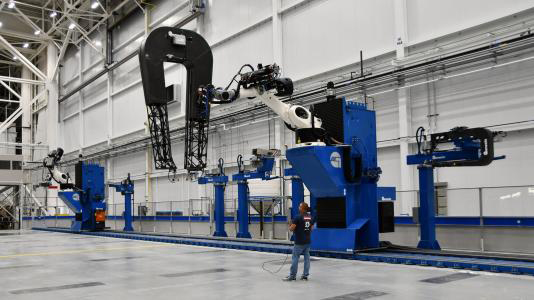
An ultrasonic-equipped robot arm inspects aerospace structures at Spirit AeroSystems. (Image by Spirit AeroSystems.)
The technology uses AI to quickly spot parts of ultrasonic scan data that may need a closer look. The AI tool uses a type of supervised machine learning model called a convolutional neural network, which is especially good at recognizing patterns in images. Trained on thousands of Spirit’s annotated ultrasonic scans, it is carefully tuned to accurately detect important defects without missing any or raising too many false alarms. The tool’s accuracy was confirmed by comparing its results to data that had already been reviewed by expert human inspectors.
The AI tool helps trained inspectors work more efficiently by highlighting areas in the ultrasonic scan that are most likely to have problems. This allows inspectors to focus their review on those areas instead of going through the entire dataset. That saves time and improves how efficiently they work, and is especially helpful when checking composite materials, which are more common in airplanes and take a lot of work to inspect.
This project brought together diverse expertise from across sectors. Spirit’s deep knowledge in ultrasonic inspection procedures, characteristics of defects, production workflows, and real-world constraints ensured the model was trained and evaluated on realistic, relevant data aligned with manufacturing standards.
Argonne led the development and training of the AI model using its high performance computing resources. Northern Illinois University contributed to AI model refinement and performance validation, and TRI Austin led the software integration effort and brought prior experience in ultrasonic inspection automation.
“This project represents a major step forward in automating quality assurance in composite manufacturing,” said Zachary Kral, NDI R&T Engineer at Spirit AeroSystems, in the release. “The collaborative approach allowed us to combine Spirit’s domain knowledge with Argonne’s AI expertise. Contributions from NIU and TRI Austin strengthened the solution’s robustness and applicability.”
Using powerful computers at the Argonne Leadership Computing Facility, a DOE Office of Science user facility, the team trained the AI tool to be both accurate and reliable.
In early use, the tool cut inspection time by 7 percent compared to current human inspection time, all while meeting strict safety and performance standards. In conventional practice, ultrasonic inspection of composite structures requires significant manual effort, with inspectors visually reviewing large datasets to identify and characterize potential defects.
The tool also saved about 3 percent in energy at the facility level for each aircraft by shortening the overall production flow time. This decreases the amount of time that production systems, inspection equipment, factory lighting, HVAC, and support infrastructure are being used.
“By combining AI with advanced computing resources, we helped deliver a solution that is both practical and scalable,” said Rajkumar Kettimuthu, senior scientist and group leader at Argonne, in the release. “This model was designed to generalize across different geometries and material systems, and its integration into a portable inspection tool enables adaption to other aircraft inspection programs with minimal retraining.”
Now in the process of being deployed across all ultrasonic inspections of the forward fuselage section of an active commercial aircraft program at Spirit, the AI tool was tested on ultrasonic scans from other composite parts. This showed it can be generalized to other components, provided the necessary training data is available.
This project illustrates how AI and high-performance computing can deliver practical solutions in complex industrial environments. It also highlights the growing role of national labs like Argonne in helping U.S. industry improve performance while reducing costs and energy use.
“This effort demonstrates what’s possible when we bring together capabilities from different sectors,” said Ian Foster, director of the Data Science and Learning division at Argonne, in the release. “It’s a blueprint for accelerating innovation and generating value for both industry and the scientific community.”
While the inspection data remain proprietary to Spirit AeroSystems, the underlying AI techniques are being made available for academic research and may be licensed for commercial use—supporting broader innovation and economic growth across sectors.
This research was supported by DOE’s Office of Science and Office of Energy Efficiency and Renewable Energy.
The Office of Energy Efficiency and Renewable Energy’s (EERE) mission is to accelerate the research, development, demonstration, and deployment of technologies and solutions to equitably transition America to net-zero greenhouse gas emissions economy-wide by no later than 2050, and ensure the clean energy economy benefits all Americans, creating good paying jobs for the American people—especially workers and communities impacted by the energy transition and those historically underserved by the energy system and overburdened by pollution.
The Argonne Leadership Computing Facility provides supercomputing capabilities to the scientific and engineering community to advance fundamental discovery and understanding in a broad range of disciplines. Supported by the U.S. Department of Energy’s (DOE’s) Office of Science, Advanced Scientific Computing Research (ASCR) program, the ALCF is one of two DOE Leadership Computing Facilities in the nation dedicated to open science.
AI ‘Adviser’ Accelerates Robotic Design of Advanced Electronic Materials
Argonne-led team develops special algorithm that monitors AI-driven autonomous experiments
By Michael Matz | Argonne National Laboratory
The AI “adviser” algorithm monitors the performance of other machine learning algorithms as autonomous experiments progress. It provides human scientists with insights that inform refinements to experimental plans.
The rapid global growth of electronics poses significant challenges for materials innovation. Traditionally, discovering new electronic materials can take many years. Emerging technologies, such as flexible electronics and bioelectronics, require much faster development. Artificial intelligence (AI)-driven autonomous experimentation has the potential to significantly speed the discovery of breakthrough materials.
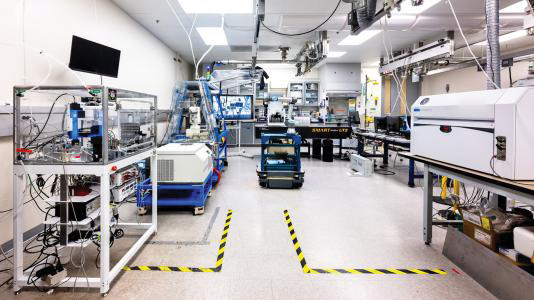
The research team used the AI adviser in Polybot, an AI-guided autonomous laboratory at the Center for Nanoscale Materials, a DOE Office of Science user facility at Argonne. (Image by Argonne National Laboratory.)
However, AI algorithms need to be trained with large amounts of data to make good decisions. A lack of data on electronic materials has limited the effectiveness of AI-driven experiments. This data scarcity is due to the long time it takes to design, fabricate, and evaluate materials. New strategies are needed that enable AI systems to perform effectively with small datasets.
A research team led by the U.S. Department of Energy’s (DOE) Argonne National Laboratory developed an innovative AI “adviser” that addresses these challenges.
The AI adviser is a specialized algorithm that monitors the performance of machine learning algorithms as autonomous experiments progress. It also extracts key insights. Human scientists use these insights to refine their hypotheses or experimental plans.
This AI-human collaboration boosts efficiency and increases the likelihood of discovering high-performance materials. The AI adviser is inspired by robo-advisers that manage financial portfolios.
The researchers applied the adviser to an AI-driven investigation of electronic materials called mixed ion-electron conducting polymers (MIECPs). The study yielded important findings on how the packing structure of these materials influences their performance.
“AI algorithms used in autonomous laboratories lack the ability to make adaptive changes to experiments based on small datasets,” said Jie Xu, one of the study’s lead authors. Xu is an Argonne scientist and assistant professor of molecular engineering at the University of Chicago Pritzker School of Molecular Engineering. “The AI adviser transformed our robotic laboratory from a relatively static workflow into a highly adaptable one. The results were compelling.”
Xu added, “I expect researchers to apply our adviser concept and methods to various materials. This will help accelerate new discoveries.”
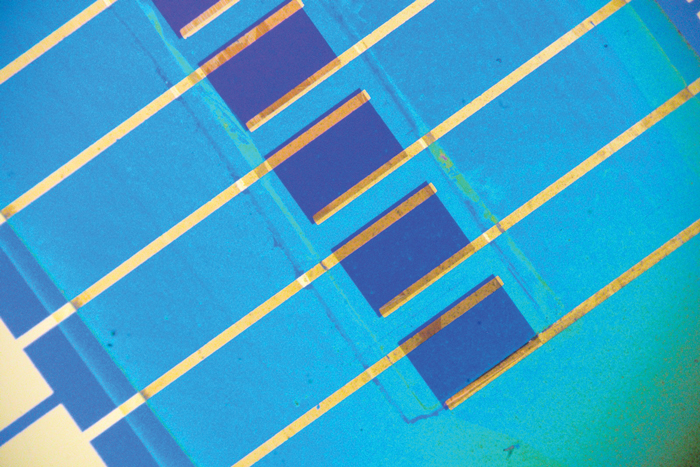
An organic electrochemical transistor fabricated during the AI-guided autonomous experiments. (Image by Argonne National Laboratory.)
The study was published in Nature Chemical Engineering. In addition to Argonne, the research team included the University of Chicago, DOE’s Lawrence Berkeley National Laboratory (LBNL), the University of Southern Mississippi, and the University of Central Florida.
Human-AI collaboration drives successful study
The scientists integrated the AI adviser into Polybot. This AI-guided robotic laboratory is in the Center for Nanoscale Materials, a DOE Office of Science user facility at Argonne. Polybot’s robotic platforms autonomously synthesize and characterize materials. Then, its AI algorithms analyze the experimental data. Based on this analysis, the algorithms decide on the next experiments.
To test the adviser, the team used Polybot to investigate MIECPs (mixed ionic-electric conducting polymers). These soft organic materials can conduct both electrons and ions simultaneously. This dual conductivity makes them promising for a wide range of applications, including wearable electronics and energy storage.
The researchers wanted to uncover the design principles that govern performance of MIECPs and to optimize their properties. Their approach was to evaluate the materials in fabricated transistors.
Polybot autonomously deposited the MIECP onto substrates. Then, it fabricated transistors from the material, measured the transistors’ performance and characterized the material’s properties. The key performance metric quantified the transistors’ ability to move and store electronic and ionic charge.
In experimental iterations, Polybot’s AI algorithms varied the processing conditions. These conditions include the material’s concentration in solution, deposition temperature, deposition speed, and substrate features. Two goals informed these adjustments: The first was to explore diverse processing conditions with as few experiments as possible. The second was to maximize understanding of material structure-property relationships.
An algorithm supervisor
The adviser is an AI algorithm that “supervises” Polybot’s AI algorithms. It evaluated experimental progress, analyzed experimental datasets, and compared the algorithms’ performance. It communicated key patterns and trends to human scientists via a livestreaming platform. The idea was to inform the scientists’ decisions on refinements to experimental workflows and parameters.
At one point, the adviser observed diminishing performance improvements. It suggested switching to another AI algorithm for subsequent experiments. The scientists implemented the recommendation, and device performance improved significantly.
The adviser also found that deposition speed contributed the most to improved performance. It shared this insight with the scientists. This informed their decision to widen the scope of investigation for this parameter, driving additional performance gains.
The adviser-enabled experimental adaptations allowed Polybot to complete the study with just 64 experiments. This is remarkably fast, considering that there were more than 4,300 possible combinations of processing conditions. The study yielded a diverse dataset on material structure-property relationships.
In-depth characterizations yield valuable design principles
The research team also used lasers, X-rays, and electric current to characterize the structure and properties of the 10 most representative material samples. The objective was to better understand how the samples’ packing structures influenced their performance. Some of the characterization work was performed at the Advanced Light Source, another DOE Office of Science user facility at LBNL.
These in-depth characterizations revealed two structural features that played a crucial role in better performance: wider spaces between layers, and thinner fibers. The team also discovered that the material crystallizes into two distinct structures. These significant findings can be leveraged to design higher-performing MIECPs.
The study was supported by the DOE Office of Science, Basic Energy Sciences program.
About Argonne’s Center for Nanoscale Materials
The Center for Nanoscale Materials is one of the five DOE Nanoscale Science Research Centers, premier national user facilities for interdisciplinary research at the nanoscale, supported by the DOE Office of Science. Together, the NSRCs comprise a suite of complementary facilities that provide researchers with state-of-the-art capabilities to fabricate, process, characterize, and model nanoscale materials, and constitute the largest infrastructure investment of the National Nanotechnology Initiative.
The NSRCs are located at DOE’s Argonne, Brookhaven, Lawrence Berkeley, Oak Ridge, Sandia, and Los Alamos National Laboratories. For more information about the DOE NSRCs, please visit https://science.osti.gov/User-Facilities/User-Facilities-at-a-Glance.
Argonne National Laboratory seeks solutions to pressing national problems in science and technology by conducting leading-edge basic and applied research in virtually every scientific discipline. Argonne is managed by UChicago Argonne, LLC, for the U.S. Department of Energy’s Office of Science.
The U.S. Department of Energy’s Office of Science is the single largest supporter of basic research in the physical sciences in the United States and is working to address some of the most pressing challenges of our time. For more information, visit https://energy.gov/science.
Michael Matz is a writer for Argonne National Laboratory, which published this article on March 10, 2026.