
AI-powered Metal Additive Manufacturing System Is Reported to Print up to 10 Times Faster than Conventional Systems
Precision Additive’s laser powder bed fusion printer is capable of printing magnesium alloys, which have historically been difficult to manufacture via 3D printing.
A new metal additive manufacturing system introduced by Precision Additive is designed to produce high-quality, qualification-ready components for defense, aerospace, energy, medical, and other mission-critical applications requiring reliable, U.S.-based manufacturing.

Bala Anand Jeldi, founder and CEO of Precision Additive. (Image: Precision Additive/PRNewswire)
In a release accompanying the product launch, Precision Additive described its PA-300 laser powder bed fusion (LPBF) printer as “the fastest printer ever made” using the company’s proprietary SSLM laser technology, adding that the printer is” built with intelligence powered by AI architecture.”
The PA Series is reported to combine proprietary high-performance laser technology, artificial intelligence, and Precision Additive’s qualification process to deliver faster, more reliable metal printing. Its advanced SSLM™ laser is said to enable build speeds up to 10 times faster than conventional systems, directly improving production performance.
According to Precision Additive, embedded AI continuously monitors the build and automatically corrects deviations in real time, creating a “self-healing” process that protects part integrity.
“These capabilities are unified through Precision Additive Qualification (PAQ), a data-driven framework that ensures consistent, repeatable results from build to build,” the company said in the release. “Together, this tightly controlled process makes it possible to reliably print magnesium alloys—a lightweight but highly reactive material that has historically been difficult to manufacture using additive technologies.”
The PA series of machines is configured to print metal alloys, including hard to print materials like magnesium, tungsten, and copper. Magnesium processing represents a key differentiator for the PA machines, the company said.
“As defense programs face fragile supply chains and increasing reliance on foreign sources for high-complexity parts, domestic manufacturing capability has become essential to readiness,” said Jon Haase, chief strategy officer and president of Government Business, in a statement. “The PA machines are designed to restore secure U.S.-based production. These machines are critical to U.S. defense and exceed international printers.”
“Additive manufacturing is entering a new era defined by intelligence, reliability, and accountability,” said Bala Anand Jeldi, founder and CEO of Precision Additive, in a statement. “Precision Additive was created to ensure advanced manufacturing systems are not only innovative, but dependable enough to support the most demanding applications.”
Jeldi brings more than 20 years of experience in additive manufacturing and magnesium alloy applications across space, defense, and automotive industries. He previously designed what is reported to be the world’s largest 3D printer and has led the development of lightweight components used in multiple space missions, including lunar and Mars programs. His work has been recognized with a Lockheed Martin Gold Medal, along with honors from the Department of Science & Technology, and includes more than 10 patents.
Precision Additive said it has a deep collaboration with NVIDIA and has applied its AI architecture in its product line. The company has collaborated with NVIDIA to advance physics-based, AI-driven manufacturing technologies. Its AI framework “supports real-time process optimization, predictive quality assurance, and scalable qualification workflows,” the company said.
Precision Additive is working to redefine laser powder bed fusion (LPBF). As a U.S. OEM and a supplier of on-demand, production parts, the Noblesville, Indiana-based company builds LPBF systems with proprietary optics, advanced machine controls, and data-driven process validation to deliver qualified, repeatable parts for mission-critical applications.
Precision Additive addresses what the company called longstanding challenges in scalability, certification, and reactive material processing, making LPBF a viable production method for the defense and aerospace sectors.
“From prototype through production, Precision Additive provides a turnkey solution that enhances efficiency, ensures reliability, and strengthens domestic manufacturing capability. Precision has a mission to make the U.S. the global innovation leader in 3D printing through innovation and AI-driven architectures,” the company said.
3D-Printed Die Casting Tool Insert Reported to Be World’s Largest
MacLean-Fogg partnered with Fraunhofer ILT on an automotive additive manufacturing milestone that is said to open the door to scalable tooling and reduced lead times.
MacLean-Fogg Company (MFC) and Fraunhofer Institute for Laser Technology ILT (Fraunhofer ILT) reported in September that they reached a new milestone in additive manufacturing for the automotive industry.
What they created was “the largest 3D-printed, nearly solid die casting tooling insert in the world, 156 kg (350 pounds), for Toyota Europe’s Yaris hybrid transmission housing,” according to a release from Maclean-Fogg.
OEM validation
A conformally cooled insert, reportedly the largest in the world, was produced using Fraunhofer ILT’s gantry-type, multi-laser Laser Powder Bed Fusion (LPBF) machine with MacLean-Fogg’s patented L-40 tool steel powder. A hybrid process was used in consideration of Toyota’s cost targets, MacLean-Fogg stated in the release.
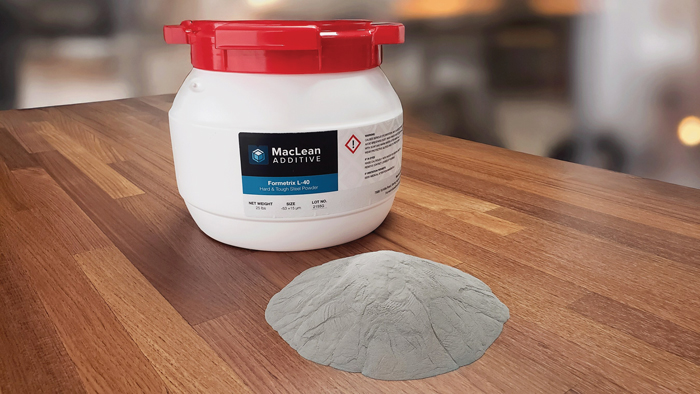
The L-40 tool steel powder developed by MacLean-Fogg for additive manufacturing and die casting applications in the automotive industry. (Image: MacLean-Fogg/PRNewswire)
“Gantry printing with L-40 tool steel powder material, a promising avenue towards scalable additive manufacturing, is opening the potential for metal 3D printing to reduce lead times and to realize more responsive manufacturing—in particular while delivering world-class insert performance, longer maintenance intervals, and cost-effective pricing structure,” said Magdalena Coventry, Ph.D., and Andrew Willett, Ph.D., of Toyota Europe, in the release. “We are thrilled to be at the forefront of innovations in the rapidly developing universe of additive manufacturing.”
Advanced materials for automotive manufacturing
MacLean-Fogg’s L-40 powder was specifically designed for the LPBF process to achieve high hardness and toughness, thereby minimizing crack formation and crack propagation even when printing at moderate pre-heat temperatures. Compared to conventional tool steels, L-40 is also reported to reduce the need for advanced post-build heat treatments, further decreasing time-to-market.
In addition to reducing the soldering of aluminum to the tooling surface, the material offers approximately twice the lifespan of conventional aluminum die-casting inserts, with lower overall tooling maintenance requirements. High sustainability, with no cobalt and a minimal amount of nickel, is another benefit,
“Toyota posed a thrilling challenge by requesting to expand the application of L-40 to large-format tooling inserts,” said MacLean-Fogg Director of Product Development, Harald Lemke, Ph.D., in the release. “We had to overcome scale-up challenges, such as ensuring consistent gas flow conditions as build sizes grew.”
Next-generation 3D printer platforms
Fraunhofer ILT addressed these requirements with its gantry-type, five-laser LPBF system, which allows for the processing of parts longer than 50 cm in side length and chamber temperatures of up to 200°C.
“This was precisely our motivating factor to develop the gantry system,” said Niklas Prätzsch, Ph.D., of Fraunhofer ILT, in the release. “L-40’s unique attributes make it possible to perform large-scale additive manufacturing of tooling inserts at lower temperatures without compromising quality.”
Unlocking the future of automotive die casting
By demonstrating this success, Fraunhofer ILT and MacLean-Fogg aim to expand the technology into structural die casting, inserts for giga-casting tools, and other large hot- or cold-forming tools where traditional powders have not yet been validated. All of these are consistent with broader trends in the automotive industry towards lightweighting, shorter development times, and local supply chain resilience, the release said.
MacLean-Fogg Company, a privately held enterprise headquartered in Mundelein, Illinois, has served the global automotive and industrial markets for more than 100 years. With 17 locations worldwide and more than 2,000 employees, MacLean-Fogg designs and manufactures high-performance fasteners, engineered components, and advanced tooling for leading OEMs and Tier-1 suppliers, the company said.
The company said it is recognized for its commitment to innovation, quality, and customer partnerships as it delivers products that improve vehicle performance, reliability, and manufacturability. Building on its strong heritage in cold forming, machining, and metalworking, MacLean-Fogg is advancing the use of additive manufacturing technologies to create scalable solutions for die casting, prototyping, and production applications, the company said.
“Driven by a culture of integrity, customer focus, and stewardship, MacLean-Fogg continues to invest in next-generation materials and processes that support lightweighting, electrification, and supply chain resilience in the automotive space,” the release stated.
The Fraunhofer Institute for Laser Technology ILT, based in Aachen, Germany, is one of the world’s leading research and development centers for laser technology. With over 500 employees and more than 19,500 m² of laboratory and office space, Fraunhofer ILT “develops innovative solutions for laser-based manufacturing processes, ranging from additive manufacturing and laser cutting to welding, surface treatment, and medical applications,” the release stated.
The institute collaborates closely with global industry partners to advance scalable, high-performance solutions that accelerate digitalization, enable new design possibilities, and increase manufacturing efficiency.
“In the field of additive manufacturing, Fraunhofer ILT is pioneering next-generation processes and large-scale system architectures that support applications in automotive, aerospace, energy, and beyond,” the release said.
Machina Labs Working to Scale Manufacturing Infrastructure for Defense, Advanced Mobility
The company recently raised new funding to accelerate deployment of its first large-scale, U.S.-based Intelligent Factory for producing advanced metal structures.
Machina Labs is aiming to reinvent metal manufacturing with an agile, advanced manufacturing platform that leverages AI and robotics.
Founded in 2019 and based in Los Angeles, Machina Labs builds and operates intelligent factories capable of rapidly forming and assembling aerospace- and defense-grade metal structures directly from digital designs. The company’s flagship platform, RoboCraftsman™, combines advanced robotics, machine learning, and proprietary RoboForming™ technology to deliver software-defined manufacturing at production scale.
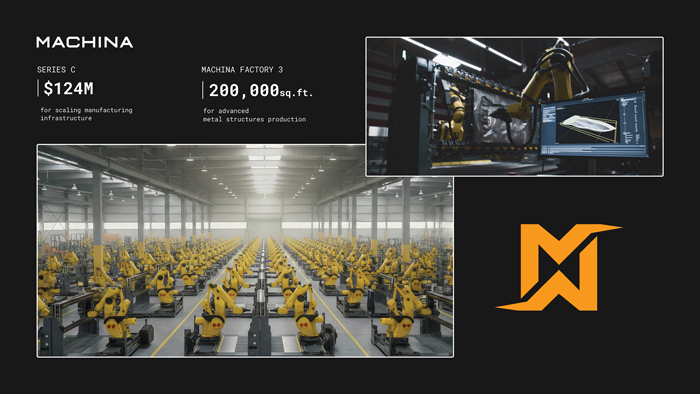
A split image of a large-scale Intelligent Factory alongside a close-up photograph of Machina’s software-defined RoboCraftsman manufacturing platform. The graphic highlights how intelligent, integrated factories can form, weld, and assemble complex metal structures for defense, aerospace, and advanced mobility programs at production scale. (Image: Machina Labs/Business Wire)
Machina Labs is currently scaling its platform to become a Tier-1 manufacturing partner for the next generation of mission-critical systems. In February, the company announced in a release that it closed a Series C financing round, totaling $124 million, and the development of its first large-scale Intelligent Factory.
Woven Capital, Toyota’s growth-stage venture arm, Lockheed Martin Ventures, Balerion Space Ventures, and Strategic Development Fund (SDF) were among the investors participating in the financing.
The funding is said to mark a critical inflection point for Machina Labs as the company scales from breakthrough manufacturing technology to deploying software-defined production infrastructure capable of supporting mission-critical metal structures across defense, aerospace, and advanced mobility.
“The world’s most advanced designs are being held back by 20th-century factories,” said Edward Mehr, CEO and co-founder of Machina Labs, in a statement. “This round allows us to scale manufacturing infrastructure that moves at the speed of software. We’re not just making parts, we’re reprogramming the factory itself to serve defense, aerospace, and automotive customers who can’t afford to wait.”
A significant portion of the capital will be used to launch Machina Labs’ first large-scale Intelligent Factory in the U.S., a 200,000-square-foot, production-ready facility that will house up to 50 RoboCraftsman™ cells and produce thousands of complex structural assemblies annually for defense and aerospace customers, the company said in the release.
From missile structures to airframes, Machina Labs’ Intelligent Factory is designed to manufacture a wide range of complex metal structures, without significant retooling or reconfiguration. Powered by Machina Labs’ RoboCraftsman platform, the Intelligent Factory will enable customers to move from digital design to production inside the same facility, compressing timelines from months to days, according to the release.
“We believe Machina Labs’ AI-driven manufacturing approach will play a key role in shaping the future of aerospace production,” said Chris Moran, vice president and general manager at Lockheed Martin Ventures, in the release. “The launch of their new factory marks a major step forward, demonstrating how intelligent, robotic production can bring greater speed, precision, and scalability to the industry.”
Manufacturing speed as a strategic imperative
Machina Labs said it is actively supporting U.S. government and commercial programs where speed of production has become a strategic constraint. The company has secured contract awards from the U.S. Air Force Research Laboratory and the U.S. Air Force Rapid Sustainment Office, and is working with a leading defense prime on metal structures production for missiles and hypersonics.
By integrating forming, machining, welding, and assembly into a single intelligent factory, Machina Labs is laying the groundwork for a future in which manufacturing capacity can be deployed, scaled, and adapted as dynamically as software, the company said.
“Modern defense systems are often limited not by design, but by how fast they can be manufactured,” said Phil Scully, general partner and co-founder at Balerion Space Ventures, in the release. “Machina Labs is building the manufacturing backbone required to close that gap and operate as a true Tier-1 partner.”
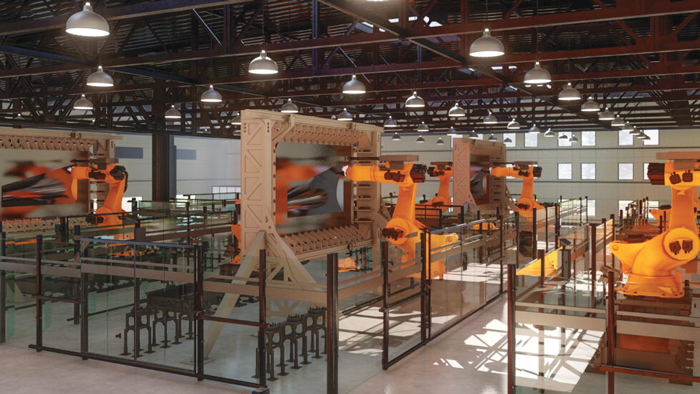
Machina Labs combines AI and robotics to rapidly manufacture advanced composite and metal products. (Photo: Machina Labs/Business Wire)
Manufacturing innovation in mobility
While defense remains a core focus, Machina Labs said its platform is inherently dual-use, supporting commercial innovation alongside national security needs. The company continues to work closely with Toyota to develop production-quality automotive panels that unlock design freedom and enable rapid customization at scale.
“The automotive industry has long been the proving ground for manufacturing innovation,” said Ro Gupta, managing director at Woven Capital, in the release. “Machina Labs is pioneering intelligent forming technology that brings craft-level precision to industrial scale, enabling the flexible, responsive production that next-generation mobility demands. This is exactly the kind of innovation that will shape advanced manufacturing’s future, and we’re proud to support their journey.”
Creative 3D Technologies Raises Seed Funding to Bring Factory-Scale Manufacturing Into a Single Modular System
Creative 3D Technologies (C3DT), is an advanced manufacturing company working to develop modular, all-in-one production systems designed to bring industrial-grade manufacturing closer to where it’s needed.
The Austin, Texas-based company pioneered what it calls Single-Cell Manufacturing—an approach that consolidates the capabilities of a traditional factory line into a single, modular unit. The company’s platform integrates additive manufacturing, machining, electronics assembly, and other core production processes into a reconfigurable system that can be deployed outside of centralized factory environments.
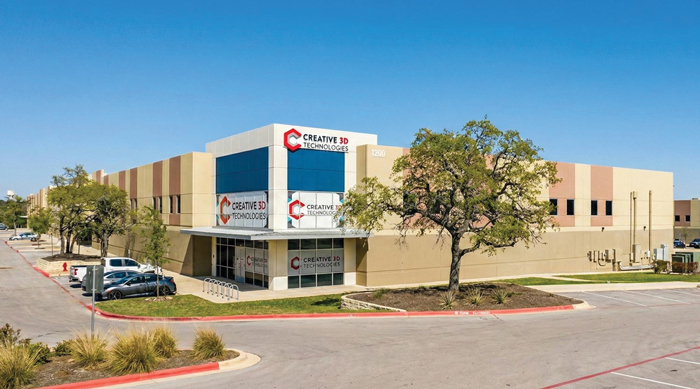
Creative 3D Technologies’ new headquarters and manufacturing facility in Cedar Park, Texas, anchors the company’s next phase of growth in advanced, U.S.-based manufacturing. (Image: Creative 3D Technologies/EIN Presswire)
“C3DT’s technology is built for applications where speed, flexibility, and resilience matter as much as scale. Its systems are designed to support industries ranging from defense and energy to advanced manufacturing and R&D, enabling localized production without the overhead or rigidity of traditional factory expansion,” the company said in a release.
In February, Creative 3D Technologies reported that it raised a $5 million seed round with participation from NJP, MetaLucks, Sher, Greenwood, and Tech Bricks. The company said it will use the funding to expand its modular EVO “Factory-in-a-Box” platform, designed to deliver industrial grade production in places where traditional factories are too slow, costly, or impractical.
Creative 3D Technologies is currently addressing a persistent gap between prototyping and mass production—where products are too complex or time-sensitive for centralized factories, but require more capability than conventional labs can provide. The company refers to this layer as Single-Cell Manufacturing.
A factory line, reduced to one cell
Today, the EVO platform is a rugged, large-format, heated-chamber additive manufacturing system designed to process a very wide range of polymer, fiber-based, and metal-filled materials at industrially relevant scales. It is optimized for organizations that need large parts, material flexibility, environmental robustness, and controlled processing, without the infrastructure burden of traditional factory-scale systems.
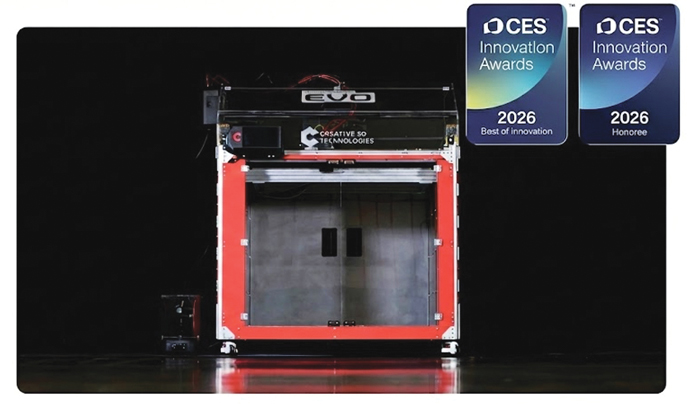
Creative 3D Technologies’ EVO “Factory In A Box.” (Image: Creative 3D Technologies/EIN
Moving toward the vision of the Factory-in a-Box, Creative 3D Technologies’ core EVO platform is built to consolidate what would typically require a full factory line, into a single, modular manufacturing system. Ultimately, EVO will move to offer more than 20 production functions—including additive manufacturing, CNC machining, electronics assembly, and pick-and-place—via additional toolheads within a single, reconfigurable unit, the company said.
“This comprehensive approach allows teams to manufacture industrial components locally, without coordinating multiple machines, vendors, or facilities. The result is faster iteration, shorter lead times, and greater control over production—particularly in environments where supply chains are constrained or unreliable,” the release stated.
Validated demand across defense and industry
Creative 3D Technologies reports successful early pilots with customers including the U.S. Army and Disney, reflecting demand for flexible, localized manufacturing in both mission-critical and commercial settings.
The company is also in early R&D on a semiconductor-focused version coined Fab-in-a-Box platform, aimed at specialty and prototype applications. Unlike traditional semiconductor fabs optimized for high-volume output, this system is designed for rapid, maskless fabrication of custom and low-volume microelectronics, where long lead times remain a major bottleneck.
Rethinking how manufacturing scales
Rather than pursuing scale through larger factories, Creative 3D Technologies is building infrastructure for a hybrid manufacturing model—one where centralized production is complemented by distributed, modular systems that can be deployed quickly and operated closer to demand..
“We’re not competing with mega-factories,” said Creative 3D Technologies’ Founder and CEO Ethan Baehrend, a veteran of the additive manufacturing industry, in the release. “We’re building the layer that sits alongside them—manufacturing capacity that can move faster, operate independently, and remain productive when centralized systems can’t.”
What’s ahead
According to the company, the Seed funding will support expanded production of the EVO platform, continued development of the company’s semiconductor roadmap, and additional deployments across defense, energy, and advanced manufacturing sectors.