
Aiming to Protect, with Pinpoint Precision
Wearable Sandia sensor tracks radiation in real time to better protect cancer patients and warfighters
By Michael Langley | Sandia National Laboratories
A new wearable patch to help protect cancer patients and American warfighters from harmful radiation has been developed by a small team of Sandia National Laboratories researchers. The disposable sensor is designed to be worn on the skin or clothes and produced at scale.
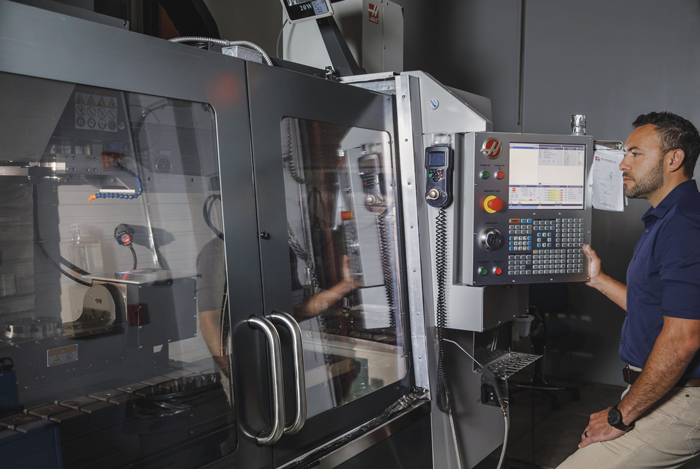
Isaac Avina uses a laser etching printer at Sandia National Laboratories’ California site to create a disposable dosimeter patch. He and the team have used the machine to create thousands of prototypes during the development cycle. (Photo by Spencer Toy)
Sandia researchers Patrick Doty and Isaac Aviña developed the wearable dosimeter that could change the way radiation therapy is administered by providing real-time feedback on radiation delivery and improving treatment accuracy. Combining advanced light-sensing polymers and microelectronic grids, the team used a state-of-the-art in-house developed laser etching machine at Sandia’s California site in Livermore to create thousands of disposable patches.
“Right now, in the medical world, we aim beams at cancerous cells with a wide range of error,” Aviña said. “That means sometimes we leave large parts of cancerous cells and other times we hit healthy tissue. To fix this problem, we need better accuracy.”
This need is particularly acute for children. A 2022 National Institutes of Health study found that it is difficult to ensure radiation goes only where it is needed and that “children are particularly susceptible to late adverse effects of radiation.”
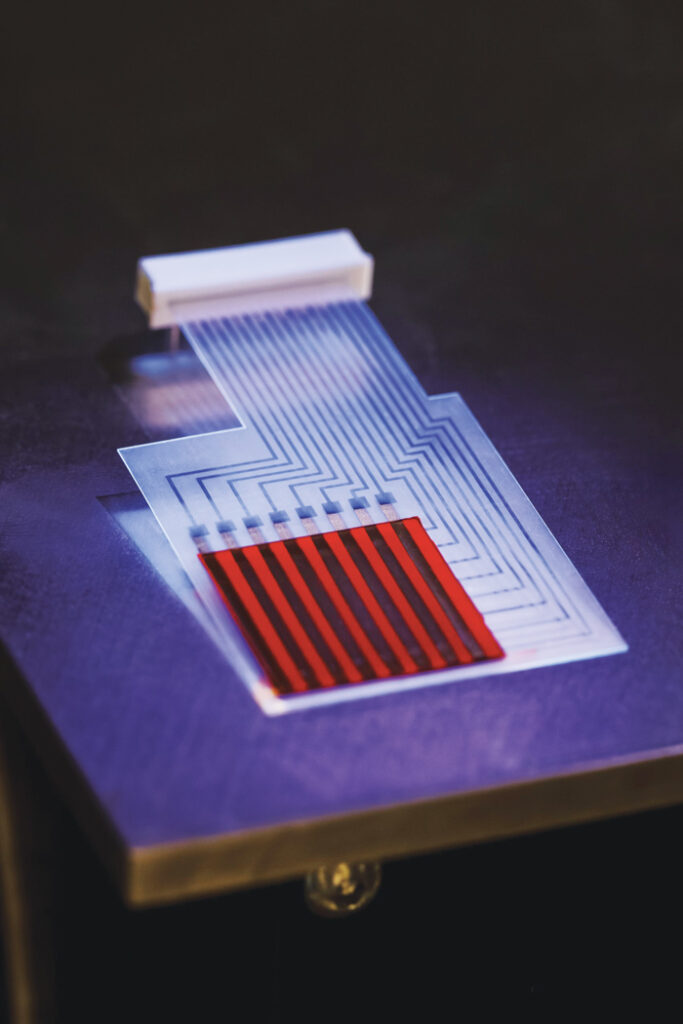
The dosimeter patch technology developed by Patrick Doty and Isaac Avina is a flexible, wearable, disposable way to protect cancer patients, health providers, first responders, and warfighters from toxic radiation exposure. (Photo by Spencer Toy)
“They know exactly what the beam current is and what the energy is, so they know exactly where it’s going in XY space and where it’s going to stop in a tank of water,” Doty said. “But what they don’t know is where the patient is. They might breathe or move.”
The new dosimeter not only measures radiation dose but can also alert clinicians if the radiation is off target. The patch includes a polymer that interacts with radiation in real time, allowing it to track both the location and dosage of radiation as it passes through the patient. If the patient moves, the system can react instantly, shutting off the beam to help prevent harm to healthy tissue.
The technology is licensed to Virginia company WearableDose Inc., which earned top global Innovation of the Year honors at the MedTech World Awards in November 2025.
The research team is now receiving funding from the Defense Threat Reduction Agency to explore how the patches can enhance situational awareness and monitor exposure for military personnel in hazardous environments. This work translates to improving military readiness and long-term health outcomes for today’s warfighters.
As the team continues to refine their technology, they remain motivated by personal experiences with cancer and the desire to improve patient care.
“Everybody should want to do something about this,” Doty said.
Michael Langley is a writer for Sandia National Laboratories.
Source: https://newsreleases.sandia.gov/dosimeter-patch/
Eight Wins for Sandia at the 2025 R&D 100 Awards
By Kristen Meub | Sandia National Laboratories
ALBUQUERQUE, N.M.—Sandia National Laboratories earned eight honors in the 2025 R&D 100 Awards, including seven technology awards and the program’s Researcher of the Year professional award. Hosted by R&D World, the awards recognize 100 of the year’s most significant technological advancements worldwide.
“This is a big year for Sandia,” said Doug Kothe, associate laboratories director and Sandia’s chief research officer. “The R&D 100 Awards are sometimes called the ‘Oscars of invention’ because they are so competitive. Winning eight in one year is incredible. It’s a new record for the Labs.”
The 2025 honorees reflect a research portfolio built for hard environments and high consequences. Several winning projects focus on sensing, measurement, and detection tools that can improve decision-making when conditions are extreme, time is limited, or safety is at stake. Others advance materials and diagnostics that help scientists better understand how systems behave under intense heat, pressure, or electrical stress.
Together, the projects offer a snapshot of the kinds of problems Sandia is tackling now and the solutions teams are pushing toward next.
Sandia’s 2025 R&D 100 Award Winners
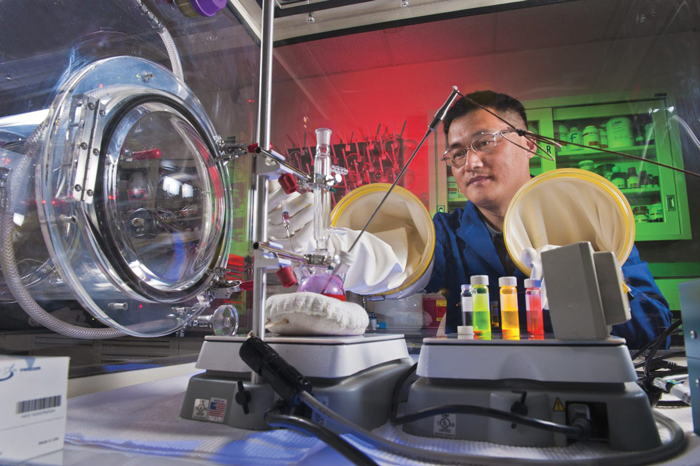
Sandia National Laboratories’ Hongyou Fan works with nano coatings in his lab. (Photo by Randy Montoya)
2025 R&D 100 Researcher of the Year: Hongyou Fan
Sandia materials scientist Hongyou Fan was named Researcher of the Year for contributions to chemical science, nanoscience. and materials science. His work has driven advances in nanoelectronics, energy, and materials separation. He has earned 24 patents, six previous R&D 100 awards, and recognition from multiple professional societies.
Electro-optical Sensor for High-energy Environments and Applications
Sandia’s electro-optical sensor measures voltages up to 20 million volts without physical contact, using a dime-sized crystal and a compact laser system. The sensor is designed to improve safety and reliability for high-energy environments. Applications range from lightning and high-energy physics research to electrical utility monitoring.
Colorized Hyperspectral X-Ray Imaging with Multi-Metal Targets, or CHXI-MMT
CHXI-MMT combines nanopatterned metal X-ray sources with advanced detection methods to deliver high-resolution X-ray images and precise material characterization. The process reduces reliance on costly accelerator facilities and could expand options for biomedical imaging, transportation security, nondestructive testing, and advanced manufacturing.
Fentanyl Analog Independent Detector (FAID)
FAID is a portable device designed to identify fentanyl and its analogs, even in trace amounts or mixed substances. Unlike traditional detection systems, the device recognizes chemical patterns without relying on extensive reference libraries. The technology could benefit military personnel, emergency responders, and law enforcement.
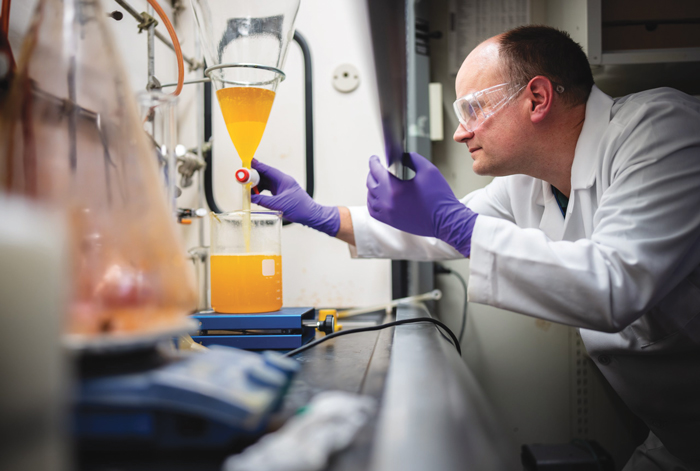
Sandia National Laboratories chemist Chad Staiger uses a separatory funnel to remove byproduct from the synthesis of a molecule. (Photo by Craig Fritz)
Low Coefficient of Thermal Expansion Molecules for Polymers
Sandia researchers developed a molecule designed to reduce thermal expansion mismatch in polymers, which can help prevent failures in harsh environments where temperature swings cause materials to expand and contract at different rates, leading to stress and potential damage. By incorporating this molecule into the polymer, manufacturers could eliminate fillers, lower costs, make processing easier, and improve durability for bonded materials. Potential applications include industrial settings and the aerospace, automotive and electronics industries.
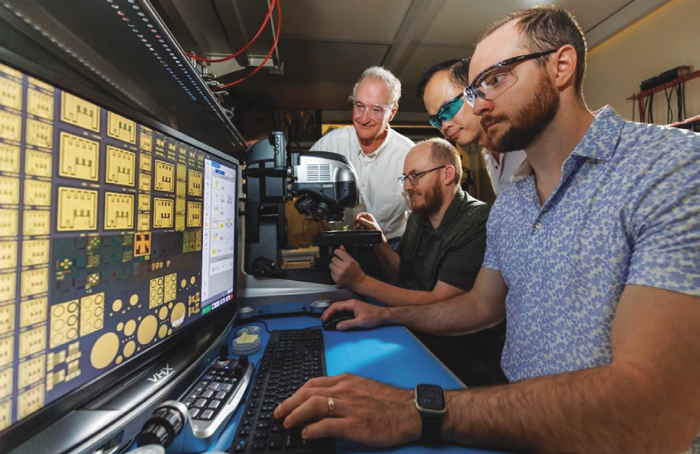
Noelle Collins sets up for an X-ray CT scan of a circuit board as part of the Non-Destructive Evaluation group at Sandia National Laboratories. (Photo by Craig Fritz)
Hafnia Gate Dielectrics for Energy Conversion
The material improves energy efficiency in power semiconductors by minimizing energy losses, which is critical amid growing demand from AI, data centers, and global electrification. Hafnia gate dielectrics can be used cost-effectively in many applications, including transportation and smart grids. Watch the video
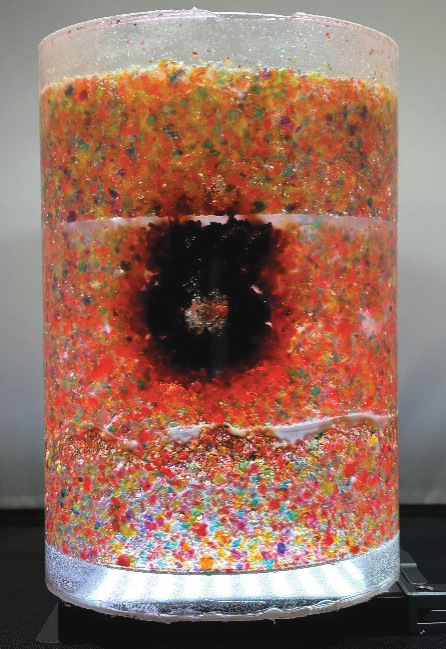
A container protected with Sandia National Laboratories’ “Bleeding Materials and Enclosures” product indicates a tamper attempt. In this image, silicone is used to encapsulate the air-sensitive beads. (Photo courtesy of Sandia National Laboratories)
Bleeding Materials and Enclosures
Sandia researchers developed tamper-indicating enclosures using affordable materials that irreversibly change color if tampered with. The materials support rapid, conclusive inspections and enhance security for applications ranging from medication packaging to national security containers. The team has received NNSA tech maturation grant funds and is refining a prototype enclosure for a potential transition pathway to industry. Watch the video
Time-resolved Diffraction for the National Ignition Facility
Sandia developed hybrid sensors that enable precise measurements of materials under extreme conditions such as high pressures and temperatures. The innovation supports high-energy-density research, including fusion ignition and Earth core studies.
Laboratory Directed Research and Development Drives Innovation
Awards recognize results, but the work behind them typically spans years. For many R&D 100 winners, early progress begins with a small, high-leverage investment that lets teams test an idea quickly, prove feasibility, and decide whether it is worth scaling.
That’s where Sandia’s Laboratory Directed Research and Development program often comes in. LDRD provides seed funding for early-stage research so teams can explore promising concepts, reduce technical risk, and build the foundation for follow-on investment through mission programs, sponsor funding, or partnerships. Six of Sandia’s seven 2025 R&D 100 awards were rooted in research supported by LDRD.
“Creativity and innovation are really the lifeblood of research and development,” said Dan Sinars, director of the Chief Research Office, which runs Sandia’s LDRD program. “We support over 500 LDRD projects each year, spanning every mission area of Sandia, and our impact assessments reveal that exploratory LDRD ideas from over a decade ago have matured into amazing technologies and capabilities today. This year’s R&D 100 awards are a great exemplar of that.”
Since 1965, Sandia has earned 169 R&D 100 awards, including this year’s winners.
“When Sandia began, scientists and engineers were charged with transforming visionary concepts into meaningful outcomes and that work is still very much alive at the Labs today,” Kothe said. “In a rapidly evolving world, our spirit of resourcefulness remains critical to the mission and to society as a whole. I’m so proud that our teams continue to push the forefront of research and technology.”
Kristen Meub is a writer for Sandia National Laboratories.