
The software engineering team at Design 1st played a key role in enabling the development of a first-of-its-kind metabolic wearable device at a fraction of the laboratory cost.
OTTAWA, ON—Product development company Design 1st is known for solving complex hardware and software challenges.
The Canada-based company employs a multidisciplinary team with deep expertise in industrial design, mechanical engineering, electronics, embedded software, and manufacturing setup. This breadth of proficiency is vital to the company’s ability to help clients—from startups to OEMs—turn ideas for sophisticated products into successful and scalable commercial items.
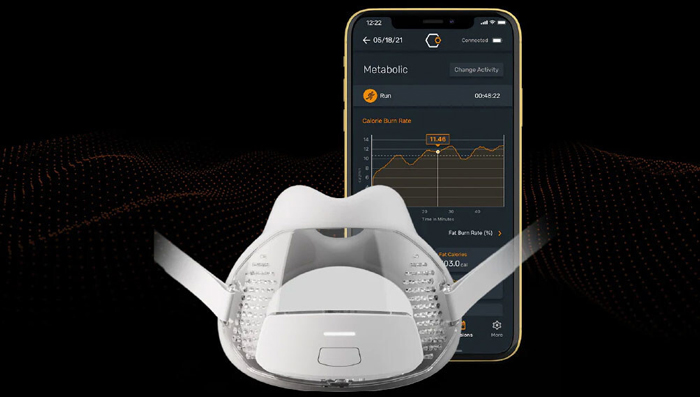
The Calibre Biometrics Wearable Breath Analysis Device. (Image: CNW Group/Design 1st)
In one example of this, the Design 1st embedded software team played an essential role in bringing an award-winning breath analysis device to market. The consumer wearable, reported to be the first of its kind, provides real-time metabolic data with lab-grade accuracy for under $500, according to a release from Design 1st.
The collaboration began when Massachusetts-based Calibre Biometrics, Inc., envisioned a high-performance breath analysis device that would be available to individuals. Previously, such devices were confined to bulky lab systems costing more than $100,000.
Calibre wanted to put this technology directly into the hands of athletes, coaches, and health-conscious consumers. Knowing that the embedded system required for such a device was not just an engineering problem, but a software problem, they turned to Design 1st.
“Design 1st’s expertise was instrumental in turning our ambitious vision into reality,” said Udi Meirav, CEO and founder of Calibre Biometrics, in the release. “Their ability to solve deep firmware and systems challenges made all the difference. Together, we delivered something that’s never been done before.”
Calibre launched the product in 2022, winning a 2022 A’Design Gold Award, an IDA Product Design Award, and a Grand Prix Design Award, according to Design 1st’s website.
Engineering real-time breath analysis at the edge
According to Design 1st, its internal software infrastructure—with custom tools built over a decade of connected device development—enabled rapid firmware deployment, early hardware integration, and fast iterations across multiple test cycles. It helped Calibre stay on track, reduce risk, and get to market with confidence.
The result, the company said, is “a triumph of design and medical-grade precision, validated in multiple design awards and peer-reviewed studies.”
“For the first time, consumers have affordable, real-time access to VO₂Max, VCO₂, fat and carb burn rates, and respiratory exchange data,” the release stated.
The in-house embedded software team at Design 1st worked alongside electrical and mechanical engineers to build a dual-core platform that fuses data from sensors reading CO₂, O₂, humidity, pressure, and temperature—50 times per second.
The firmware runs custom gas mixing algorithms, steady-state detection, and environmental compensation in real time. Battery life exceeds 14 hours, supported by adaptive power scaling and Bluetooth LE optimization.
To streamline manufacturing, the team developed automated calibration routines and Python-based testing tools.
“This project was as technically demanding as it was rewarding,” said Yih-Shyang Tsai, a senior embedded engineer and vice president, embedded software at Design 1st, in the release. “Our team architected the firmware, managed power, and aligned every subsystem to meet strict accuracy, usability, and manufacturability requirements.”
A roadmap for sensor-driven, embedded intelligence products
The success of Calibre is said to provide a blueprint for product teams building advanced wearables and connected devices. When accuracy, performance, and user trust matter, software and hardware integration can’t be an afterthought—it’s the foundation.
Real-time sensing, seamless wireless, and day-long battery life don’t come from generic firmware or fragmented development. Instead, they’re the result of deep, early collaboration between embedded software and product design, according to Design 1st.
“Design 1st helped Calibre achieve what many in the industry believed impossible—clinical-level metabolic breath analysis in a lightweight, consumer-grade wearable,” the release stated. “For startups and product teams pushing boundaries, the right embedded partner doesn’t just accelerate development—it makes innovation work.”