
The joint team will complete preliminary design of the GEK1500 engine to meet high performance and aggressive cost targets, the companies said.
SAN DIEGO, Calif.—In February, GE Aerospace and Kratos Defense & Security Solutions, Inc., announced a joint U.S. Air Force (USAF) contract for $12.4 million to design a next-generation engine for small Collaborative Combat Aircraft (CCA).
According to a joint release by the companies, the initial phase of the program will complete the preliminary design of the GEK1500 engine to meet demanding performance requirements while achieving aggressive cost targets for affordable mass.
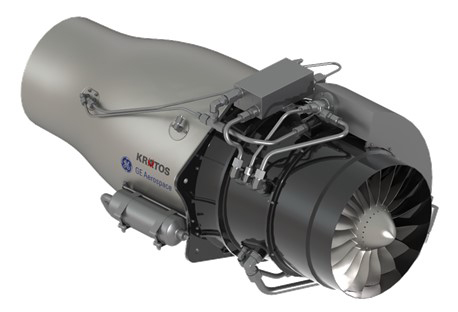
The design of the GEK1500 jet engine leverages the GEK800 cruise missile engine architecture. (Image courtesy GE Aerospace/Kratos Defense & Security Solutions)
GE Aerospace is a global aerospace propulsion, services, and systems company with approximately 53,000 employees worldwide and an installed base of approximately 49,000 commercial and 29,000 military aircraft engines. Kratos Defense & Security Solutions is a technology, products, system, and software company that addresses the defense, national security, and commercial markets.
“Building on the success of our GEK800 engine program, the development of the GEK1500 further demonstrates our team’s ability and commitment to deliver high-performance, affordable, jet engines that can be rapidly produced to meet the demands of our defense customers,” said Stacey Rock, president of Kratos Turbine Technologies Division, in the release.
The GEK1500 is a 1,500-pound thrust jet engine that could potentially power unmanned aerial systems (UAS), collaborative combat aircraft (CCAs), and missiles. The design of the GEK1500 leverages the GEK800 cruise missile engine architecture, which is successfully completing technical maturation.
“Lessons learned from recent GEK800 altitude testing are directly informing GEK1500—improving thrust, power generation, and lifecycle cost—so we can meet CCA requirements without compromising affordability or schedule,” said Steve “Doogie” Russell, vice president and general manager of Edison Works at GE Aerospace, in the release.
An additional option on the contract, if exercised, would enable the team to assess key design risks and characterize engine performance under relevant flight and installation conditions for the GEK1500 engine. The Air Force has prioritized the development of high performing and low-cost engines to enable the disruptive capabilities of small CCAs.
Recent altitude testing of the GEK800 engine is reported to have demonstrated critical technologies that will provide future systems with increased range, increased thrust, decreased life cycle cost, and increased electrical power. The investments and progress made to date on the GEK800 is expected to reduce the cost and schedule timelines for the GEK1500 and provide enhanced performance for small, collaborative combat aircraft.
In June, Kratos and GE Aerospace announced the signing of a formal teaming agreement to advance propulsion technologies for the next generation of affordable unmanned aerial systems and CCA-type aircraft, covering the GEK800 and a framework for partnering on additional engines. The result is another formal teaming agreement covering the GEK1500.
“This collaboration strengthens the companies’ ongoing partnership and builds on a 2024 Memorandum of Understanding (MOU) to advance the development and production of small, cost-effective engines for unmanned platforms,” the release stated. “The teaming agreement expanded on that MOU and provided the framework for the two companies to develop, manufacture, test, and field the GEK800 and additional GEK engines in higher thrust classes.”
According to the release, Kratos brings to the project “more than 25 years of experience in developing and producing small, affordable engines for UAS, drones, and missile platforms.” GE Aerospace is reported to add “a century of expertise in propulsion technology and the ability to scale advanced designs into high-rate production, helping bridge the gap from prototype to deployment.”