The startup’s focus is on building rapidly certifiable systems to redefine the economics of aerospace manufacturing.
TORRANCE, Calif.—Aerospace and defense component supplier Salient Motion is an aerospace technology company focused on developing modular, software-driven motion control systems that power critical actuation and power electronics across commercial and defense platforms.
The company’s stated mission is to modernize aerospace manufacturing by reducing certification barriers, increasing reliability, and enabling faster deployment of advanced technologies.
Recently, Salient Motion reported that it developed motion control systems for commercial aircraft that can achieve certification in months rather than years. The development marks “a significant departure from traditional aerospace development timelines,” the company said in a release.
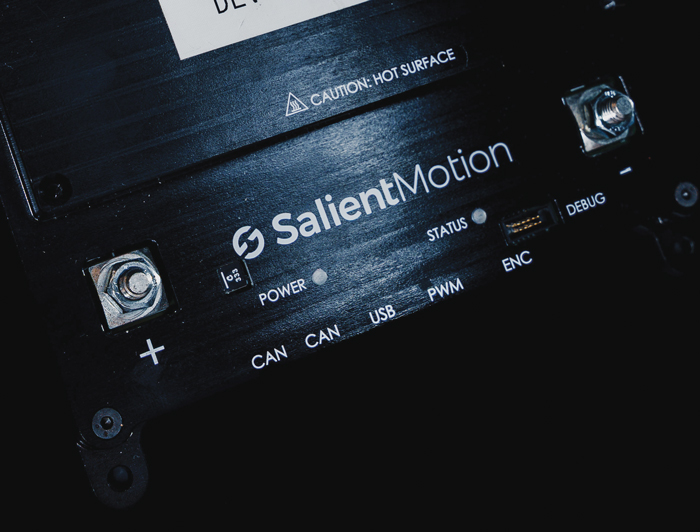
Salient Motion develops modular, software-driven motion control systems that reuse certified hardware and software to cut costs, simplify integration and speed aerospace certification. (Image: Salient Motion/Business Wire)
Salient Motion is working with Boeing to advance actuation systems—the mechanisms behind aircraft functions ranging from passenger seating to cargo handling—using a modular platform that reuses certified components across programs. The company’s technology replaces decades-old, single-use hardware architectures with a reconfigurable platform that’s built more like a modern software stack—reusable, upgradable, and fast to certify.
Founded in 2022, the company said it is moving through the certification process at a pace unusual for the aerospace industry.
“In aerospace, certification costs and timelines have always been the biggest drag on innovation,” said Vishaal Mali, Salient Motion’s co-founder and CEO, in the release. “By modularizing hardware and reusing certified software across systems, we’re compressing development timelines and cutting those costs dramatically.”
The company’s approach has attracted investment from AE Ventures, reflecting growing market interest in startups that can accelerate aerospace digital transformation. Unlike conventional supplier relationships, Salient Motion’s model treats OEMs as development partners—sharing R&D investment and aftermarket revenue while reducing non-recurring engineering costs for each new program.
“Our modular platform lets aerospace evolve the way software does,” Mali said. “Certify once, deploy everywhere. That’s the leverage modern aviation has been missing.”
New economics of innovation
According to Salient Motion, the aerospace industry has long been trapped by single-source suppliers and certification cycles that push costs to the breaking point. The company’s modular platform breaks that pattern.
By reusing previously certified hardware and software across aircraft programs, the company stated that it can develop and qualify new systems in a fraction of the time, dramatically lowering the cost of getting components to market. Standardized digital interfaces further simplify integration, reducing engineering overhead and shortening production timelines.
“The result is a new era in aerospace manufacturing—one where certification accelerates, costs decline, and innovation breaks free from the limits of legacy suppliers,” the release said.
“We are focused on components where we can drive meaningful performance and cost improvements with our motion control technology,” said Mali. “By focusing on building cost-effective, certifiable systems for our OEM and airline partners, we’re able to provide a second source more efficiently than ever before.”
Beyond actuation: the road ahead
Salient Motion’s broader mission is to replace legacy components across commercial aviation, defense, and space applications. The company’s modular, software-driven platform is designed to extend beyond actuation into a wide range of aircraft systems. According to Salient Motion, this positions the company as “a comprehensive technology partner capable of transforming multiple aspects of the aerospace industry.”