
Its new capability will enable prototyping and low-to-mid volume part production for the medical, aerospace, and data center industries, the company said.
SPARKS, Nev.—Future Form, a manufacturer of precision-engineered parts for the data center, medical, defense, nuclear and aerospace industries, recently added 3D printing services to its portfolio of manufacturing services, the company said in a release.
In providing 3D printing services, Future Form will use the HP Multi-Jet Fusion (MJF) 3D printing system. The cutting-edge scalable platform supports functional prototyping to final part production, and meets the needs of a broad range of applications and industries, according to Future Form.
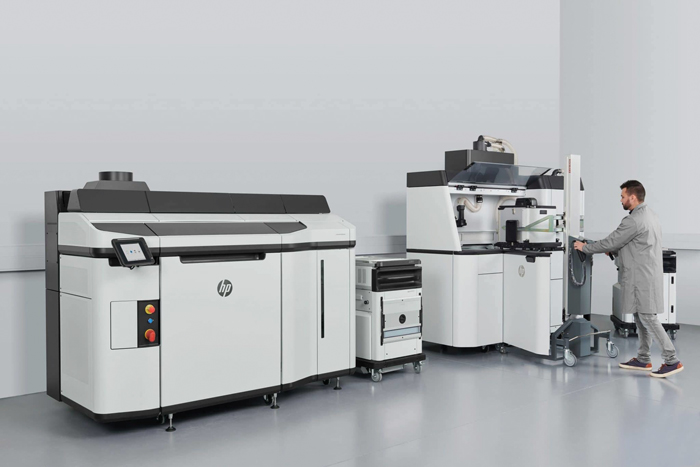
Future Form is using this HP Multi-Jet Fusion (MJF) 3D printing system, a cutting-edge scalable platform that supports functional prototyping to final part production. (Image: Future Form/PRNewswire)
“We specialize in plastic additive manufacturing, focusing on where it delivers the greatest value,” said Ben Thomas, CEO of Future Form, in the release. “Using advanced Multi-Jet Fusion technology, we produce high-quality, functional parts with excellent surface finish, fast turnaround, and cost efficiency without the tooling expense or long lead times of injection molding.”
The company’s addition of Multi-Jet Fusion technology is said to reflect Future Form’s forward-looking approach to manufacturing production. It also reflects the growth and evolution of 3D printing—also known as additive manufacturing—from prototyping resource to core industrial technology.
“For low- to mid-volume production and/or prototyping, plastic 3D printing is quickly becoming a smarter alternative to traditional manufacturing methods,” Thomas said. He noted that continuing supply chain issues have also fueled a rise in 3D printing in U.S. manufacturing.
“By adding these services, we’re ensuring we can deliver high-quality parts to our customers when they need them, without costly transportation fees or exorbitant mark-ups,” he said.
This growth of 3D printing is particularly pronounced in certain sectors, such as aerospace and defense, where more than 90 percent of major U.S. aerospace firms are reported to use 3D printing for flight-certified parts, not just models. Its use is also increasing in data center construction, where 3D printing is being adopted in areas such as modular construction, liquid-to-chip cooling components, and high-temperature alloy components for gas turbines.
“The use of 3D printing is growing rapidly in the data center sector due to the industry’s faster time-to-power needs,” said Thomas, adding that certain parts can be produced significantly faster and more cost effectively using 3D printing rather than traditional resources.
The release noted, “Not only has 3D printing for parts and equipment manufacturing grown, but the service component of that sector is rising sharply. According to the most recent industry data from the Wohlers Report 2026, 3D printing services now make up 48 percent of the entire 3D printing market.”
Some of the key reasons for 3D printing’s growing popularity are reported to include the following factors:
Supply chain resilience: 3D printing allows for “digital inventory.” Instead of waiting for a part to arrive from overseas, a U.S. manufacturer can print it on-demand.
Complex geometries: Technologies like Laser Powder Bed Fusion ( LPBF) allow manufacturers to create parts—such as internal cooling channels in engines—that are physically impossible to make with traditional mills or lathes.
Sustainability: Companies in the U.S. are increasingly using 3D printing to meet environmental mandates, as it produces significantly less scrap waste than subtractive manufacturing processes.
In addition to 3D printing, Future Form’s capabilities are reported to span engineering, CNC machining, sheet metal fabrication, tube laser cutting, automated bending, welding, powder coating, and assembly.