
The company expects to begin producing the Mac mini later this year in Houston, where it will also launch a training center to support development of advanced manufacturing skills.
CUPERTINO, Calif.—Apple® announced in February that a significant expansion of its factory operations in Houston would enable the company to bring future production of the Mac mini® to the United States for the first time. Beginning later this year, Mac mini will be produced in a new factory on Apple’s Houston manufacturing site, doubling the footprint of the campus, Apple stated in a company release.
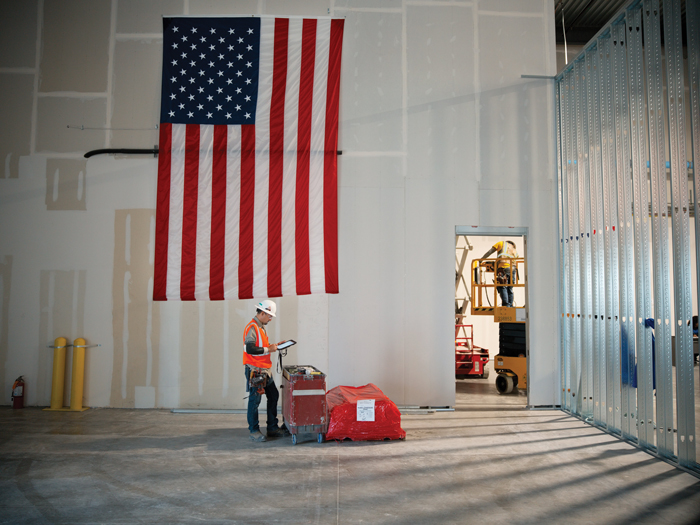
Apple’s 20,000-square-foot Advanced Manufacturing Center opens later this year, and will provide hands-on training to students, supplier employees, and U.S. businesses of all sizes. (Image courtesy Apple Inc.)
The company said it will also expand manufacturing of advanced AI servers at the factory and provide hands-on training at its new Advanced Manufacturing Center, beginning later this year. Altogether, Apple’s Houston operations are expected to create thousands of jobs, according to the release.
“Apple is deeply committed to the future of American manufacturing, and we’re proud to significantly expand our footprint in Houston with the production of Mac mini starting later this year,” said Tim Cook, Apple’s CEO, in a statement. “We began shipping advanced AI servers from Houston ahead of schedule, and we’re excited to accelerate that work even further.”
Apple began producing advanced AI servers in Houston in 2025 for the first time, and production is already ahead of schedule. Servers assembled in Houston —including logic boards produced onsite—are used in Apple data centers around the country.
Beyond production, Apple said it is “investing in the workforce that will drive American manufacturing forward.” Later this year, the company’s 20,000-square-foot Advanced Manufacturing Center is scheduled to open its doors in Houston.
Currently under construction, the dedicated facility will provide hands-on training in advanced manufacturing techniques to students, supplier employees, and American businesses of all sizes. Apple experts will teach participants the same innovative processes that are used to make Apple products, allowing American manufacturers to take their work to the next level, the company said in the release.
Since announcing its $600 billion commitment to the U.S. last year, Apple and its American Manufacturing Program partners have already reached several milestones.
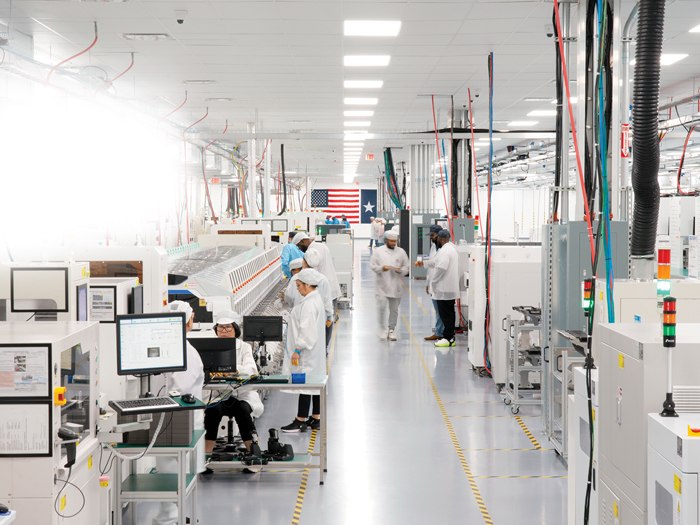
In Houston, workers assemble advanced AI servers, including logic boards produced onsite, which are then used in Apple data centers in the U.S. (Image courtesy Apple Inc.)
Apple stated it exceeded its target and sourced more than 20 billion U.S.-made chips from 24 factories across 12 states, including those of partners like TSMC, Broadcom, and Texas Instruments. In addition, GlobalWafers began production at its new $4 billion bare silicon wafer facility in Sherman, Texas. At Apple’s direction, wafers produced in Sherman will be used by Apple’s chip manufacturing partners in the U.S., including TSMC and Texas Instruments, the release stated.
Supported by Apple’s investment, Amkor broke ground on its new $7 billion semiconductor advanced packaging and test facility in Peoria, Arizona, where Apple will be the first and largest customer. Corning’s Harrodsburg, Kentucky, facility is now 100 percent dedicated to cover glass for iPhone® and Apple Watch® shipped globally. By the end of this year, every new iPhone and Apple Watch will have cover glass made in the state.
Apple also stated that in 2026, it is on track to purchase well over 100 million advanced chips produced by TSMC at its Arizona facility—a significant increase from 2025.
Yet another milestone is Apple’s opening of the Apple Manufacturing Academy in Detroit, which is reportedly already supporting more than 130 small- and medium-sized American manufacturers with hands-on training in AI, automation, and smart manufacturing. The academy recently expanded with new virtual programming, giving businesses across the country on-demand access to the curriculum developed by Apple experts and Michigan State University faculty, the company said.