
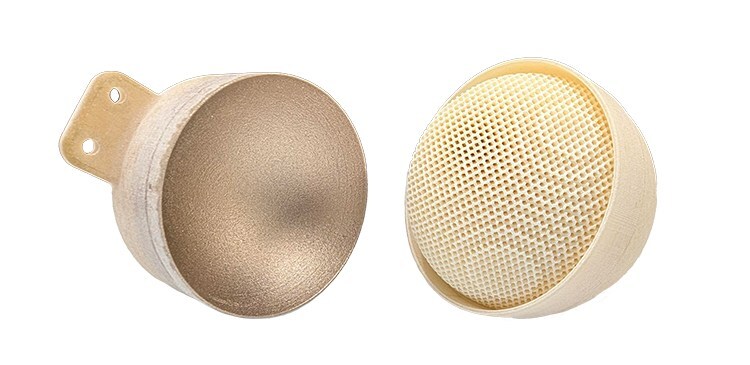
A Luneburg Retroreflector. (Image courtesy Inkbit/PRNewswire)
Additive manufacturer Inkbit’s new class of low-loss materials is designed for radio frequency and mmWave applications.
MEDFORD, Mass.—A class of low-loss dielectric materials introduced by additive manufacturing company Inkbit is reported to be particularly well-suited to mmWave applications.
Inkbit is an MIT spinout engaged in “additive manufacturing at the intersection of machine vision and material science.” It unveiled its Cyclic Olefin Thermosets (COT), a new class of materials available through its exclusive platform, in June.
“When coupled with our platform, which scales seamlessly from prototyping to production, this class of materials will enable rapid innovation,” said Inkbit CEO Davide Marini, in a company release, “opening paths for faster, cost-effective iteration, and end-use production across the radio frequency and microwave market space.”
The launch marks Inkbit’s official entry into the antenna systems and wave-guiding component space, offering a powerful alternative to traditional manufacturing of Gradient Index (GRIN) lenses, waveguides, and beam-steering structures, the company said in the release.
In traditional workflows, GRIN lenses and dielectric components require multi-step manufacturing, precision machining, or complex assembly of stacked layers. Each step introduces variability and imperfections that reduce electromagnetic performance.
“With Inkbit, these same components can be printed as monolithic parts, eliminating manual assembly while achieving tight control over dielectric gradients and geometries,” the release stated.
According to Inkbit, the Cyclic Olefin Thermosets deliver a long-missing combination of low dielectric loss, thermal stability, and mechanical strength in additive manufacturing. These qualities were previously only possible through high cost, high labor processes. Now, engineers can iterate freely, without compromising material performance or waiting for custom tooling, the company said.
“Limitations around existing material options and manufacturing processes has meant complex dielectric structures have mostly been an academic curiosity for antenna engineers,” said Inkbit Materials R&D Lead Scott Twiddy, in the release. “We look to change that at Inkbit, with this new class of low-loss polymer that can be processed in high-resolution at a production scale. Engineers can iterate quickly without compromising on performance, utilizing the same materials and process for both development and production.”
Key benefits for RF designers, according to Inkbit, include low dielectric loss at mmWave frequencies; dimensional stability across high temperatures; high print resolution and multi-material compatibility; and tool-free fabrication of complex 3D dielectric geometries. In addition, GRIN lensing is validated up to 90 GHz, and GRIN lattices are auto-generated via Inkbit Construct.
“Iteration is the mother of invention,” Marini said. “With this new class of materials and our production platform, mmWave engineers can now design, test, and deploy advanced dielectric components at a much higher iteration rate than was ever possible.”
Together with Inkbit’s Vision-Controlled Jetting (VCJ) platform, COT is said to enable digitally-driven, scalable manufacturing of next-generation RF and microwave components, “ideal for telecom, aerospace, and defense applications,” the company said in the release.