
As the automaker began production at its new facility in Liberty, it committed an additional U.S. investment of up to $10 billion over the next five years to support future mobility efforts.
LIBERTY, N.C.—In November, Toyota announced it started production at its new battery plant in Liberty, North Carolina—its eleventh U.S. plant and the company’s first and only battery plant outside of Japan.
The $13.9 billion facility, part of what Toyota described as its “multi-pathway approach to global vehicle electrification,” is expected to create up to 5,100 new American jobs. The company also announced an additional investment of up to $10 billion over the next five years to support future mobility efforts. This will increase Toyota’s total U.S. investment to nearly $60 billion since beginning operations here nearly 70 years ago, the company said in a release.
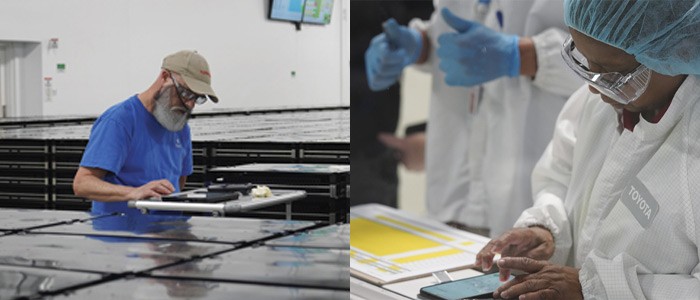
Manufacturing workers (left and right) at Toyota’s new battery manufacturing facility in Liberty, N.C., the company’s first battery plant in the United States. The state-of-the-art plant will house 14 battery production lines supporting hybrid electric vehicles (HEVs), battery electric vehicles (BEVs), and plug-in hybrid electric vehicles (PHEVs). (Photos courtesy Toyota Motor North America)
“Today’s launch of Toyota’s first U.S. battery plant and additional U.S. investment up to $10 billion marks a pivotal moment in our company’s history,” said Ted Ogawa, president and chief executive officer, Toyota Motor North America (TMNA), in a statement. “Toyota is a pioneer in electrified vehicles, and the company’s significant manufacturing investment in the U.S. and North Carolina further solidifies our commitment to team members, customers, dealers, communities, and suppliers.”
United States Secretary of Transportation Sean Duffy expressed support for manufacturing investments in the U.S., noting that Toyota North Carolina’s investment of nearly $14 billion and the creation of more than 5,000 new jobs marks a turning point for the Piedmont Triad region.
“Toyota’s move to expand production in North Carolina is the latest show of confidence in this administration’s efforts to reshore manufacturing, generate new, great paying jobs, and inject billions of dollars into the economy,” he said in the release.
The 1,850-acre mega site can reportedly produce 30 GWh annually at full capacity. It will serve as Toyota’s hub for developing and producing lithium-ion batteries needed for its ever-growing portfolio of electrified vehicles. The state-of-the-art plant will house 14 battery production lines supporting hybrid electric vehicles (HEVs), battery electric vehicles (BEVs), and plug-in hybrid electric vehicles (PHEVs), making it a historic investment for Toyota with a substantial economic impact on the state.
“Today marks a historic milestone as Toyota begins battery production right here in North Carolina,” said Governor Josh Stein, in a statement. “This groundbreaking investment will create more than 5,000 new jobs for North Carolinians and will strengthen our commitment to leading the way in both the automotive supply chain and the clean energy economy.”
Batteries assembled at Toyota North Carolina are set to power the Camry HEV, Corolla Cross HEV, RAV4 HEV, and a yet-to-be-announced all-electric 3-row BEV—the first of its kind for Toyota to be built in the United States. Currently, the plant ships HEV modules to Toyota Kentucky and to Mazda Toyota Manufacturing in Alabama. Additional production lines at Toyota North Carolina are set to launch by 2030, according to the release.
Once construction is complete, the new facility will be more than a place of work. It will also be a vibrant community, featuring a range of amenities for team members, including on-site childcare, a pharmacy, a medical clinic, and a fitness center.
“We’re excited to see this innovative facility come to life and to provide cutting-edge careers for more than 5,000 North Carolinians,” said Don Stewart, president of Toyota North Carolina, in the release. “Today’s celebration would not be complete without thanking our team members. Their dedication, commitment, and resolve have truly led us to this historic moment. We also are grateful for the support shown to us by the State of North Carolina, Randolph County, and the greater Triad region, a place we are all proud to call home.”
The company stated that it “remains steadfast in its commitment to being the best in town by supporting workforce development and educational initiatives.”
“Through partnerships with schools and educators across the region, Toyota is developing the Triad’s future workforce with its time, talent and treasure,” the company said in the release.
During the ceremony, Toyota announced the second phase of Driving Possibilities in Guilford County Schools and the Asheboro City School District, with a Toyota USA Foundation grant of an additional $2.7 million. Driving Possibilities is a national STEM education initiative that brings together community, education leaders, local and national nonprofits, and industry partners to co-create programs that strengthen communities and prepare young people for future STEM careers.
“This incredible gift will provide our students and their families with life-changing opportunities,” said Wendy Poteat, president and CEO of shift_ed, a non-profit regional leader connecting education to workforce development, and coordinating partner for the NC Driving Possibilities program. “Toyota has become a generous supporter and dedicated stakeholder in enriching our school districts by inspiring innovation and nurturing curiosity and creativity in our learners from classroom to career. Programs like these are essential in closing opportunity and exposure gaps, empowering students to reach their full potential.”
Driving Possibilities is funded by the Toyota USA Foundation, with additional support provided by Toyota Motor North America (TMNA) and Toyota Financial Services (TFS).
Toyota stated it has sold more than 6.6 million hybrid, plug-in hybrid, fuel cell, and battery electric vehicles in the U.S. since 2000. The company currently assembles 11 HEVs and PHEVs in the U.S. as part of Toyota’s commitment to reducing carbon emissions and its philosophy of building where it sells, according to the release.