
The company highlighted numerous developments at CES 2026, including the launch of its Digital Twin Composer software and an expanded partnership with NVIDIA to build an Industrial AI Operating System.
LAS VEGAS— Siemens AG is a prominent technology company focused on industry, infrastructure, mobility, and healthcare. At CES 2026, the company’s keynote address marked a new era of technology for industry and infrastructure, showcasing how customers and partners are harnessing artificial intelligence to transform their businesses, the company said in a release.
With AI-enabled technologies, deep domain expertise, and trusted partnerships, Siemens is working to converting this technological leap into measurable benefits for customers, partners, and society.
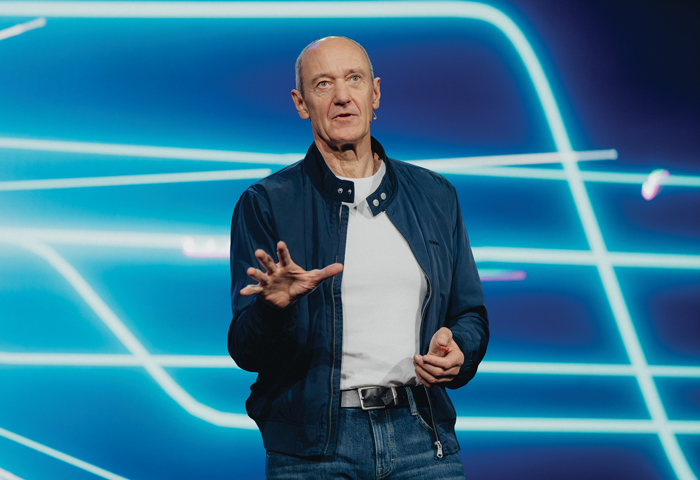
Roland Busch, chief executive officer and president of Siemens AG, delivering the keynote address at CES. (Photo: Business Wire)
“Just as electricity once revolutionized the world, industry is shifting toward elements where AI powers products, factories, buildings, grids and transportation. Industrial AI is no longer a feature; it’s a force that will reshape the next century,” said Roland Busch, president and CEO of Siemens AG, in the release. “Siemens is delivering AI-native capabilities, intelligence embedded end-to-end across design, engineering, and operations, to help our customers anticipate issues, accelerate innovation, and reduce cost.
“From the most comprehensive digital twin and AI-powered hardware to copilots on the shop floor, we’re scaling intelligence across the physical world, so businesses realize speed, quality, and efficiency all at once. This is how we scale a once-in-a-generation technology shift into measurable outcomes.”
Among other highlights, Siemens touted its long-standing partnership with NVIDIA at CES 2026: The companies are expanding their partnership to build the Industrial AI Operating System, helping customers transform how they design, engineer, and operate physical systems.
Siemens and NVIDIA will work together to build AI-accelerated industrial systems across the full lifecycle of products and production, enabling faster innovation, continuous optimization, and more resilient, sustainable manufacturing. The companies also aim to build the world’s first fully AI-driven, adaptive manufacturing sites globally, starting in 2026 with the Siemens Electronics Factory in Erlangen, Germany, as the first blueprint.
To support development, NVIDIA will provide AI infrastructure, simulation libraries, models, frameworks, and blueprints, and Siemens stated it will commit “hundreds of industrial AI experts and leading hardware and software.” To make this vision a reality, the companies have identified impact areas that include AI-native EDA, AI-native Simulation, AI-driven adaptive manufacturing and supply chain, and AI-factories.
Siemens also announced that it will be integrating NVIDIA NIM and NVIDIA Nemotron open AI models into its electronic design automation (EDA) software offerings to advance generative and agentic workflows for semiconductor and PCB design. This is expected to maximize accuracy through domain specialization and significantly lower operational costs by enabling the most efficient model to handle and adapt to every specific need.
“Generative AI and accelerated computing have ignited a new industrial revolution, transforming digital twins from passive simulations into the active intelligence of the physical world,” said Jensen Huang, founder and CEO of NVIDIA, in the release. “Our partnership with Siemens fuses the world’s leading industrial software with NVIDIA’s full-stack AI platform to close the gap between ideas and reality—empowering industries to simulate complex systems in software, then seamlessly automate and operate them in the physical world.”
New technology connects digital twin with real-time, real-world data
Siemens’ primary product launch at CES 2026 is the Digital Twin Composer, expected to be available on the Siemens Xcelerator Marketplace in mid-2026. This new technology brings together Siemens’ comprehensive digital twin, simulations built using NVIDIA Omniverse libraries, and real-time, real-world engineering data, the company said in the release.
With the Digital Twin Composer, companies can create a virtual 3D model of any product, process, or plant; put it in a 3D scene of their choosing; then move back and forth through time, precisely visualizing the effects of everything from weather changes to engineering changes. With Siemens’ software as the data backbone, the Digital Twin Composer builds Industrial Metaverse environments at scale, empowering organizations to apply industrial AI, simulation, and real-time physical data to make decisions virtually, at speed and scale.
Digital Twin Composer is part of Siemens Xcelerator, a portfolio of software used by companies worldwide to develop digital twins.
In addition, PepsiCo and Siemens are digitally transforming select U.S. manufacturing and warehouse facilities by converting them into high-fidelity 3D digital twins that simulate plant operations and the end-to-end supply chain to establish a performance baseline. Within weeks, teams optimized and validated new configurations to boost capacity and throughput, giving PepsiCo a unified, real-time view of operations with flexibility to integrate AI-driven capabilities over time.
By leveraging Siemens’ Digital Twin Composer, NVIDIA Omniverse libraries, and computer vision, PepsiCo can now recreate every machine, conveyor, pallet route, and operator path with physics-level accuracy. This enables AI agents to simulate, test, and refine system changes, identifying up to 90 percent of potential issues before any physical modifications occur, according to the release. The approach is said to have already delivered a 20 percent increase in throughput on initial deployment and is driving faster design cycles, nearly 100 percent design validation, and 10 to 15 percent reductions in capital expenditure (Capex) by uncovering hidden capacity and validating investments in a virtual environment.
New industrial copilots streamline manufacturing operations
Siemens also spotlighted its partnership with Microsoft, in a conversation with Jay Parikh, executive vice president for CoreAI. Together, Siemens and Microsoft are bridging the worlds of IT and operations, with a collaboration centered on using AI to help organizations across industries improve productivity, resilience, and innovation. Among the highlights: co-building the award-winning industrial copilot.
Siemens also announced that it is expanding its set of AI-powered copilots across the industrial value chain. This will embed intelligence that extends from design and simulation to product lifecycle management, manufacturing, and operations, the company said.
According to the release, Siemens will deploy nine new AI-powered copilots for its software offerings, including Teamcenter, Polarion, and Opcenter. The copilots, respectively, are reported to streamline product data navigation, reducing errors and accelerating time to market; automate compliance, helping to ensure faster regulatory approvals and lower risk; and transform manufacturing processes, driving cost savings and operational efficiency.
These copilots, along with the rest of Siemens’ expanding portfolio of industrial AI solutions, are available to companies of every size on the Siemens Xcelerator Marketplace.
AI-driven innovations in life sciences, energy, and manufacturing
In life sciences, Siemens’ acquisition of Dotmatics has enabled the integration of vast research data, fueling drug discovery and development. With Dotmatics’s Luma platform, scientists can unify billions of data points generated across instruments and labs, creating a coherent foundation for AI-driven exploration. Combined with Siemens Simcenter simulation and digital twins, teams can rapidly test molecules, identify promising candidates, and virtually scale production to help life-changing therapies reach patients up to 50 percent faster and at a lower cost, the release stated.
In energy, Bob Mumgaard, CEO and co-founder of Commonwealth Fusion Systems, described how the company uses Siemens’ technologies along the path to commercial fusion. Commonwealth Fusion Systems uses design software and a strong data backbone to help it accelerate the development of fusion machines that are said to promise clean, limitless energy for generations to come.
In manufacturing, Siemens announced a collaboration to bring Industrial AI to Meta Ray-Ban AI Glasses. “With hands-free, real-time audio guidance, safety insights, and feedback, shop floor workers will feel empowered to solve problems efficiently and confidently,” the company stated.