The company combines reliable, advanced manufacturing technology with proactive customer communication to simplify their experience on complex projects.
By Mark Shortt
Precision sheet metal fabricator Continental Industries supports a variety of industries with services that include fiber and CO2 laser cutting, turret punching, and press brakes equipped with 8-axis back gauges to support complex geometries and tight tolerances. The Anaheim, California-based company also provides certified MIG, TIG, spot, and laser welding to round out its integrated fabrication offerings.
Its diverse customer base gives Continental Industries the opportunity to apply its precision fabrication expertise across multiple industries that demand high quality, reliability, and scalability, according to Director of Sales Mike Moss.
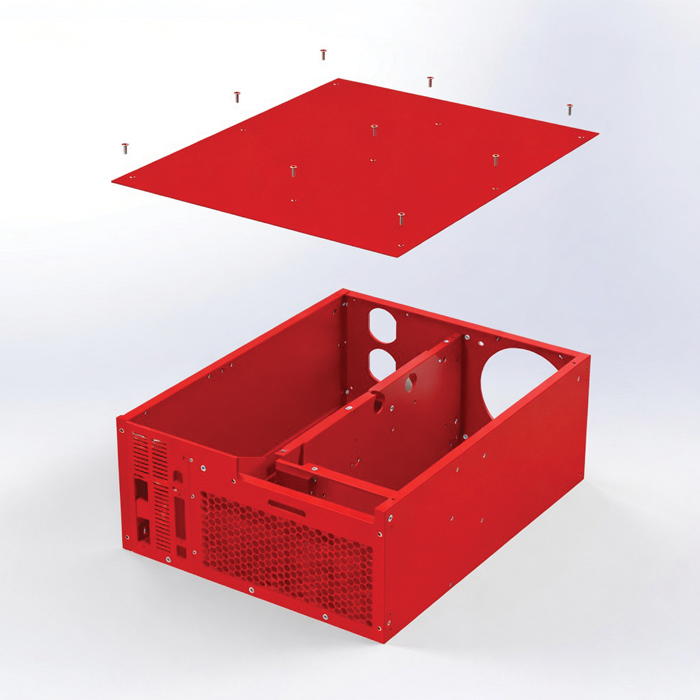
A 6U rackmount enclosure for a spectrometer. (Image courtesy Continental Industries)
One of the company’s key markets today is AI and data center infrastructure, a rapidly growing sector that Continental supports with precision components and assemblies for products such as data storage racks and power distribution units used in high-performance computing environments. (For more on Continental Industries’ role in supporting the data center industry, see How Contract Manufacturers Are Helping Data Centers Meet an Exponential Rise in Demand.)
“It’s just growing exponentially,” Moss said in a recent interview with Design-2-Part. “Lead times are short, demand is high, and it’s really a growth area for us.”
Moss has been with Continental Industries since 2013, a period of time in which he’s seen remarkable changes.
“We went from a smaller company, a smaller building, with much fewer employees, to where we are now,” he said. “We’re at 40,000 square feet with about 50 or 60 full-time employees, and we’ve outgrown this space already.”
Since Moss started with the company, Continental Industries has evolved from having a floor full of mechanical punch presses and basic manufacturing equipment, to now having fully automated cycle loaders, high-tech fiber lasers, servo-electronic press brakes, and offline programming. The digital revolution has brought changes, too.
“We’ve moved up into a very high-tech shop, which has helped with our efficiency,” he said. “Also, with the way we’re attracting business now: A lot of it is done digitally. Customers are finding us using AI, and in response, we have an inbound and outbound sales strategy that’s very effective, so it’s helping us grow business.”
Mike Moss took time out with Design-2-Part recently to discuss Continental Industries’ evolving manufacturing capabilities and its role in supporting several dynamic markets. Here’s what he had to say:
Design-2-Part: As a precision sheet metal fabricator, what industry sectors does Continental Industries serve?
Mike Moss: Continental Industries serves a diverse range of technology driven and industrial markets. Our key sectors include AI and data center infrastructure, where we fabricate precision components and assemblies used in high-performance computing environments, such as data storage racks, aisle containment, PDUs (power distribution units) et cetera. We are also heavily involved in the industrial machinery sector, producing control panels and a variety of fabricated components for equipment manufacturers.
In addition, we support aerospace and defense customers—including programs associated with federal agencies such as the Department of Homeland Security—and correctional institutions. Other markets we serve include lighting, electronics, and test and measurement equipment.
This diverse customer base allows us to apply our precision fabrication expertise across multiple industries that demand high quality, reliability, and scalability.
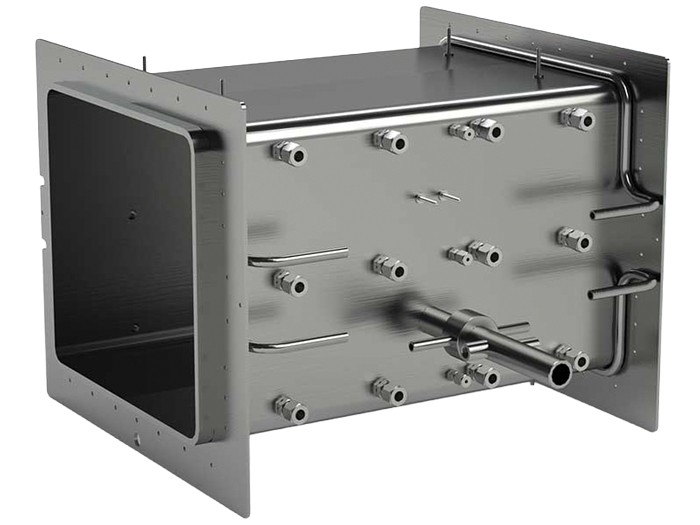
A stainless steel vacuum chamber, part of a vacuum bakeout oven system. (Image courtesy Continental Industries)
D2P: What design, engineering, or manufacturing services does Continental provide in support of these industries?
MM: Continental Industries supports these industries through advanced precision sheet metal fabrication and value-added manufacturing services that emphasize quality, efficiency, and scalability.
Our capabilities include fiber and CO₂ laser cutting, supported by automated multi-shelf tower systems, turret punching, and automated sheet loading and unloading to maximize throughput and consistency.
We maintain strict quality control through laser inspection technology and comprehensive SPC reporting, ensuring repeatability and traceability throughout production. Our forming capabilities include six press brakes equipped with eight-axis back gauges to support complex geometries and tight tolerances.
Continental also provides certified MIG, TIG, spot, and laser welding to deliver fully integrated fabrication solutions.
In addition, we work closely with customers early in the design process to optimize parts for manufacturability, cost efficiency, and production scalability. This collaborative approach allows us to deliver high-quality components while helping customers streamline production and bring products to market more efficiently.”
D2P: What types of parts does the company produce for OEMs and product manufacturers in these sectors?
MM: We manufacture precision sheet metal component parts and complete mechanical assemblies for OEMs and product manufacturers serving [as mentioned earlier] the defense, homeland security, aerospace, commercial electronics, and medical sectors.
Our customers include manufacturers of electronic chassis, rack-mount and Hoffman-style enclosures, box builds, medical device housings, RF system enclosures, electronic test and measurement equipment housings, AI and data storage racks, as well as components used in flight simulation and ground support equipment.
These products are designed to house and protect complex electronic systems used in applications such as aerospace platforms, medical instrumentation, data center infrastructure, and security systems.
Parts are produced using a range of advanced manufacturing processes in precision sheet metal fabrication, laser cutting, forming, welding, hardware insertion, finishing, and full mechanical assembly. This allows us to deliver both individual component parts and mechanical assemblies ready for use in the customer’s final product.
D2P: As a supplier-partner to OEMs and product manufacturers, what is Continental Industries’ greatest strength? Why do customers choose your parts or services?
MM: Our company’s strengths are reflected in our tagline: “Precision, Quality, and Service… Fabrication Simplified.”
Precision and quality are built into our manufacturing processes through modern equipment, automation, experienced personnel, and disciplined quality control. Customers rely on us to consistently deliver accurately manufactured parts that meet demanding specifications across industries such as aerospace, defense, and medical.
Equally important is our commitment to service. We place a strong emphasis on responsiveness and communication throughout the customer relationship. RFQs are acknowledged quickly, order confirmations and delivery commitments are clearly communicated, and our team responds promptly to inquiries, design questions, and open order updates.
This combination of reliable manufacturing, on-time delivery, and proactive communication gives customers confidence that their projects are being managed professionally and efficiently. In many ways, that is what we mean by “Fabrication Simplified.” We make the process easy and dependable for our customers.
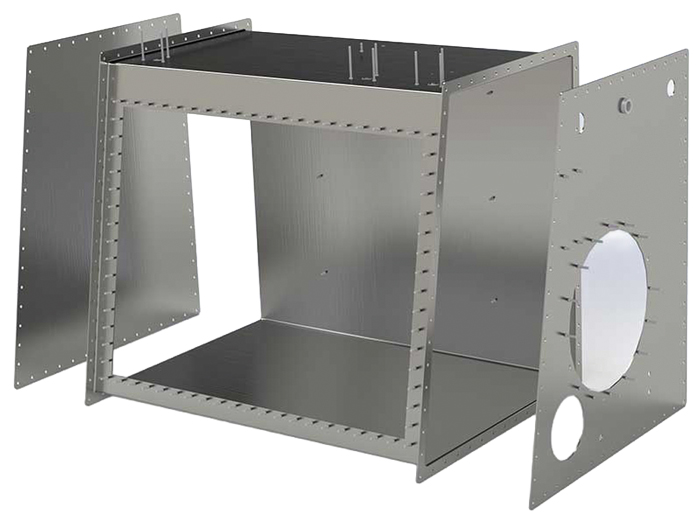
An isolator glove box, atmospheric enclosure, or inert gas enclosure. (Image courtesy Continental Industries)
D2P: In what ways do Continental’s personnel apply advanced skills or expertise in manufacturing parts or providing manufacturing services for your customers?
MM: Our personnel combine design expertise with advanced manufacturing technology to improve efficiency and ensure consistent quality for our customers.
Much of this begins in the pre-production planning stage, where our design team utilizes advanced CAD/CAM software and SolidWorks 3D modeling to analyze customer designs and develop efficient workflows. The software’s unfolding and analysis capabilities allow our team to identify and resolve potential manufacturability issues during the design stage, saving both time and cost before production begins.
Once designs are finalized, our programming team develops machine programs, determines bend sequences, and selects the appropriate tooling to ensure efficient production on the shop floor. This preparation streamlines the process for machine operators and helps maximize the performance of our automated fabrication equipment, including our fully automated laser cutting system, turret punch presses with automated sheet loading and unloading systems.
Our team also leverages advanced inspection technology to maintain quality and provide detailed verification to our customers.
A laser-based inspection system allows us to perform reverse engineering of 2D flat parts, conduct first-article and in-process inspections, and generate SPC reports that can be shared directly with customers. This automation significantly reduces inspection time while increasing measurement accuracy by minimizing human error.
By combining skilled personnel, advanced software tools, automated manufacturing equipment, and modern inspection systems, we can deliver complex parts efficiently while maintaining the high standards our customers expect.
D2P: Depending on the process used, what are some examples of tolerances or other quantifiable results that Continental Industries can achieve with its manufacturing processes?
MM: The tolerances we achieve depend on the manufacturing process and the specific design requirements of the part.
For example, our laser cutting processes routinely achieve tolerances of ±.002 inches, while our turret punching operations maintain hole-to-hole positional tolerances within ±.005 inches. Formed features are typically held within ±.005 inches, depending on material type, thickness, and geometry.
D2P: What additional capabilities or services do you offer that would be of interest to a design engineer, manufacturing engineer, or purchaser?
MM: In addition to manufacturing production components, we provide a range of value-added services that support our customers throughout the product lifecycle.
Our engineering team works closely with design and manufacturing engineers to assist with design for manufacturability (DFM), helping identify opportunities to simplify fabrication, reduce costs, and improve production efficiency before a design reaches the shop floor.
We also support new product development through prototyping and early-stage production, allowing customers to validate designs and move more quickly into full-scale manufacturing.
From a supply chain standpoint, we offer programs such as Just-In-Time (JIT) manufacturing and Vendor Managed Inventory (VMI), which help customers reduce inventory costs while ensuring that critical components are available when needed. These capabilities allow us to function not just as a parts supplier, but as a manufacturing partner that helps streamline both product development and ongoing production.
D2P: Can you tell us about any awards or certifications that Continental has recently earned?
MM: Continental Industries is ITAR registered and maintains manufacturing processes that are ISO compliant, supporting the stringent documentation, traceability, and quality requirements of customers in the aerospace, defense, and medical sectors. These standards are reflected in our internal quality systems, inspection procedures, and continuous improvement initiatives that ensure consistent product quality and regulatory compliance for our customers.
D2P: Have there been any recent expansions to your facility or additions to your production capacity?
MM: We have recently expanded both our production capacity and operational efficiency through several equipment investments and facility improvements.
A key addition is an ENSIS 3015 6kW fiber laser cutting system with full automation, including an AMS cycle loader and multi-shelf tower. This fully automated system allows for high-speed cutting across a wide range of material thicknesses and supports unattended “lights-out” production for both short and long production runs.
We have also added an EMK 3016NT servo-driven turret punch press with a 5-foot x 10-foot sheet capacity and automated loading and unloading capabilities, further increasing our ability to run jobs efficiently while maintaining tight tolerances.
In addition, we recently introduced laser welding capabilities, expanding our ability to produce high-quality welded assemblies with improved precision and reduced heat distortion compared to traditional welding methods.
To support our continued growth, we have also expanded our facility with an additional 16,000 square feet of warehouse space, improving material handling, inventory management, and overall production flow.
D2P: How many people does Continental Industries employ, and approximately how many square feet of workspace do you have?
MM: Our company employs approximately 50 full-time personnel supporting engineering, production, quality, and administrative functions.
Our facility includes approximately 25,000 square feet of manufacturing space, supported by an additional 16,000 square feet of warehouse and material storage area.
This space accommodates our fabrication equipment, assembly operations, and quality inspection areas, while the dedicated warehouse capacity supports efficient material handling and inventory management for both production and customer supply chain programs.
D2P: Can you describe—without disclosing any confidential or protected information—an application that illustrates Continental’s ability to solve a technical challenge?
MM: Rather than a single application, our experience reflects a consistent pattern across a wide range of customer engagements.
As Continental Industries continues to grow and invest in advanced equipment, automation, and evolving technologies, our customers increasingly rely on us for projects that push technical and manufacturing boundaries.
These applications often involve highly complex geometries, precision-formed components, and intricate welded assemblies that demand both innovation and execution at a high level.
D2P: What were the application’s performance requirements?
MM: The requirements we encounter typically involve tight tolerances, repeatability at scale, and structural integrity under demanding conditions. Customers expect not only dimensional accuracy, but also consistency across production runs, adherence to strict quality standards, and the ability to meet aggressive timelines. In many cases, components must integrate seamlessly into larger systems, making precision and reliability critical.
D2P: What was the major technical or engineering challenge?
MM: The primary challenges often stem from complex bending geometries, advanced forming requirements, and weld specifications that initially appear difficult to achieve within standard process limits.
These challenges are compounded by material variability, design constraints, and the need to maintain efficiency while meeting exacting quality standards. Successfully addressing these issues requires both technical expertise and the ability to adapt processes beyond conventional approaches.
D2P: How did Continental apply its services to meet the application requirements?
MM: Continental Industries addresses these challenges through a combination of experienced personnel, advanced software, and state-of-the-art machinery.
Our team leverages deep industry knowledge alongside modern automation and precision equipment to develop practical, repeatable solutions. By integrating engineering insight with disciplined quality standards and continuous process improvement, we are able to consistently meet and often exceed the technical demands presented by our customers.
D2P: You mentioned that successfully addressing some of the technical challenges that you encounter requires not just technical expertise, but the ability to adapt processes beyond conventional approaches. What’s an example of how Continental might adapt a process beyond conventional approaches to solve a technical challenge?
MM: As the company has grown over the years, so has the type of client we attract. We had a lot of commercial work that we’ve done in the past, and we still do. It’s a good part of our base, but we’re growing into more tech companies, we’re growing into more medical companies. We’re doing more with aerospace and defense, and there’s higher demands on these things, like different materials and different weld call-outs.
We went from just having a standard shop with MIG, TIG, and spot welding. We’ve incorporated a laser welding system, and we have contracted with a weld company. So, to certify our welders, we get quotes that come in that we say, “We can do this,” but they say, “This must be done to a certified spec.”
We have to have our welders certified in that spec. We have to provide samples. They have to be inspected process by process. It’s no longer something we can just clamp on a weld table and put a weld bead on and send it out. They have to inspect every portion of the weld process on an assembly and get approval before we do that.
So instead of just welding a part up, it requires time, it requires inspection from outside people, and it requires that our welders are certified in this material type and this particular type of weld that they’re calling out. So, we now have a stable of welders that are more qualified than they were, let’s say, a year ago, in order to do these things. And we’re constantly getting challenged with other components from the same companies that say, “This is now a certified weld job.” And we’re having to repeat that process.
So, we have a mechanical engineer overseeing our quality side, who teams up with our project managers and the outside people with all of these processes.
D2P: Are there any other opportunities that you see for additional work from other sectors?
MM: We have to maintain a balance. We can’t be too heavily saturated in one area, for the obvious concerns that if the workflow goes away or [if] the market in that sector takes a crash, then the company would be devastated financially.
So, we maintain a good balance. We’re still in medical; we’re still in defense, we’re still in automotive, we’re still in commercial electronics, and we maintain a balance. None of those are experiencing the exponential growth that we see on the data side. But we do maintain a balance and we put limits on the amount of work that we can bring in, just so that the company stays financially healthy.