
Many of the delays that affect RF systems begin early, when manufacturing constraints aren’t considered during design.
The following article was contributed by the engineering team at Coaxial Components Corp., with insights from Managing Director John Haas.
In many radio frequency (RF) system development projects, manufacturing is treated as the final step.
Design teams focus on performance, system architecture, and component selection. Prototypes are developed, tested, and refined. Only after the design is validated does the project move toward production.
But in practice, many of the delays that affect RF systems don’t begin in production—they begin much earlier, when manufacturing constraints aren’t considered during design.
At Coaxicom (Coaxial Components Corp.), this is a pattern we see regularly when working with engineering and procurement teams across aerospace, defense, and advanced technology programs.
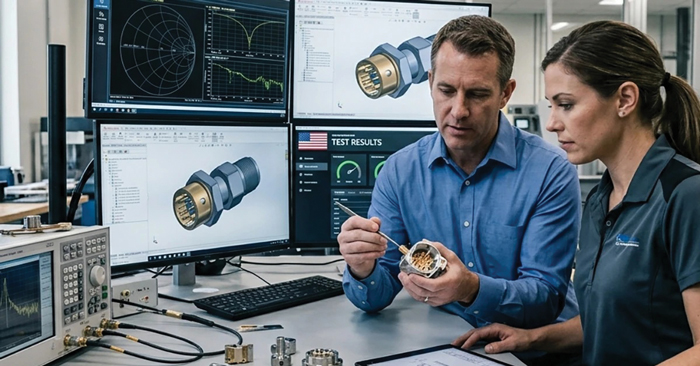
Engineering team members perform RF component testing and engineering analysis at Coaxial Components Corp. (Photo courtesy Coaxicom)
Where RF Projects Actually Slow Down
When delays occur, they are often attributed to supply chain issues or component availability. But in many cases, the root cause goes deeper.
The challenge is not just sourcing a connector or cable assembly. It is whether the selected component can be manufactured, assembled, or delivered within the required timeline.
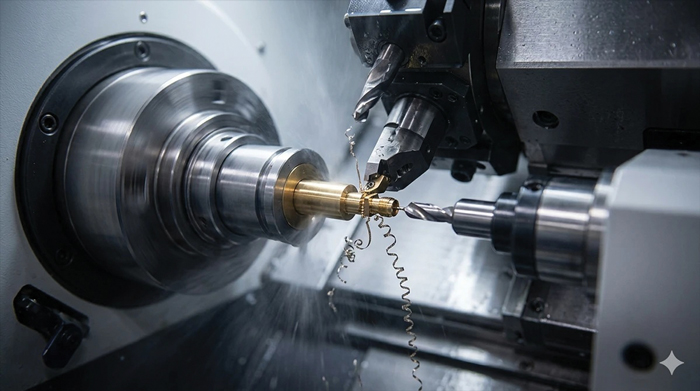
Coaxicom maintains both precision machining and RF assembly capabilities in-house, enabling teams to move quickly from feasibility discussions into actionable production paths without the delays often associated with external coordination. (Photos courtesy Coaxicom)
Design decisions made early in the process can introduce constraints that are only discovered later—when production timelines, material availability, or machining complexity come into play.
At that stage, options become limited, and delays become difficult to avoid. In many cases, these challenges only become visible once a manufacturing partner is engaged. At Coaxicom, teams frequently come to us at this stage looking for ways to adapt designs to real-world production constraints without compromising performance.
The Prototype-to-Production Gap
A design that works in a prototype environment does not always translate directly into production.
“One of the most common challenges we see is that a design works perfectly in a prototype environment, but hasn’t been evaluated against real-world manufacturing constraints,” said John Haas, managing director at Coaxial Components Corp., a designer and manufacturer of RF and microwave components and cable assemblies in Stuart, Florida. “By the time the project moves toward production, teams are dealing with lead times, material availability, or component geometries that weren’t part of the original design conversation. That’s where delays start to compound.”
During prototyping, teams may rely on available components, modify existing parts, or work around constraints in ways that are not scalable. These solutions can validate performance, but they do not always account for repeatable manufacturing. When the project transitions to production, new challenges often emerge:
- Extended lead times for specific RF components
- Limitations in machining complex geometries
- Material constraints affecting performance or availability
- Assembly requirements that were not considered during design
- These issues can trigger redesign cycles, adding time and complexity to projects that were already moving on tight schedules.
Why Catalog-Based Thinking Breaks Down
Much of the RF connector industry is built around standardized product catalogs. For many applications, this works well. But as systems become more advanced—particularly in aerospace, defense, and emerging technologies—design requirements often extend beyond standard configurations.
Engineers may initially design around available catalog components, assuming those parts can be sourced when needed. However, long lead times, limited availability, or performance constraints can quickly disrupt that assumption. In these cases, relying solely on catalog solutions can create delays rather than prevent them.
At Coaxicom, many customer engagements begin at this exact point—when standard catalog options no longer align with performance requirements or production timelines. In these situations, the conversation often shifts from sourcing a part to evaluating whether a component can be manufactured, modified, or assembled in a way that supports both performance and delivery requirements.
This is also where differences between manufacturing models become more apparent. Large global RF manufacturers are typically structured around standardized product lines and long production cycles, which can limit flexibility when requirements fall outside of catalog specifications.
In contrast, more agile manufacturing environments are designed to evaluate custom configurations, machining feasibility, and alternative production paths much earlier in the process.
What Changes When Manufacturing Is Involved Early
When manufacturing teams are involved earlier in the development process, the dynamic changes significantly. Instead of validating feasibility after the design is complete, teams can evaluate manufacturability in parallel with RF component manufacturing requirements.
This is where manufacturing environments built for flexibility can make a measurable difference in both timelines and outcomes. At Coaxicom, production is structured to support both precision component manufacturing and rapid assembly from in-house inventory, allowing teams to evaluate multiple paths to production quickly. This flexibility gives engineers and procurement teams more options earlier in the process, often reducing the need for late-stage redesign.
This allows for early identification of potential production challenges, guidance on material selection and component geometry, and evaluation of alternative approaches, including custom machining or assembly. It also allows for alignment between design intent and manufacturing capability.
This collaborative approach reduces the likelihood of redesign cycles and helps teams move more efficiently from concept to production. Because Coaxicom maintains both precision machining and RF assembly capabilities in-house, teams are able to move quickly from feasibility discussions into actionable production paths without the delays often associated with external coordination.
The Shift Toward Collaborative Manufacturing
As RF systems become more complex and development timelines continue to compress, there is a growing need for closer integration between engineering and manufacturing. Agile manufacturing environments are structured to support this shift.
“When manufacturing is part of the conversation early, it changes how decisions get made,” Haas explained. “It’s not just about whether a design works—it’s about whether it can be produced efficiently, at scale, and within the timeline the program actually requires.”
Rather than operating within rigid production models, these environments allow for faster evaluation, flexible production methods, and direct collaboration between engineers and manufacturing specialists. This approach is particularly valuable for organizations working on advanced technologies, where standard solutions may not be sufficient and timelines cannot accommodate extended delays.
What Engineers and Procurement Teams Should Consider
For teams developing RF systems today, reducing delays often comes down to when and how manufacturing is engaged.
A few key considerations include:
- Involving manufacturing partners earlier in the design process
- Evaluating component availability before finalizing specifications
- Considering custom or semi-custom solutions when standard components introduce constraints
- Prioritizing suppliers that offer direct engineering collaboration and flexible production capabilities
These steps can help prevent late-stage challenges and improve overall development efficiency.
Closing Perspective
The line between engineering and manufacturing is becoming less distinct. Organizations that integrate manufacturing insight earlier in the process are better positioned to reduce risk, maintain timelines, and bring advanced systems to market more efficiently.
For many teams, that shift begins by working with manufacturing partners who are structured not just to produce components, but to actively support the development process itself—bringing manufacturing insight into the conversation earlier, when it has the greatest impact.

When insight from manufacturing (right) is integrated earlier in the development process (left), teams can evaluate manufacturability in parallel with RF component manufacturing requirements. (Photos courtesy Coaxicom)
For teams evaluating RF component requirements or production feasibility, early collaboration with a manufacturing partner can provide valuable insight into potential constraints and opportunities.
Coaxial Components Corp., operating under the Coaxicom brand, is a U.S.-based manufacturer of RF connectors, adapters, attenuators, cable assemblies, and precision microwave components. The company serves the aerospace, defense, telecommunications, and advanced technology industries.
Founded in 1968, Coaxial Components Corp. operates a domestic manufacturing facility in Stuart, Florida, providing precision CNC machining, RF assembly, and testing capabilities. The company is certified to ISO 9001:2015 and AS9100 Rev. D, while maintaining an ITAR-compliant manufacturing environment that supports production of controlled components used within regulated defense and aerospace programs.
An earlier version of this article was released on Coaxicom’s website.
Source: