Driven to be ‘America’s best and biggest’ MIM provider, Advanced Powder Products combines grit, technical leadership, and vertical integration to help customers scale quickly into production.
By Mark Shortt
PHILIPSBURG, Pa.—In the heart of a scenic, Central Pennsylvania region known historically for its abundance of raw materials, an award-winning metal injection molding company works diligently to craft small, intricate metal parts to exacting levels of precision.
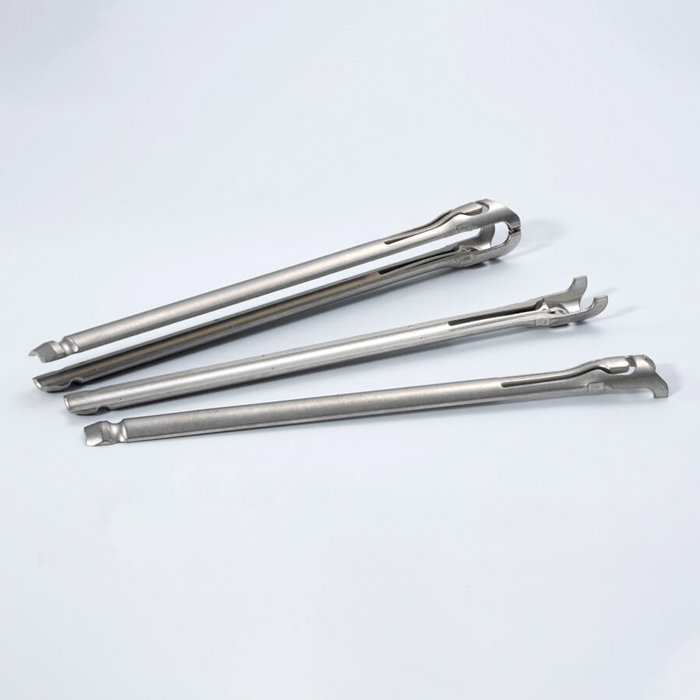
Advanced Powder Products, Inc. (APP) won a Grand Prize in the 2024 Powder Metallurgy Design Excellence Awards Competition for this metal injection molded screw chuck used in spinal surgery. (Photo courtesy Advanced Powder Products, Inc.)
Co-founded in 2000 by pioneering metallurgist Donald F. Heaney, Advanced Powder Products, Inc. (APP) is driven by its bold mission to be “America’s best and biggest metal injection molding company.” The roadmap to fulfilling that mission includes “using technology and manufacturing to solve problems and create opportunity for all who engage with APP,” the company’s website states.
Judging by APP’s growth in revenues, head count, and manufacturing space, as well as its development of proprietary technologies and the multiple industry awards it has received over the years, the company appears to be right on track.
Customers of APP manufacture products like medical devices, military equipment, industrial equipment, firearms, and sporting goods. According to APP Director of Business Development Nick Eidem, the company’s expertise in providing the highly complex parts needed for these applications has earned APP multiple Grand Prizes in the Metal Powder Industries Federation’s (MPIF) annual Powder Metallurgy Design Excellence Awards Competitions—most recently in 2024 for a metal injection molded Screw Chuck used in spinal surgery. The company has also received multiple MPIF Awards of Distinction, including one awarded in 2023 for dental brackets used in a new orthodontic correction procedure.
In 2025, APP made its ninth appearance on the Inc. 5000 list of fastest-growing privately-held companies in America. The annual list ranks independent companies according to their percentage revenue growth over a three-year period.

“Metal injection molding is best suited for applications that require small, complex, high-precision metal components produced in medium to high volumes,” according to APP Director of Business Development Nick Eidem. Features such as internal threads, undercuts, thin walls, and fine details can often be molded directly into the part. (Photo courtesy Advanced Powder Products, Inc.)
Currently operating out of two facilities totaling 60,000 square feet in Philipsburg, Pennsylvania, APP leverages equipment that includes 19 automated molders, three compounding lines, and two ProtoMIM molders. Also seeing action are three Binder Jet printers, 11 production furnaces, and five CNC machines for secondary purposes.
However, the company is planning an expansion that will include renovations to its two facilities, along with the addition of 30,000 square feet to its current manufacturing footprint, APP Sales Coordinator Brooke Frailey confirmed. The company expects to add an array of new compounding lines, automated production molders, and ProtoMIM molders, as well as CNC machines that provide 4-axis heat treating of 17-4 stainless steel and S7 tool steel.
When the expansion is completed, APP will have upgraded its capacity to accommodate more than $20 million in new business. Advanced Powder Products currently employs more than 200 team members, and holds certifications to the ISO 9001:2015 and ISO 13485:2016 (medical) international standards for quality management systems.
In addition, the company holds a Federal Firearms License (FFL) and is compliant with International Traffic in Arms Regulations (ITAR), Cybersecurity Maturity Model Certification (CMMC), and the AS9100 (aerospace) quality management standard.
Technical leadership
Eidem said a major key to the company’s success is the technical leadership provided by the company’s founder and owner, Heaney, who “laid the foundation that empowers a team of 30-plus degreed engineers to solve the toughest MIM challenges.”
While teaching at Penn State, Heaney helped pioneer and commercialize the process of injection molding, according to APP’s website. He is also the editor of the Handbook of Metal Injection Molding, widely regarded as a trusted guide to the process.
“Don Heaney literally wrote the Handbook of Metal Injection Molding and is considered a world resource for technical information on powder metallurgy,” the website stated. “Heaney took that knowledge and successfully applied it in building Advanced Powder Products.”
Thanks to Heaney’s influence, APP provides “deep technical expertise across the entire part development cycle, combining materials science, precision engineering, and advanced manufacturing to deliver high performance metal injection molded parts,” Eidem explained. The company prides itself on its vertically integrated capacity.
“We make the feedstock, build the tools, and produce the parts—all in-house. This gives us the speed, capability, and capacity to deliver complex MIM parts fast and at scale,” he said.
The MIM process
According to Eidem, metal injection molding can produce highly intricate and detailed components that would be difficult or expensive to machine traditionally. Features such as internal threads, undercuts, thin walls, and fine details can often be molded directly into the part.
“Metal injection molding is best suited for applications that require small, complex, high-precision metal components produced in medium to high volumes,” he said. “The process excels when traditional machining becomes too expensive, time-consuming, or limited in design capability.”
The metal injection molding process mixes fine metal powders with a polymer binder to create a feedstock, which is then molded into shape by equipment similar to what is used for plastic injection molding. By forcing the feedstock into a precision, specially designed mold, the process produces parts with unique dimensional features. Parts come out of the mold as soft and fragile “green” parts, before undergoing a secondary process that removes the binder material and hardens them with high-temperature sintering, according to the company’s website.
The high-density metal parts that emerge from the process can provide mechanical performance—including strength, hardness, and corrosion resistance—comparable to what wrought metals provide.
APP Recognized with Grand Prize for Metal Injection Molded Screw Chuck
The component, used in spinal surgery, took first place for MIM components in the Medical/Dental category.
In the 2024 Powder Metallurgy Design Excellence Awards Competition, sponsored by the Metal Powder Industries Federation (MPIF), APP demonstrated how technologies like metal injection molding (MIM) are driving continuous improvement and innovation.
Advanced Powder Products, Inc. (APP) won a Grand Prize in the Medical/Dental category for a metal injection molded Screw Chuck used in spinal surgery.
Metal injection molding is widely used in the medical industry for its ability to produce small, complex geometries that would not be financially feasible to manufacture any other way. As the use of MIM in the medical industry grows, design engineers are pushing the capabilities of MIM with more and more complex designs.
Advanced Powder Products was given the opportunity to showcase MIM technology on an Orthopedic Screw Chuck concept that would push the limits of MIM and provide the customer with an affordable solution to their innovative product.
The Screw Chuck was initially presented as a one-piece design, symmetric about its center axis, that needed to break into two pieces in its end use. Through extensive design modifications for metal injection molding, both parties were able to produce a plausible tooling solution: manufacture half of the part and laser-weld the two halves together to create the final assembly.
Source: Advanced Powder Products, Inc.
Metal 3D printing to production MIM
The company’s three-tiered MIM technology portfolio consists of metal 3D printing (PrintAlloy®), rapid MIM prototyping (ProtoMIM®), and production metal injection molding (MIM). Eidem said APP has helped customers speed up product development and reduce risk through its ProtoMIM and PrintAlloy technologies.
“Together, these processes reduce development costs, shorten time-to-market, and provide a smoother transition into full-scale production,” he noted.
PrintAlloy, invented by APP in 2015, is described by the company as “a metal powder printing technology that has the same metallurgical properties as MIM.” By enabling fast creation of low-cost metal prototypes without tooling, the metal 3D printing technology makes it easier to test complex geometries and iterate designs quickly, Eidem said.
ProtoMIM rapid prototyping, invented by the company in 2014, is a “low-cost, high speed method of manufacturing MIM components,” according to APP. The technology is capable of providing—in weeks—prototype MIM parts that are representative of production metal components. They enable customers to validate designs and functionality before they invest in full production tooling.
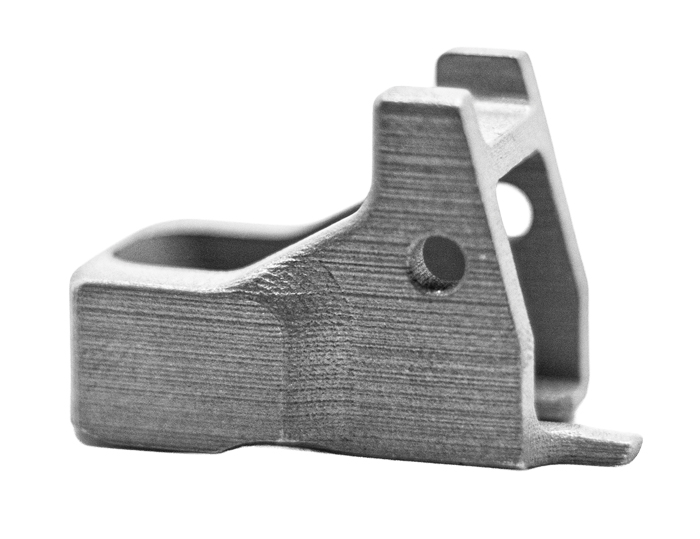
Metal injection molding produces highly intricate and detailed components that would be difficult or expensive to machine traditionally. The high-density metal parts that emerge from the process can provide mechanical performance—including strength, hardness, and corrosion resistance—comparable to what wrought metals provide. (Photo courtesy Advanced Powder Products, Inc.)
“When you use ProtoMIM, you can see what the part would really be like in production, so it makes production much faster and smoother,” Eidem said.
Looking ahead, Eidem expects that a handful of current industry developments could have a positive impact on future demand for metal injection molding. He anticipates that emerging technologies, such as metal additive manufacturing and hybrid prototyping workflows, will help increase future demand by accelerating product development and helping customers transition into high-volume MIM production more efficiently.
“At the same time, growth in electric vehicles, minimally invasive medical devices, and advanced electronics is expected to further expand opportunities for precision MIM components in the coming years,” he said.