
Sintavia reported that it designed, simulated, and validated a complex, multi-circuit aerospace heat exchanger in two weeks.
HOLLYWOOD, Fla.—Aerospace component manufacturer Sintavia, LLC reported in March that it had integrated NVIDIA’s RTX PRO 6000 Blackwell Workstation Edition to design, simulate, and validate a complex aerospace heat exchanger in only two weeks. According to a release from Sintavia, the process would have taken months previously.
“The resulting heat exchanger demonstrated a 30 percent reduction in weight and 20 percent improvement in thermal efficiency for aerospace applications, and was validated using CT scanning and in-house testing,” the company said in the release.
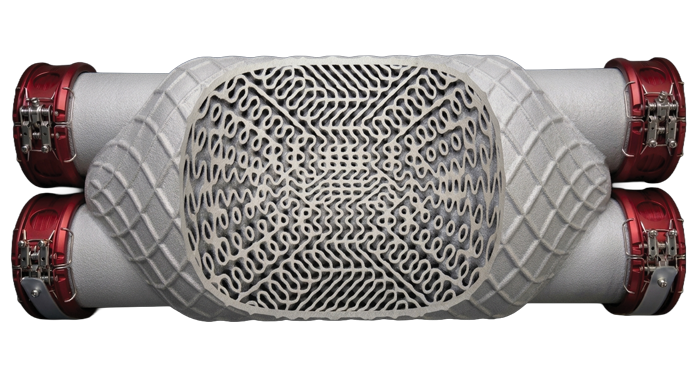
A scooped version of a representative heat exchanger (Image: Sintavia/Business Wire)
As part of the project, Sintavia adopted a simulation-driven approach. It integrated computational fluid dynamics (CFD) in Siemens Simcenter™ STAR-CCM+™ software and implicit modeling in nTop, leveraging NVIDIA Blackwell architecture to unlock what the company called “next-level performance on what has historically been a large, compute- and memory-bandwidth intensive workload.”
By combining all of these features, Sintavia stated, it was able to rapidly iterate its simulation without sacrificing fidelity or safety. In Sintavia’s tests, NVIDIA Blackwell GPU ran a 30 million-cell Simcenter STAR-CCM+ conjugate heat transfer simulation with over 300 iterations in just seven minutes. This is reportedly 11 times faster than on a 24-core CPU, allowing Sintavia to make near real-time adjustments to meet customer performance requirements. The result was a fully optimized heat exchanger that was printable the next day, the company said.
“At Sintavia, we’re not just designing heat exchangers, we’re pioneering a new era of thermal management with solutions that are lighter, stronger, and engineered for the most demanding environments,” said Jose Troitino, principal design engineer at Sintavia, in the release. “Because we operate in a fully digital environment—from simulation, through manufacturing and inspection—we are always looking at faster and more efficient solutions to reduce span time at each step. We are very proud that we have been able to do so alongside NVIDIA, Siemens, and nTop.”
Additional information on the project is available at: Sintavia Aerospace Component Design with NVIDIA GPUs | NVIDIA Customer Stories.
Sintavia describes itself as “the world’s leading all-digital aerospace component supplier.” The company stated that over the past four years, it has “designed and delivered the first metal additive component on a fighter jet, a nuclear submarine, a hypersonic missile, a piloted aircraft critical safety system, and a military rotorcraft.”
“By combining a fully digital design-print-certify workstream alongside a fully digital additive manufacturing process, Sintavia is redefining the aerospace component supply landscape,” the company said in the release.