
Now available in the U.S., WSCAD’s electrical design platform is said to help engineers and machine and panel builders work faster, reduce repetitive tasks, and upskill employees.
CHARLOTTE, N.C.—WSCAD, developer of what it called “the world’s first AI-powered electrical design platform,” officially launched its U.S. market version of ELECTRIX AI in April, the company said in a release.
According to WSCAD, ELECTRIX AI combines electrical engineering, control cabinet design, fluid and process engineering, electrical installation, and building automation in one seamless electrical CAD software. Built-in AI capabilities are reported to accelerate engineering workflows, allowing electrical engineers, designers, and planners to reduce manual work and automate the creation of finished parts and products, such as control cabinets, design schematics, supporting files, and bills of materials.
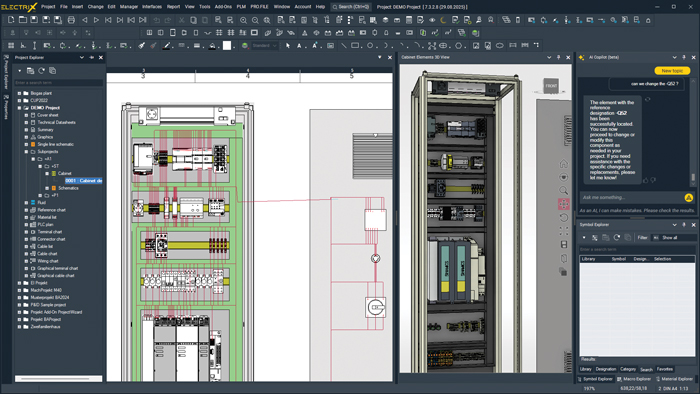
A screenshot of ELECTRIX AI, an electrical design platform, showing schematic and 3D cabinet views. (Image: WSCAD/Business Wire)
“ELECTRIX AI helps users work efficiently across tasks, from importing schematic data, exchanging components, and validating project requirements and compliance, to translating documentation and automatically generating control cabinets, wiring, and finished design files,” the release stated.
The software has reportedly demonstrated measurable productivity gains. In one case, customer WAGO reduced engineering time by 50 percent, allowing its team to complete projects faster and service more total customers without increasing headcount, according to WSCAD.
“Electrical engineers do not need more hype around AI, they need practical tools that help them get real work done faster,” said Axel Zein, Ph.D. and CEO of WSCAD, in the release. “ELECTRIX AI gives engineers an AI-powered assistant that supports their work inside the CAD environment, helping them save time, work smarter, reduce friction in the design process, and create capacity for more innovation.”
ELECTRIX AI is fully equipped to meet U.S. electrical specifications and regulatory requirements. It comes with complete support for NFPA 79, includes all the relevant IEEE 315 / ANSI Y32.2 symbols out-of-the-box, and lets users design projects in full compliance with NFPA 70 (NEC) and UL 508A. It’s reportedly the only AI-powered electrical design platform on the market.
The CAD software streamlines time-intensive steps in the electrical design process. Following are some of its key capabilities:
AI-assisted project checks: Users can upload project requirements and have the software review schematics against those specifications, identifying issues and exceptions.
Automated project translation: Engineers can translate electrical project documentation into more than 102 languages directly inside the software environment.
Control cabinet generation: Once schematics are complete, the software can automatically generate layouts, place components, and support routing workflows.
An extensive library of components and schematics from leading U.S. manufacturers, such as Rockwell Automation, Eaton, Honeywell, Phoenix Contact, nVent Hoffmann, and TE Connectivity. In all, it offers more than 2.2 million files.
“Importantly, no project data, personal data, or user-specific information is shared externally due to privacy-sensitive functions or when certain capabilities operate with models running locally,” the release stated.
As the need for skilled design engineers expands, ELECTRIX AI is said to support the next generation of electrical engineers. It helps address productivity demands and the shortage of available talent. By automating manual or repetitive tasks, companies can better leverage experienced engineers while enabling newer team members to contribute more quickly, the company said.
“AI will change the role of electrical engineers, but not replace the job,” Zein said in the release. “The engineer remains in charge. What changes is that AI can take over more routine tasks, allowing humans to become more productive, more strategic, and ultimately, more valuable.”