Laserax’s new laser workstation enables ultra-fine marking and micro-processing on delicate components while minimizing heat impact, the company said.
QUEBEC CITY—Medical device manufacturers are challenged today by increasing demands for traceability, precision, and regulatory compliance. Laserax, a designer and manufacturer of industrial laser machines, is addressing these challenges with a new high-precision UV laser system built to reduce thermal impact typically associated with conventional laser processes.
“Precision, cleanliness, and reliability are critical in medical manufacturing,” the company said in a March release. “Laser technology enables non-contact processing that delivers consistent results without consumables, making it ideal for applications that require permanent identification or precise surface modifications.”
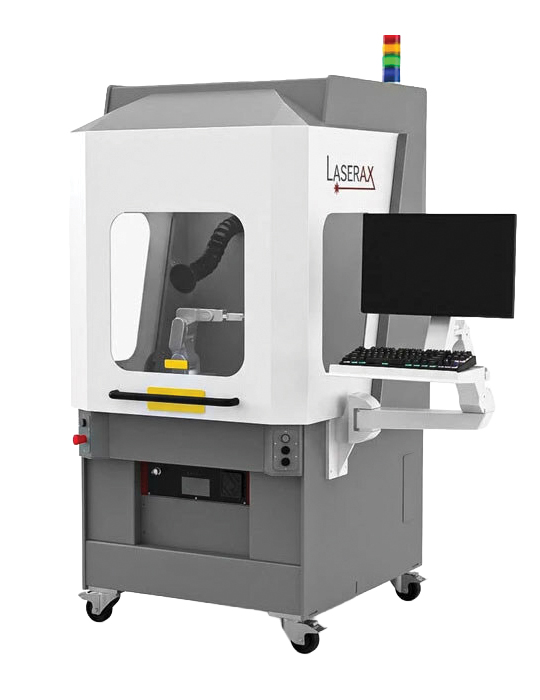
The PrecisionFLEX medical laser machine, designed and manufactured by Laserax. (Image courtesy Laserax/PRWeb)
Laserax said its PrecisionFLEX laser workstation uses advanced ultraviolet (UV) laser technology that is “capable of producing high-resolution, permanent markings and micro-processing results while minimizing heat impact on delicate materials.” The system is described as “ideal for marking plastics, coatings, ceramics, and metals commonly found in medical instruments and components.”
“Built to process delicate components with exceptional accuracy, PrecisionFLEX enables manufacturers to perform marking, texturing, ablation, and selective cleaning operations on sensitive materials used in medical applications,” the company said in the release.
By pairing a UV laser with high-resolution scanning optics, PrecisionFLEX is capable of producing extremely fine features and clean markings. With a 355nm wavelength and ultrafine spot sizes down to 7μm, the system is reported to provide exceptional accuracy on small or heat-sensitive medical parts, such as plastic connectors, coated components, or glass elements.
According to Laserax, the short UV wavelength enables “cold marking,” reducing the thermal impact typically associated with conventional laser processes.
“This makes PrecisionFLEX particularly suitable for medical device components where maintaining the integrity of delicate materials is essential,” the company said.
PrecisionFLEX integrates a precision robotic part handler as a standard feature to ensure consistent positioning and repeatable results across production runs. The robot can present parts from multiple angles and efficiently handle trays or batches, according to the release.
Delivered as a Class 1 enclosed laser system, the workstation is designed to permit safe operation within manufacturing facilities while protecting operators from laser exposure. “PrecisionFLEX is built for seamless integration into medical device production environments, supporting both standalone operation and automated workflows,” the release stated.
PrecisionFLEX is delivered from a single supplier as a fully integrated system that includes the laser source, optics, fume extraction, workstation, automation components, robot, and control software. This approach is said to simplify integration, reduce project complexity, and ensure consistent performance throughout the system’s lifecycle.
Laserax said its secure remote support capabilities allow the company’s experts to diagnose and resolve issues quickly, minimizing downtime and ensuring uninterrupted production.