
Lockheed Martin To Produce Next Generation Interceptor at New Facility in Alabama
The 88,000-square-foot facility in Courtland expands the company’s advanced manufacturing capacity, supporting rapid delivery of domestic defense capability.
Defense technology company Lockheed Martin will produce the Next Generation Interceptor (NGI) for the Missile Defense Agency (MDA) at a new Missile Assembly Building 5 (MAB-5) in Courtland, Alabama, the company said in a June release.
By producing the interceptor at the state-of-the-art, 88,000-square-foot facility, Lockheed Martin is expected to bolster the nation’s “layered missile defense architecture.”
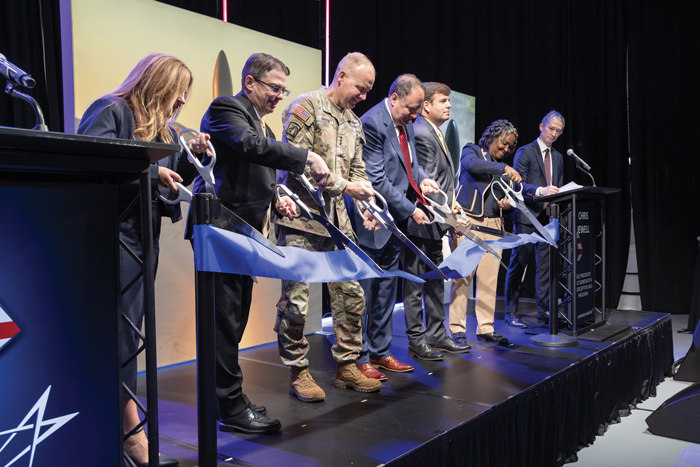
Lockheed Martin Space leaders are show opening the new Next Generation Interceptor (NGI) factory in Courtland, Alabama. From left: Sarah Reeves, VP of Strategic Defense Systems; Johnathon Caldwell, VP and general manager of Strategic & Missile Defense Systems; Lt. Gen. Brian Gibson, vice director for Golden Dome for America; Robert Lightfoot, president of Lockheed Martin Space; U.S. Rep. Dale Strong (R-AL); Reshondra McInnis, site director, Courtland campus; and Christopher Jewell, VP of NGI.
The MAB-5 is reported to consolidate Lockheed Martin’s most sophisticated digital manufacturing tools and smart processes, enabling high efficiency, repeatable production. The plant draws best practices from high-reliability programs, including Terminal High Altitude Area Defense (THAAD) and hypersonics, and adopts a “digital twin” methodology that reduces risk from design through sustainment. Automation and data driven workflows are said to guarantee consistent, high-quality output.
The release stated that by bringing together digital engineering and modern manufacturing techniques, the facility is designed to accelerate production while maintaining the highest standards of quality and reliability.
In a statement, Director of Golden Dome for America, General Mike Guetlein, hailed the facility as a critical asset to national security. General Guetlein leads the Defense Department’s effort to develop a next-generation missile defense shield,
“You are not just building infrastructure, you are building the Arsenal of Freedom,” Gen. Guetlein said in the release.
Smarter, more agile defense
The Next Generation Interceptor is described as an open system interceptor that meshes seamlessly with a layered defense network of space-based sensors, radars, command and control systems, and other interceptors.
“Think of this as deterrence through defense,” said Christopher Jewell, NGI vice president and program manager at Lockheed Martin, in a statement. “It sends a clear signal that threats can be detected, tracked, and defeated before they ever reach their intended target.”
Its modular architecture is said to allow rapid incorporation of new technologies. Unlike legacy systems, NGI upgrades can be performed while the missile remains in its silo, avoiding costly removal and replacement.
“NGI was designed from the start to adapt,” Jewell added. “Its digital foundation allows new technologies to be integrated more quickly, ensuring the system can stay ahead of emerging threats.”
“Golden Dome for America is real, and it is not theoretical,” General Guetlein said. “We are building it right now in Courtland. We are taking proven, world-class capabilities, combining them with next-generation space-based tracking and advanced interceptors, and fusing them together with artificial intelligence.”
The NGI is moving from design to production, with key elements of the system advancing through development test and integration. Core technologies, including the interceptor’s engagement capability, sensors, software, and propulsion, are demonstrating system-level performance and operation ahead of critical design review (CDR), according to the company.
The Missile Assembly Building 5 is expected to streamline workflows, cut unnecessary handling, and support tighter tolerances required for complex components. Integrated digital tools link design data directly to the factory floor, bolstering configuration control, quality assurance, and repeatability as production scales, the company said.
“These facilities were intentionally designed around the system they produce,” Jewell said. “By aligning the factory to the product at the onset of development, we can improve quality, increase efficiency, adapt, and ramp up production quicker as the system evolves.”
The opening of MAB-5 is said to underscore Lockheed Martin’s longstanding commitment to North Alabama as a hub for deterrence and defense. The company stated that it has been present in the region since 1963 and has been producing defense systems in Courtland since 1994.
Lockheed Martin’s Troy, Alabama, facility will also support NGI production through hardware integration and large-scale manufacturing. Together, the Troy and Courtland campuses form the core of the company’s commitment to national missile defense readiness, the company said.
“The talent in north Alabama is the engine behind the next generation of our nation’s defense systems, and this project will create high-skill jobs and new career pathways while strengthening our local economy,” said U.S. Rep. Dale Strong, in the release. “This state-of-the-art facility will play a major role in protecting our homeland as well as reshaping Courtland’s role as a steady source of quality jobs and growth for the Tennessee Valley.”
Roaring Demand for 3D Printed Jet Engines Leads Beehive Industries to Invest More than $50 Million in EOS Technology
Beehive’s engines, designed for swarm-class drones and other next-generation uncrewed aerial systems, enable low-cost, high-volume production that is critical to evolving defense strategies, the company said.
Booming demand for its 3D-printed jet engines is leading Beehive Industries to invest heavily in metal additive manufacturing (AM) technology to support the production of its flagship propulsion product, the Frenzy™ 8 engine line.
The U.S.-based manufacturer specializes in design and development of advanced, additively manufactured jet engines for uncrewed aerial defense applications. Beehive uses innovative additive manufacturing techniques to build high-performance propulsion systems with “unmatched speed, affordability, and scalability to meet the evolving needs of the warfighter and strengthen American defense superiority,” the company said in a release.
Beehive Industries’ latest investment in additive technology is rooted in its signing of a strategic agreement at EOS global headquarters in Krailling, Germany, on June 17. The company’s partnership with EOS is said to underscore a shared commitment to scaling additive manufacturing for high-performance aerospace and defense applications. It is supported by a $50 million investment by Beehive in EOS M4 ONYX technology, according to the release.
The agreement calls for delivery, over the next 12 months, of 30 EOS M4 ONYX systems to Beehive’s Colorado and Tennessee facilities, bringing its total of EOS metal additive manufacturing machines to 50.
“Beehive is experiencing unprecedented demand for our Frenzy 8 engines, driven by major defense programs and the urgent need for affordable, high-rate production of uncrewed systems,” said Darius Ehteshami, COO and CFO of Beehive Industries, in a statement. “Our expanded collaboration with EOS and this substantial investment in best-in-class 3D printers will significantly increase our production capacity while reinforcing our commitment to delivering scalable, American-made propulsion solutions that strengthen warfighter capabilities.”
The company’s investment follows a series of major milestones, including successful high-altitude testing of the Frenzy 8 engine, flight readiness validation, and a recent $29.7 million U.S. Air Force contract that supports vehicle integration, flight testing, and qualification of the propulsion platform. Beehive’s engines are specifically designed for swarm-class drones and other next-generation uncrewed aerial systems, enabling low-cost, high-volume production critical to evolving defense strategies, the company said.
Beehive stated that it selected the EOS M4 ONYX platform for its combination of throughput, process stability, automation, and part quality, as well as its ability to support the company’s new growth phase. Introduced as EOS’s newest industrial metal additive manufacturing platform, the EOS M4 ONYX is reported to deliver significantly increased productivity through its six-laser architecture, expanded build volume, and advanced process monitoring capabilities.
The platform also includes EOS’s latest RFS Pro advanced powder filtration system, and is engineered specifically for demanding industries, such as aerospace, defense, energy, and aviation manufacturing. Beehive will use EOS’s software to support real-time process monitoring, production data tracking, and quality management, all of which are expected to help improve repeatability and traceability across the company’s additive manufacturing operations.
“Choosing to expand our fleet with these 30 EOS M4 ONYX systems was a strategic decision driven by EOS’s willingness to truly partner with us,” said Beehive President of Additive Parts Sales, Jonaaron Jones, in the release. “Throughout this process, the EOS team leaned in, worked creatively, and demonstrated a deep commitment to our long-term growth. We value this kind of collaborative, forward-thinking partnership, and it sets a high bar for our equipment suppliers as we continue to scale and meet our production goals.”
Beehive Industries said it has emerged as “one of the leading AM-centered defense manufacturing companies in the United States.” Besides the Frenzy™ engine family, the company is developing the Rampart™ turbofan platform for next-generation, 1,000-plus pound-force (lbf) applications, while also operating what it described as “one of the nation’s largest metal AM operations for high-performance aerospace and defense components.”
“Beehive Industries’ unprecedented investment demonstrates how additive manufacturing has become a foundational production technology for the next generation of advanced propulsion systems,” said Marie Niehaus-Langer, CEO of EOS, in a statement. “The success of the Frenzy engine program highlights what is possible when innovative design and industrialized additive manufacturing come together. We are proud to support Beehive as they expand production capacity and accelerate the delivery of high-performance technologies to customers around the world.”
The expanded EOS installation is said to reinforce Beehive Industries’ long-term commitment to additive manufacturing as the foundation for scalable American propulsion manufacturing.
“As global defense priorities continue shifting toward affordable, rapidly deployable autonomous systems, Beehive and EOS are jointly enabling a new era of high-rate, digitally driven production for mission-critical aerospace hardware,” the release stated.
Lockheed Martin, GM Defense Collaborating to Strengthen U.S. Manufacturing and Defense Industrial Base
A new collaboration between Lockheed Martin and GM Defense aims to strengthen America’s manufacturing and defense industrial base, according to a release from Lockheed Martin.
Working under a memorandum of understanding (MOU), Lockheed Martin and GM Defense will explore opportunities to accelerate the delivery of critical capabilities and innovation. They will do so by combining Lockheed Martin’s defense production expertise with General Motors’ advanced industrial capabilities in high-rate commercial manufacturing and engineering.
The collaboration, announced in June, is expected to focus on “strengthening defense supply chains, advancing manufacturing and design capabilities, and evaluating opportunities to expand production capacity through commercial manufacturing expertise and infrastructure,” the release stated.
Initial efforts will include exploring ways to accelerate production readiness and apply proven commercial manufacturing approaches to support defense production requirements.
“America’s security depends not only on developing advanced technologies, but on our ability to produce them quickly, reliably, and at scale,” said Lockheed Martin Chief Operating Officer Frank St. John, in a statement. “This collaboration brings together two leaders in American manufacturing and innovation to explore new ways to strengthen the defense industrial base, expand production capacity, and accelerate delivery of critical capabilities for the United States and its allies.”
The collaboration reflects growing demand for greater production capacity, supply chain resilience, and manufacturing agility across the defense sector. By combining commercial and defense expertise, the companies aim to identify opportunities that can accelerate production timelines while maintaining the quality, performance, and reliability standards required for mission-critical systems, the release said.
“Working together, GM Defense and Lockheed will further strengthen American manufacturing and national defense by driving greater speed, efficiency, and innovation in the aerospace and defense sectors,” said Steve duMont, president of GM Defense, in a statement. “Over the coming weeks, we will be working to identify initial projects to pursue together.”
Lockheed Martin is a global defense technology company working to drive innovation and advance scientific discovery.
“Our all-domain mission solutions and 21st Century Security® vision accelerate the delivery of transformative technologies to ensure those we serve always stay ahead of ready,” the company said in the release.
GM Defense stated that it delivers integrated vehicles, power, and autonomy and connectivity solutions to global defense, security, and government markets.
“The exceptional reliability of GM Defense’s technologies results from decades of proven performance and billions of dollars spent in independent research and development by its parent, General Motors, a world leader in global design, engineering, and manufacturing capabilities,” the company said in the release.
New Link 16 Test Capability for F-16 Reported to Enhance Aircraft Readiness
BAE Systems developed and integrated the automated test capability for MIDS JTRS terminals, reducing downtime and enabling aircraft to return to operation faster.
In May, BAE Systems reported that it completed the successful development and integration of an upgraded Link 16 test capability for Multifunctional Information Distribution System – Joint Tactical Radio System (MIDS JTRS) terminals on U.S. Air Force F-16 aircraft.
The upgrade streamlines the maintenance process, allowing aircraft to return to operation faster, according to a release by BAE Systems.
Link 16 is a standardized communications system used by NATO, the U.S., and its allies to share encrypted real-time tactical data. MIDS JTRS is a four-channel software-defined radio designed to run the complex Link 16 waveform and up to three additional communication protocols. It is described as “a scalable and flexible solution to tailor networks to mission needs.”
The new automated test capability is now integrated on the Versamodule Extensions for Instrumentation Improved Avionics Intermediate Shop (VXIIAIS). It is also integrated on the Rackmount Improved Avionics Intermediate Shop (R-IAIS), which enables the rapid on-site validation of MIDS JTRS at customer bases, the company said in the release.
“This enhanced Link 16 test capability on the R-IAIS system marks a major milestone in our efforts to support the U.S. Air Force’s modernization efforts,” said Meg Redlin, product line director for Advanced Mission Solutions at BAE Systems, in a statement. “Providing more fidelity in testing with tactical navigation functions will enable U.S. forces and allies to rapidly diagnose failures and validate the operational status of their MIDS JTRS terminals on-site, increasing the availability of their aircraft and reducing maintenance downtime.”
According to BAE Systems, MIDS JTRS provides situational awareness and enables Link 16 connectivity with jam-resistant, line-of-sight voice, video, and data communications for sea, ground, and air assets.
“This rapid solution offers greater performance to the previous MIDS-Low Volume Terminal test for F-16 aircraft,” the release stated.
BAE Systems provides emulators and software for the avionics shop to use when testing the MIDS JTRS terminal. In turn, that technology passes information to the aircraft maintainers to accurately diagnose and verify repairs. It also enables them to do on-site testing while improving line-replaceable recovery rates and decreasing the need to purchase additional parts.
Tactical Targeting Networking Technology offers a low latency, high communications capability that provides critical platform connectivity and throughput within contested environments. “The Department of War is fielding MIDS JTRS on the F-15, F-16, F/A-18, and F-22 aircraft, as well as ship and command and control assets,” the release stated.
BAE Systems stated that it has designed and manufactured comprehensive test systems for military and commercial applications for 45 years, delivering more than 700 stations.
“Fielded in 25 countries, these unique and flexible offerings provide organizational, intermediate, and depot-level support for electronic warfare, display, radar, communications, stores management, and flight and fire control systems,” the release stated.
Work on the upgraded Link 16 automatic test equipment takes place at BAE Systems facilities in San Diego and Wayne, New Jersey.
AeroVironment Expands Huntsville Facility to Speed Production of Next-Generation Interceptor
The facility expansion is seen as a critical step in scaling production of Freedom Eagle-1, accelerating its delivery to the field, and providing cost-effective defense against mass aerial threats.
Global defense technology company AeroVironment, Inc. (AV) reported in May that an additional government investment of $20.2 million in its Huntsville, Alabama facility will enable the company to increase quantities of low-rate initial production (LRIP)—and accelerate future full-rate production (FRP)—of the Next-Generation Counter-Unmanned Aircraft System Missile (NGCM), known as Freedom Eagle-1 (FE-1).
According to a release from AV, the expanded site will serve as the system-level integration, manufacturing, and production hub for FE-1. In addition, it will “enable rapid scale-up of interceptor production and accelerated delivery timelines to meet urgent U.S. Army and Combatant Command operational needs.”
The company said in the release that the 24,000-square-foot expansion and associated job growth in Huntsville reflect AV’s continued investment in meeting evolving national security demands for subsonic missiles. At the same time, they are expected to strengthen cost-effective production capacity, drive innovation, and support on-time delivery.
“Growing our presence in Huntsville places AV more firmly at the center of the Army’s air and missile defense ecosystem, enabling tighter integration, faster iteration, and more efficient production at scale,” said AV Chairman, President, and Chief Executive Officer Wahid Nawabi, in a statement. “That proximity is critical as we begin production of Freedom Eagle-1, a system designed to deliver a scalable, cost-effective response to increasingly complex and high-volume aerial threats.”
The investment builds on AV’s recent selection and $95.9 million contract award under the U.S. Army’s NGCM and Long-Range Kinetic Interceptor (LRKI) programs, executed through the U.S. Army Combat Capabilities Development Command Aviation & Missile Center (CCDC AvMC) and the Aviation & Missile Technology Consortium (AMTC). It also marks the next phase in transitioning Freedom Eagle-1 from development to scaled production and operational fielding, the company said.
In March, AV announced a $97 million contract to design and integrate prototype test environments for next-generation missile defense sensor testing at Redstone Arsenal. The
Arsenal is a Huntsville-based federal center that is home to more than 70 organizations, including NASA, the FBI, Missile Defense Agency, Army Program Acquisition Executive Fires, and the future U.S. Space Command headquarters.
“This expansion is a critical step in scaling production of Freedom Eagle-1 and accelerating its delivery to the field,” said Jimmy Jenkins, executive vice president of AV’s Precision Strike and Defense Systems Group, in the release. “By increasing manufacturing capacity, strengthening integration, and enabling production at volume, we’re delivering a cost-effective interceptor designed to counter increasingly complex and high-volume aerial threats.”
Freedom Eagle-1 is designed to address these challenges with a combination of performance and affordability. The system is described as a low-cost, high-performance interceptor capable of neutralizing Groups 2 and 3 uncrewed aerial systems (UAS) while maintaining residual capability against Group 1 UAS, fixed-wing, and rotary-wing aircraft. Its capabilities are reported to include increased lethality, extended range, and rapid launch.
The system is reported to have achieved several key development milestones, including a successful live-fire demonstration of its dual-thrust solid rocket motor, controlled test vehicle launches, and warhead testing. In meeting these milestones, it has demonstrated technical maturity and reduced risk as the program transitions toward field deployment, according to AV.
“As the nation’s defense and security demands increase, it is crucial that we meet capability needs, and there is no better place for AV’s expansion as Alabama continues to lead in defense manufacturing and innovation,” said Congressman Robert Aderholt (AL-04).
The expansion in Huntsville is also said to reflect AV’s broader strategy to scale domestic manufacturing capacity. The company recently announced a $30 million expansion of its Albuquerque, New Mexico campus, a move that is expected to generate more than $670 million in economic impact over the next decade, create more than 450 high-wage jobs, and boost production of mission-critical defense and space technologies.
AeroVironment is a defense technology company with integrated capabilities across air, land, sea, space, and cyber. The company develops and deploys autonomous systems, loitering munitions, counter-UAS technologies, space-based platforms, directed energy systems, and cyber and electronic warfare capabilities. All are “built to meet the mission needs of today’s warfighter and tomorrow’s conflicts,” the company said in the release.
Seven-year, $35 Billion Award Aims To Propel Faster Production of Critical Missile Defense Interceptors
Under the award, Lockheed Martin will work to quadruple production of Terminal High Altitude Area Defense (THAAD) missile defense interceptors.
In June, the U.S. Government awarded defense technology company Lockheed Martin a seven-year, “undefinitized” contract action (UCA) for up to $35 billion to quadruple production of Terminal High Altitude Area Defense (THAAD) missile defense interceptors, according to a release by the company.
In a separate fact sheet for an F-35 undefinitized contract action, Lockheed Martin defines an undefinitized contract action as “a common contracting tool that provides funding while the detailed contract terms continue to be finalized.”
The award is reportedly one of the first major multi-year procurement contracts executed under the Pentagon’s Acquisition Transformation Strategy, which aims to assemble an Arsenal of Freedom by rebuilding and expanding America’s defense industrial base (DIB) to deliver capabilities and capacity more quickly.
The contract puts into action the THAAD framework agreement between the Pentagon and Lockheed Martin, signed in January. As such, it is expected to provide the long-term demand signal needed to accelerate production capacity, strengthen the defense industrial base, and deliver critical missile defense capability at speed and scale for the U.S. and its allies.
“This award reflects our shared vision with the Department of War to strengthen America’s Arsenal of Freedom through a transformational shift to multi-year procurement,” said Tim Cahill, president, Lockheed Martin Missiles and Fire Control, in a statement. “This new approach propels our efforts to strengthen the defense industrial base, expand production, and deliver capabilities to the American warfighter at unprecedented speed and scale.”
The award comes weeks after Lockheed Martin broke ground on a new Munitions Production Center in Troy, Alabama, as part of the company’s more than $9 billion investment through 2030.
“This investment is already delivering tangible results to meet heightened munitions demand, including more than 20 new or modernized facilities across the United States,” the release stated. Lockheed Martin also recently opened the Next Generation Interceptor facility in Courtland, Alabama, and the Munitions Acceleration Center in Camden, Arkansas.
Lockheed Martin described THAAD as “the only U.S. system designed to intercept threats both inside and outside the atmosphere.” As such, it is said to provide a critical layer of missile defense. “Its performance has been demonstrated in operations including Operation Epic Fury, where it continues to defend forces and key infrastructure against evolving threats,” the release stated.
Lockheed Martin also provided additional context around its leadership in acquisition transformation, as well as its efforts to increase job growth and strengthen supply chain resilience.
Acquisition transformation leadership: Lockheed Martin stated it was the first in the industry to announce a framework agreement for munitions acceleration under the Pentagon’s Acquisition Transformation Strategy. Since January, landmark framework agreements have been established to expand production capacity for PAC-3® MSE, the THAAD interceptor, and Precision Strike Missile (PrSM). In April, the U.S. government awarded Lockheed Martin a $4.7 billion contract to continue critical accelerated production of PAC-3 MSE this year.
American job growth: Lockheed Martin is continuing to expand its workforce, creating tens of thousands of high-quality American jobs across manufacturing, engineering, and skilled trades, according to the company. “These investments ensure America and its allies have the proven capabilities needed to protect people, infrastructure, and freedom around the globe,” the company stated.
Supply Chain Resilience: Lockheed Martin is also working to strengthen resilience of the domestic supply chain, deepening collaboration with suppliers and driving innovation across operations. The company said it is “engaging regularly with suppliers critical to scaling munitions production, focusing on building stronger relationships, emphasizing speed, and driving solutions to better prepare for current and future threats.”
Kratos Awarded Sole-source Contract for New Air Defense Missile System
Kratos Defense & Security Solutions, Inc., a technology company in the defense, national security and global markets, recently received an approximate $36 million sole-source contract award for a new air defense missile system, the company said in a July release.
Kratos stated that it provides rapid engineering, development, and production, at scale, of affordable military-grade hardware, products, and systems. Its products, systems, and hardware are used for hypersonic, missile, radar, air defense, directed energy, high-powered microwave, and counter unmanned aerial systems (C-UAS). They are also used in chemical, biological, radiological, and nuclear (CBRN) systems, as well as unmanned aerial drone systems.
“Building military-grade hardware on schedule and on budget, hardware that must work every time, is hard, and is also a clear differentiating capability of Kratos,” said Tom Mills, president of Kratos’s C5ISR Division, in a statement. “The entire C5ISR team is proud to have been selected for this critical national security program.”
Eric DeMarco, president and CEO of Kratos, said that Kratos’s air defense-related hardware, products, and systems business—both in the United States and internationally—is :currently seeing increased demand from numerous customers for multiple systems, platforms, and technologies.”
“Over the past several years, Kratos has made significant investments in property, plant, equipment, and facilities, which we are continuing as we are laser focused on supporting the United States Department of War and the rebuild and recapitalization of our nation’s defense industrial base,” DeMarco said in the release.
Work under this contract award will be performed at a secure Kratos manufacturing facility, the company said.
Kratos Defense & Security Solutions, Inc. is a technology, products, system, and software company that addresses the defense, national security, and commercial markets. According to Kratos, it views affordability is a technology. The company said it seeks to use proven, leading-edge approaches and technology, as opposed to unproven, bleeding edge approaches or technology. Its approach is designed to reduce cost, schedule and risk, enabling the company to get to market fast with cost-effective solutions.
“We believe that Kratos is known as an innovative, disruptive change agent in the industry, a company that is an expert in designing products and systems up front for successful rapid, large quantity, low-cost future manufacturing,” the company stated in the release. The company said its expertise is “a value-add competitive differentiator” for its large traditional prime system integrator partners and its government and commercial customers.
Kratos said its primary business areas include virtualized ground systems for satellites and space vehicles, including software for command & control (C2) and telemetry, tracking, and control (TT&C). They also include jet powered unmanned aerial drone systems, hypersonic vehicles and rocket systems, propulsion systems for drones, missiles, loitering munitions, supersonic systems, and space craft and launch systems, among others.
Additional products include C5ISR and microwave electronic products for missile, radar, missile defense, space, satellite, counter UAS, directed energy, communication and other systems, and virtual and augmented reality training systems for the warfighter.
Armed with New Funding, Amca Vows to Strengthen America’s Critical Component Supply Chain
By expanding its rapid product development platform across its manufacturing network, the company is working to speed delivery of components most essential to national readiness.
At a time of growing geopolitical instability and mounting strain on the legacy industrial base, America needs a faster and more resilient way to engineer, qualify, and manufacture critical defense and aviation components, according to Amca, an El Segundo-based company dedicated to building what it calls “America’s new industrial base.”
“A supply chain developed in a different era increasingly struggles to support the speed, scale, and flexibility required to sustain the country’s most critical systems,” Amca stated in a May release.
Amca recently closed a $300 million Series B funding round to meet this challenge and accelerate the development of America’s new industrial base. The company said in the release that it rapidly develops and manufactures critical aerospace and defense components by combining engineering, qualification testing, technical data development, and certified manufacturing capacity into a single integrated platform.
The round was led by Amca’s Series A lead, Caffeinated Capital, with major participation from Lightspeed Venture Partners and continued support from existing investors, including Andreessen Horowitz, Lux Capital, Construct Capital, and House Capital. With the financing, Amca is currently valued at more than $1 billion, 18 months after its founding, making it one of the fastest-growing companies in aerospace and defense to reach this milestone, the company said.
In addition to building entirely new factories from scratch, Amca acquires and reconfigures longstanding certified manufacturers. It adds new engineering and software infrastructure and works to rapidly develop new critical components that can move immediately into production.
“In doing so, it recapitalizes a domestic supply chain bottlenecked by declining capacity and competitiveness, increasing lead times, and an aging workforce,” the release stated.
Over the past year, Amca has scaled quickly. The company now operates six critical component factories across the nation in California, Iowa, and New York. Among them is BC Systems, a power electronics supplier that supports multiple growing, classified defense programs. Amca also opened an advanced prototyping and testing facility in El Segundo, where it is headquartered.
“Across these facilities, Amca operates over 123,000 square feet of online qualified production capacity, spanning every major class of critical component: hydraulics, avionics, power electronics, and more,” the release stated.
The company is also deploying RAPID, Amca’s vertically integrated, AI-powered product development platform across its entire manufacturing network. RAPID combines design engineering, prototyping, testing, technical documentation, and manufacturing support into one workflow, reducing the time required to move production-grade hardware from development into deployment by more than 67 percent versus industry-standard lead times. It is being used to engineer, qualify, and produce components for major platforms, including the F-35 and commercial widebody and narrowbody aircraft, the company said.
Amca supplies products to major aerospace and defense customers, including Boeing, Lockheed Martin, Northrop Grumman, Airbus, Embraer, Honeywell, and Raytheon. It also directly supports U.S. military sustainment programs focused on readiness-related shortages and declining supply sources.
The company said it plans to use its new funding to expand RAPID across its manufacturing network, create and acquire additional factories nationwide, and accelerate delivery of the components most essential to national readiness.
“For decades, America’s industrial base has become increasingly uncompetitive and capacity-constrained, leaving critical supply chains slow-moving and difficult to surge,” the release stated. “To address today’s bottlenecks, Amca is building a new industrial base that is faster, distributed, multi-sourced, and ready to support the unprecedented industrial production the country needs, at scale.”
As it helps build America’s new industrial base, the company is increasing competition and capacity for the critical components needed to defend the United States and build the physical infrastructure the country needs. Amca operates seven factories nationwide, including its headquarters in El Segundo, and manufactures avionics, hydraulic, and electrical components for platforms such as the F-35, F-16, F/A-18, Mk-48, and M1 Abrams.