
An additive manufacturing technology developed by Fabric8Labs can fabricate 3D antennas directly onto PCBs for wireless applications. It can also print high-current interconnects and passive components directly onto high-performance ceramics.
SAN DIEGO—Fabric8Labs, the developer of a patented Electrochemical Additive Manufacturing (ECAM) technology, is scaling up production of next-generation electronics components that are reported to enable leading-edge systems in thermal management (AI/HPC), wireless communications (RF), and power electronics.
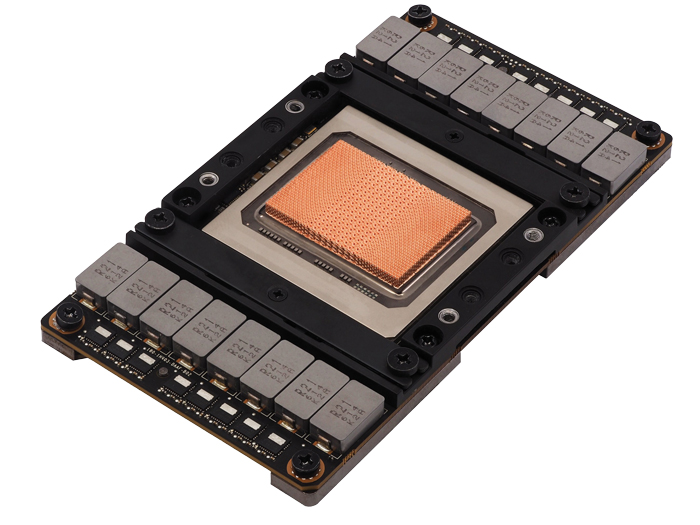
Image shows ECAM copper structures on silicon packaging. (Image: Fabric8Labs/ PRNewswire)
Fabric8Labs has pioneered what the company calls “the most advanced additive manufacturing platform.” Electrochemical Additive Manufacturing (ECAM) is described as “a room-temperature metal additive manufacturing technology that leverages electroplating principles to create ultra-high resolution, three-dimensional metal parts without the need for expensive post-processing.”
The platform is used to build components rapidly at the atomic level, resulting in excellent feature resolution and surface finish. These attributes are well-suited to applications ranging from thermal management for AI data centers to wireless (RF) communications and power electronics.
With the rapid growth of AI data centers, advanced thermal management solutions are becoming critical to ensure performance, efficiency, and reliability. From single-phase direct-to-chip (DTC) cooling to cutting-edge direct-to-silicon immersion systems, ECAM technology is reported to ensure next-generation AI and HPC chips will stay cooler under ever-increasing power densities.
Communications systems requirements increasingly demand faster, more efficient wireless (RF) systems that can be integrated into compact, space-constrained devices and infrastructure. Fabric8Labs stated that it leverages its room-temperature process to fabricate 3D antennas directly onto printed circuit boards (PCBs) and high-performance substrates. While doing so, it is said to optimize size, weight, power, and cost (SWaP-C) for systems in low Earth orbit (LEO) satellite constellations, wireless backhaul networks, and mobile vehicle communications.
Another application is power electronics. Vehicle electrification requires components that deliver higher efficiency in smaller, more reliable packages. The ECAM-fabricated high-current interconnects and passive components, which can be printed directly onto high-performance ceramics, reduce assembly steps and material interfaces, resulting in more compact, efficient EV systems, the company said in the release.
Last November, the company announced a $50 million funding round to expand its U.S.-based advanced manufacturing facilities, boosting capacity to produce tens of millions of components annually. In a company release, Fabric8Labs said its U.S.-based manufacturing footprint enables customers to move seamlessly from prototyping to high-volume production.
Fabric8Labs’s latest round of financing was led by NEA and Intel Capital, with participation from existing investors Lam Capital, the corporate venture arm of Lam Research Corp.; TDK Ventures; and SE Ventures. New investors include Marunouchi Innovation Partners, SK hynix, Ericsson Ventures, Masco Ventures, and Toppan Global Venture Partners.
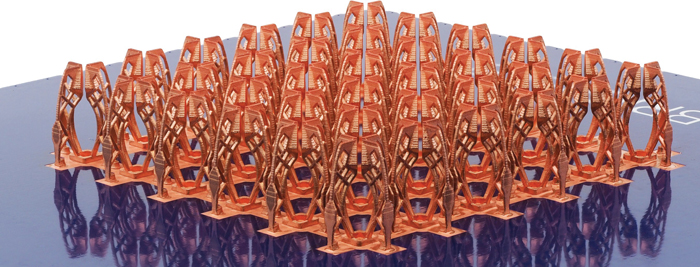
An ECAM phased array antenna that was printed directly on a PCB. (Image: Fabric8Labs/ PRNewswire)
“We believe Fabric8Labs is redefining additive manufacturing with its breakthrough ECAM technology.” said Greg Papadopoulos, Ph.D., and a venture partner at NEA. “Early on, we recognized the potential of ECAM to deliver unmatched precision, scalability, and design freedom—unlocking new opportunities across thermal management, aerospace, and power electronics. We’re thrilled to continue supporting the team as they expand U.S. production and scale this transformative platform.”
The new funding puts Fabric8Labs on course to accelerate expansion of its capacity, team growth, and production ramp-up.
The company expects to ramp production of its U.S. manufacturing footprint from 5 million to 22 million components per year to meet growing demand across thermal management, RF, and power applications. It plans to expand its team across manufacturing, design, quality, and process engineering to support “growth customer” programs. Fabric8Labs also aims to expand its production team to support engagements in AI/HPC thermal management, RF/wireless, and power electronics, moving quickly from first article to full production.
“This investment accelerates our mission to scale Electrochemical Additive Manufacturing (ECAM) for customers in high-growth, fast-moving industries where we are solving their most demanding challenges,” said Jeff Herman, co-founder and CEO of Fabric8Labs, in the release. “With ECAM, we’re reshaping how critical components are designed and manufactured—delivering the performance, reliability, and supply chain resiliency that enables customers to rapidly innovate and deploy advanced systems.”
Customers increasingly require a U.S.-based components manufacturer to supply these advanced products and advance concepts from prototype through production. Fabric8Labs’s U.S.-based manufacturing footprint is ISO 9001 certified and ITAR registered, ensuring high quality and reduced supply chain risk for customers.
With the new investment, Fabric8Labs said it is poised to redefine how critical technologies are designed, manufactured, and integrated at the system level.
“By combining U.S.-based production capacity with its ECAM process, the company is enabling a new era of advanced manufacturing—one that empowers innovation and strengthens supply chains, enabling the next generation of AI infrastructure, electronics, aerospace, and energy systems,” the release stated.