
The Mantis Robotics MR-1 robot arm meets the international standard for industrial robot safety requirements, and is said to lay the foundation for safe humanoids and AI robots everywhere.
PLEASANTON, Calif.—In February, Mantis Robotics announced what it described as “a landmark shift in industrial automation.” Its MR-1 flagship robot became “the first fenceless, high-speed industrial arm to receive safety certification to ISO 10218 and ISO 13849,” the company said in a release.
The MR-1 is now certified to ISO 10218-1 and ISO 13849-1 and carries CE marking, demonstrating compliance with EU machinery and functional safety requirements. ISO 10218-1 is the international standard for industrial robot safety requirements, incorporating safe design, installation, operation, and maintenance of robot systems. ISO 13849-1, the foundational standard for safety-related parts of control systems across all machinery, is a universal requirement for machine safety, the release stated.
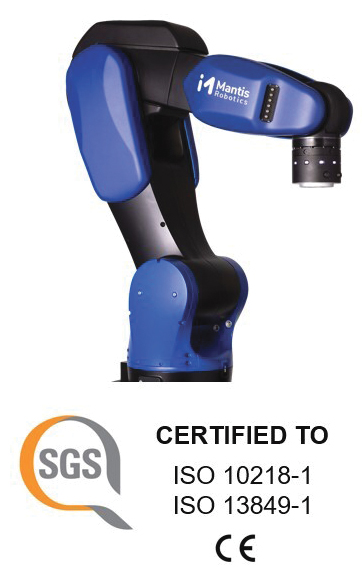
The Mantis MR-1 Robot, shown with safety certifications awarded in February. (Image: Mantis Robotics/PRNewswire)
By integrating proprietary Physical AI, the MR-1 reportedly eliminates the traditional “safety versus speed” compromise, allowing high-speed throughput in shared human workspaces without the need for physical barriers.
“This safety certification represents a true breakthrough for robotics, creating an entirely new category of robot that can interact safely with people without compromising productivity,” said Gerry Vannuffelen, CEO of Mantis Robotics, in the release. “The bottleneck to scaling AI robots isn’t intelligence; it’s safety. Mantis’s revolutionary proximity detection technology enables robots—in any form—to autonomously and safely adjust to the world around them, at industrial speeds. With this technology, we’re unlocking one of the largest platform opportunities in robotics.”
Enabling the next generation of robotics
According to Mantis Robotics, its safety-certified, fenceless technology moves beyond individual hardware to provide the foundational platform for human-robot collaboration in the AI era. As AI-powered robots and humanoids move from controlled industrial cells into shared human environments (warehouses, factories, and eventually, homes), safety becomes the critical enabler of scale.
“Mantis is building the essential safety architecture required for AI and humanoids to scale from factories into everyday environments,” the company said in the release.
The Mantis MR-1 robot is engineered for safety, with 47 embedded safety functions versus 17 in the most commonly deployed robots or cobots on the market, according to the release. All safety features are certified PL=d (Performance Level d), signifying a high level of reliability and functional safety. The MR-1’s embedded range-based object detection (“STAR”), powered by Mantis SafetyCore, continuously monitors for dynamic objects within its operating range. It automatically adjusts speed and behavior to support safe human–robot collaboration.
“The robot’s combination of Physical AI and code–free, rapid deployment—in the exact same footprint as a human worker—drives maximum productivity and a superior return on automation investment,” Vannuffelen added.
The Mantis MR-1 robot arm offers a 5kg payload, maximum speed up to 10 meters per second, and a 900mm reach. Described as “safe out of the box,” the robot ships standard with robot controller and the Mantis Studio code-free deployment software, with a 3D digital twin and real-world modeling features.
The MR-1 safety certification was issued by SGS Fimko Oy, the Finnish subsidiary of SGS SA. The global testing, inspection and certification company has been in business over 100 years.