
AM’s Measured Growth Signals a More Mature Industry
The additive manufacturing market is projected to reach $20.3 billion by 2030, but growth is shifting toward proven applications, production value, and disciplined investment.
The following article was contributed by AMT – The Association For Manufacturing Technology.
In 2025, the additive manufacturing (AM) market’s growth appeared increasingly tied to applications with clear production value, especially across aerospace, defense, medical, and industrial use cases. This shift reflects a broader trend across the industry as investment and adoption become more focused on proven applications and measurable outcomes.
Venture capital funding, mergers and acquisitions, and public market investments throughout the year suggest the AM industry is continuing to move from broad R&D experimentation toward niche commercialization opportunities.
AMT – The Association For Manufacturing Technology estimates the global AM market at approximately $12.5 billion in 2025, with projections reaching $20.3 billion by 2030. This estimate represents a more measured growth trajectory than some previous industry projections anticipated.
The slower pace is not necessarily a negative sign. As AM matures, growth is increasingly shaped by factors such as qualification requirements, cost-per-part, material performance and availability, machine utilization, and integration into existing manufacturing workflows. AM’s shift from experimental technology to a more established manufacturing tool may indicate broader acceptance and adoption across industrial markets.
Subsector performance also points to a market becoming more utilization-focused. Service providers remained the largest portion of the AM market, with revenue increasing by approximately $630 million from 2024.
Materials revenue also rose by over $600 million from 2024, while industrial systems revenue remained relatively flat compared to the prior year. This pattern may indicate that manufacturers and service providers are utilizing existing installed capacity rather than expanding through new system acquisitions. Higher material consumption and stronger service provider activity could be signs that AM assets are being used more consistently for production.
For investors, this marks a more disciplined phase for AM markets. Earlier investment cycles focused on platform development, broad technology adoption, or long-term disruption. In 2025, investment activity appeared more closely tied to proven use cases. Funding was focused on companies with clear applications, demonstrated ROI, and production scalability. Simultaneously, consolidation and restructuring across the industry suggest that companies are seeking stronger business models, more efficient operations, and greater vertical integration capabilities.
Regional growth rates from 2021 to 2025 were 11.7 percent in AMER, 13.1 percent in APAC, and 1.8 percent in EMEA. APAC’s growth could be attributed to increasing momentum within Asian manufacturing ecosystems, while AMER’s growth continues to benefit from demand in aerospace, defense, medical, and advanced manufacturing applications.
EMEA’s slower growth may reflect a combination of broader industrial softness, cautious capital investment, and selective AM adoption across automotive and industrial machinery markets. It may also reflect a more mature installed base in parts of Europe, shifting from new system purchases toward utilization, qualification, and productivity improvements.
Despite these signs of maturation, challenges such as qualification timelines, material availability, workforce skills, and post-processing requirements continue to impact how quickly AM is able to scale. For many manufacturers, the decision to adopt AM depends on whether the technology can meet existing production standards while delivering a measurable advantage over traditional processes.
As additive manufacturing continues its transition from an emerging technology to an established production tool, success will increasingly depend on measurable business outcomes rather than technical capability alone. The companies best positioned for growth will be those that can demonstrate qualified applications, scalable economics, and seamless integration into broader manufacturing operations.
To explore the trends shaping the industry, download the latest AMT Additive Manufacturing Report. Manufacturers, investors, and industry stakeholders can also access AMT Research Services for deeper market intelligence, forecasting, and analysis.
About the Author
Matthew Foulk is an emerging technology senior analyst for AMT – The Association For Manufacturing Technology. Currently, his research centers on additive manufacturing, supporting AMT’s initiatives in high-growth technology sectors.
Recovery Is Real, but Unequal
AI infrastructure and automation demand fuels robust manufacturing technology growth
The following article was contributed by AMT – The Association For Manufacturing Technology.
As manufacturers [entered] the second half of 2026, many [were] seeing stronger demand and new opportunities, though growth is uneven across sectors. These insights on demand trends, policy pressures, and emerging technology adoption were highlighted during AMT – The Association For Manufacturing Technology’s Summer Economic Forum.
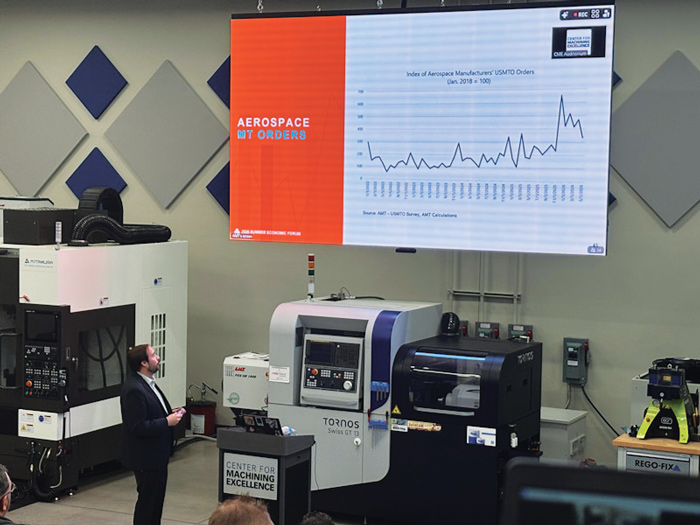
AMT Principal Economist Christopher Chidzik discusses manufacturing technology orders from the aerospace industry. (Photo courtesy AMT – The Association For Manufacturing Technology)
In such a varied economic environment, opportunities may depend on end-market exposure, automation needs, capital expenditure plans, and the ability to manage costs. From navigating AI integration to addressing automation needs, manufacturers are making decisions now that will impact long-term financial outcomes.
Growth Drivers
Overall, demand signals are improving. Signs point to increased capital investment and a focus on technology adoption, according to Mark Killion, director of U.S. industries at Oxford Economics. These factors led Oxford to upgrade its outlook for machine tool orders, now forecasting a 20.4 percent annual increase in 2026. As of May 2026, machine tool orders were up just over 30 percent year to date.
The buildout of AI infrastructure, including the massive push to expand data centers, continues to drive growth, particularly in the electronics and electrical sectors. Similar growth patterns are emerging in the space economy and defense spending, with major investments leading the industrial recovery. Even outside the space and defense sectors, technology and durable goods producers are expected to lead capex growth.
Businesses are reinvesting profits to realize productivity gains and continued growth. The market is also benefiting from the cyclical nature of machinery investments.
“Inventories are cyclical…The big story is we’re in the middle of an industrial recovery, and it’s investment-led, which is a perfect setup for industrial machinery and machine tools in particular,” Killion explained. “The capex wave is starting to broaden out a bit. It led growth last year…but it was very concentrated in AI infrastructure. This year, it’s broadening out to additional industries.”
Killion noted that new orders for oil and gas machinery were up 42 percent and defense goods were up 32 percent in the first quarter, while industrial machinery was up 39 percent; turbines, generators, and construction machinery were up 20 percent; and electrical equipment was up 12 percent.
The Markets Powering Manufacturing Growth
During his presentation, AMT’s Principal Economist Chris Chidzik narrowed the focus from the broader economy to manufacturing technology orders and customer demand. Some manufacturing segments have rebounded faster since 2021 than others, Chidzik noted. He also emphasized the importance of automation demand and its connection to rising average order values, ongoing labor constraints, and productivity demands.
“In 2025, demand for automation was about four times higher than in 2018,” said Chidzik, adding that one reason is the increasing availability and affordability of automation for shops that may not have considered it in the past.
A company’s outlook tends to depend heavily on its customers, making specific end-market strategies essential to success. For instance, job shops, medical manufacturers, and aerospace and defense companies all face different demands and investment needs.
In aerospace and defense, extensive backlogs and new defense production needs are supporting continued investment in machinery. Aerospace orders spiked sharply at the end of 2025 and remain elevated.
Medical manufacturing is benefiting from demographic trends as the population ages and demand for customized medical interventions increases, Chidzik noted. In fact, manufacturing technology orders from medical manufacturers were up 9 percent from May 2025 to May 2026.
In May 2025 alone, industrial machinery producers purchased the most manufacturing technology since November 2017. “Those producers are foreseeing increased demand and investing now,” Chidzik said.
Risks and Uncertainties
Risks remain. Higher costs, high interest rates, inflation, and geopolitical uncertainties continue to impact manufacturing planning for late 2026 into 2027, creating the potential for a rocky recovery in some manufacturing sectors, according to Killion.
In particular, rising costs are a challenge for both manufacturers and their customers. Killion explained that high energy prices and strong demand may delay inflation relief, keeping margins under pressure. Inflation has been slow to resolve and remains elevated, putting margins at risk. Killion also noted that continuing uncertainty surrounding the conflict in Iran and the blockage of the Strait of Hormuz have led to persistent supply risks and elevated costs.
Manufacturing workforce challenges continue to hinder companies seeking to grow. Despite increased automation, manufacturers still face a shortage of skilled workers and a tight labor market.
“There’s still a huge demand for people to do a lot of jobs,” Chidzik said. “Automation can only get you so far. It sounds quite counterintuitive, but sometimes the most automated shops…[employ] the most people.” Chidzik noted that while production can be automated, companies often need more employees in shipping, accounting, HR, management, and other support functions. Complex manufacturing still depends on a well-trained workforce and integrated automation.
About the Author
Christopher Downs is the director of data products at AMT, where he leads the development of research tools and data products that power strategic decision-making across the manufacturing technology industry. Since joining AMT in 2015, Chris has held diverse roles spanning product development, data strategy, research operations, marketing, user growth, and survey methodology.