Boker’s Inc.
Over the years, Boker’s has continued to invest in advanced equipment and new processes to meet the evolving needs and product diversification of its customers.
Boker’s Inc. is a precision metal stamping specialist with more than 100 years of experience in manufactured custom stampings and washers, helping OEMs in all industries meet tight tolerances in applications that require precision stamped components. Boker’s is AS9100:2016 and ISO 9001: 2015 certified, as well as a certified Women-Owned business (WBENC.)
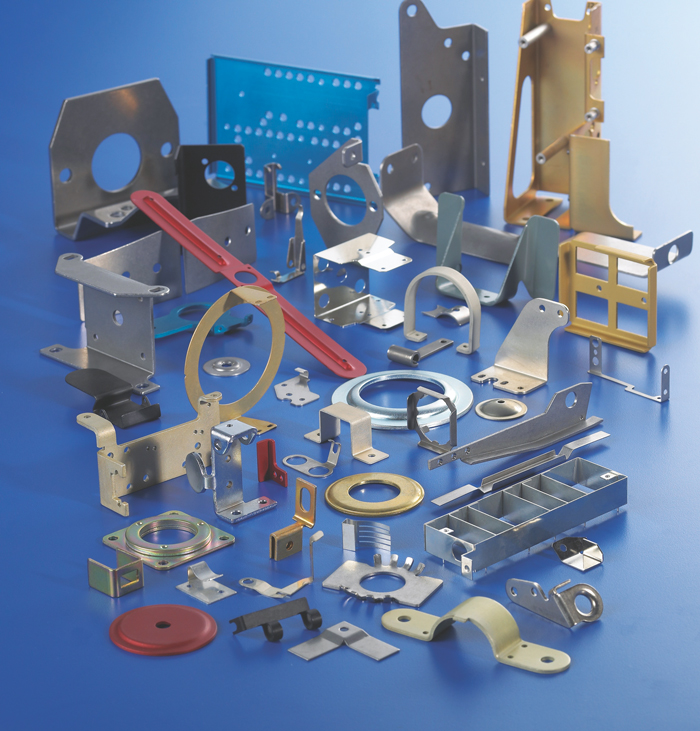
An assortment of precision stampings produced by Boker’s at its Minneapolis facility. (Photo courtesy Boker’s, Inc.)
Boker’s states that it leads in the stamping industry by meeting or exceeding quality objectives, by on-time delivery, and through meeting or exceeding customer service expectations. Its team accomplishes all of this with cost-efficient processes, trained and engaged employees, and continuous process improvements aligned with recognized international quality standards.
The company offers more than 32,000 non-standard flat round washer, spacer, and shim sizes with no tooling charge. Its specialty is making these non-standard washers to the customer’s precise specifications. Boker’s shapes more than 2,000 types of metal, plastics, laminates, and other materials. Certificates of compliance or chemical/physical analysis are available upon request.
Boker’s operates a 165,000-square-foot facility in Minneapolis that includes a raw stock and shear department, tool and die department, and heat-treating department, as well as stamping, washer, and secondary operations, cleaning/deburring, inspection, and shipping departments. The company has 46 punch presses from 10 to 180 tons, and two high-speed Minster progressive die presses rated at 60 and 150 tons. It also operates two material handling conveyors, two optical part detection systems, and a high-speed Aida progressive die press of 121 tons.
The company’s inspection department includes a Keyence vision system, a Numerex Coordinate measuring machine, a digital Buehler hardness tester, and a digital profilometer, among other inspection devices. The cleaning and deburring department includes a Lewis ultrasonic cleaner, a peeling centrifuge, a custom multi-station vibratory deburring system, centrifuge tumblers, and heated centrifugal dryers, among many other cleaning and deburring devices.
Over the years, Boker’s has continued to invest in advanced equipment and new processes to meet the evolving needs and product diversification of its customers.
Among its many capabilities, Boker’s manufactures Belleville washers, which have a conical shape that customers use when they need the washer to support a high-capacity load in limited space with small deflections. These washers are typically made from beryllium copper or from high carbon steel.
Among Boker’s other washers are whatever a customer orders, such as metallic flat washers, non-metallic flat washers, custom washers, specialty flat washers, or finishing washers. The company also makes tab washers, tab lock washers, beveled washers, serrated tooth cup washers, countersunk washers, or, to simplify it, any combination of millions of shapes, sizes, and types.
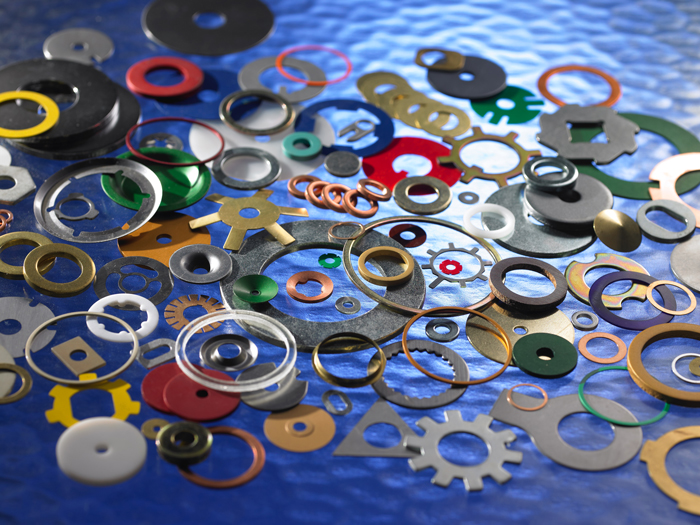
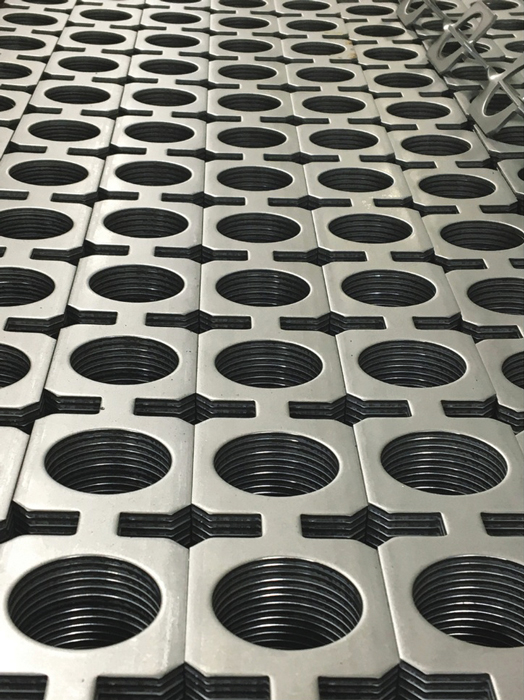
A variety of custom washers produced by Boker’s. (Photo courtesy Boker’s, Inc.)
Boker’s precision metal stampings can be as large as 12-inch by 12-inch flat in any thickness from 0.005-inch to 0.190-inch. The draws can be as deep as 3-inch with a diameter up to 8-inch. Secondary operations include deburring, tapping, reaming, counterboring, and spot facing, among others. Boker’s has access to more than 2,000 material options for precision metal stamping.
At Boker’s, fast delivery is the standard practice. The company can also meet customers’ delivery and stocking requirements with flexible ‘Just in Time’ and ‘Dock to Stock’ programs.
After founding Boker’s in 1919 in Vitus Boker’s basement, Vitus and his son John Boker called the company V.A. Boker and Sons, Inc. Next, his children William, Richard, and Marie, joined the firm, and Boker’s developed a reputation for tooling knowledge, prototypes, and for manufacturing custom parts for automated machinery.
Boker’s has been owned and operated by two families in the last 107 years and is now owned and operated by its fifth-generation family. Today, Boker’s continues the values and traditions of its founder for high-quality components, hard work, and attention to detail.
That’s why companies on the forefront of technology have trusted Boker’s to manufacture precise, made-to-order metal stampings and washers for applications in aerospace and defense, robotics and automation, alternative energy, medical and dental equipment, and more, producing anywhere from 100 parts to millions of parts for customers around the world.
For more information about Boker’s, visit https://www.bokers.com.
ETCO
ETCO’s precision stamping capabilities include the manufacture of automotive industry parts, such as distributor terminals, spark plug terminals, and battery post terminals, among others.
ETCO, founded in 1947, is an advanced metal stamping house that built its reputation on engineering precision metal stamping, as well as high-volume and low volume stamping.
The company’s engineering abilities include designing and manufacturing prototype tooling used to manufacture tight tolerance, metal stamped parts in a range of volumes. For the automotive, appliance, and medical markets, ETCO manufactures high volume parts. In some cases, ETCO produces parts at up to 1,500 parts per minute.
Among its specialties, ETCO makes automotive industry parts, including distributor terminals, spark plug terminals, insulated straight and right-angle boots, battery post terminals, heavy duty ring terminals, and stamped top post battery terminals. This work recalls the first ETCO products, its original patented plug blades.
The blades were placed in strips and on reels so they could be crimped to a wire two at a time, instead of being soldered one at a time by hand. This increased production speed tenfold. Faster production and reduced labor remain one of ETCO’s goals, and that means improving its customers’ productivity.
ETCO’s expert die makers ensure all tool and dies are engineered and made in-house to maintain material thickness, in a range of alloys and configurations, from 0.008-inch to 0.090-inch, with tolerances of 0.002-inch. ETCO operates manufacturing facilities in Warwick, Rhode Island, and in Bradenton, Florida.
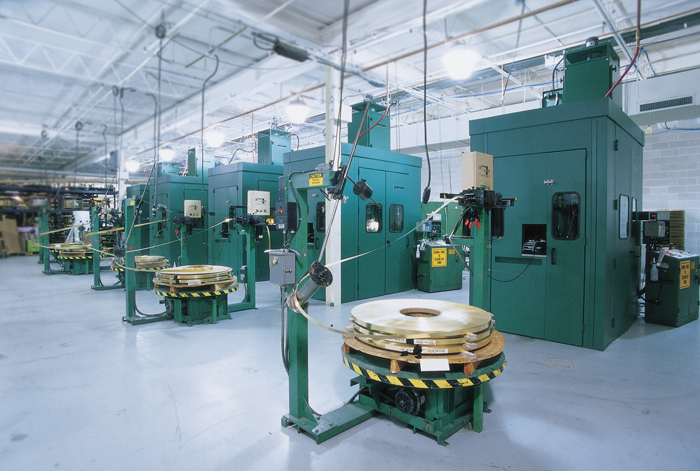
A view of ETCO’s shop floor. The company manufactures a variety of precision stamped electrical terminals for numerous industries. (Photo courtesy ETCO)
ETCO operates more than 20 high-speed Bruderer stamping presses, from 10-ton to 60-ton, that operate nearly 24 hours a day. In addition to designing and engineering tools and dies in-house, the company also builds tools and dies in-house using CNC machines and electrical discharge machining (EDM). Its metal stamping capabilities include in-die tapping for threaded features, in-die assembly of mixed metal and multi-component parts, as well as riveting, staking and contact insertion. They also include selective tipping, reel-to-reel epoxy coating, and skiving for contoured thickness profiles.
“Our in-house engineering department provides customers with a turnkey solution, including design development, rapid prototyping, production, and custom automated assembly machinery,” the company said.
ETCO stamps a wide range of materials, including aluminum, brass, bronze, cold rolled steel, copper, nickel plated steel, stainless steel, and various special high-performance copper alloys.
With approximately 1,500 standard products, along with its custom precision stamping and tooling capabilities, ETCO serves a wide range of industries, including automotive, appliance, medical, HVAC, power generation, agriculture/off-highway, marine, electronics, and other industrial applications.
“From starting with only the most high-quality raw materials to collaborating with your team throughout the development process, we’re committed to creating a solution that keeps your product running smoothly,” the company said.
Operations such as bending, welding, brazing, crimping, cutting, inserting and component attachment may be performed in-strip or with custom-designed equipment, in-house.
When it comes to crimping, tighter is not necessarily better. A quality crimp requires the correct amount of compression between the terminal and conductor to produce a secure mechanical and electrical connection. An over-crimp can damage or crush the wire strands, while an under-crimp can result in a loose connection and poor electrical performance. So technically, the goal isn’t to produce the “tightest” crimp, but rather a properly controlled and repeatable crimp.
In addition to designing equipment to augment tool and die capabilities, ETCO also designs and builds automated assembly and wire-termination equipment. These machines are integrated into a customer’s robotics, pick-and-place systems, vision inspection, PLC-controlled automation, and high-speed wire processing.
ETCO’s research and development team looks for ways to improve the status quo, such as looking for an improved crimping method, for highly reliable electrical connections. “We understand that even the smallest parts can make a huge difference. Your unique products deserve innovative solutions, so we work with your engineering team during the prototyping stage to custom-make intricate parts,” ETCO said.
ETCO’s manufacturing started with the patent to speed the manufacture of plug blades, the flat metal blades attached to plugs that are inserted into electrical outlets. Many of its products involve electrical connecting, including the above mentioned wire-termination equipment, as well as spark plug terminals, insulated straight and right-angle boots, battery post terminals, heavy duty ring terminals, and stamped top post battery terminals.
For more information about ETCO, visit https://www.etco.com.
Micro Forms, Inc.
Precision metal stamper Micro Forms combines deep technical know-how with hands-on collaboration and a practical, get-it-done attitude to help customers work through production challenges.
Micro Forms Inc. has spent nearly six decades earning a reputation as a precision metal stamping partner that companies can actually count on. What began in 1967 as a small machine shop in Garland, Texas, has grown into a full-scale stamping operation serving customers across the country. These customers range from electronics and telecommunications firms to energy, aerospace, and industrial manufacturers who need parts that hold up under demanding conditions.
What sets Micro Forms apart is how integrated the operation really is. The company designs and builds its own tooling in-house, which means engineers are involved from the earliest design and prototyping conversations all the way through full production runs. That kind of hands-on collaboration lets Micro Forms fine-tune a part for manufacturability, tighten lead times, and hold consistent tolerances over the life of a program, rather than handing a print off to a vendor and hoping for the best.
The company runs more than 20 stamping presses ranging from 20-ton to 150-ton, some capable of striking up to 1,000 times a minute, which gives it the flexibility to handle both long production runs in the millions of parts and shorter, quick-turn jobs of under 10,000 pieces that need rapid tooling changes and design flexibility.
That short-run side tends to draw a different kind of customer: electronic OEMs prototyping a bracket or housing, medical device makers validating a new design, industrial machinery companies that just need a replacement part fast. Tolerances can be held to plus or minus 0.001 inch, and the material list runs wide: stainless steel, cold rolled steel, aluminum, copper alloys, and beryllium copper, among others.
Stamped parts produced by Micro Forms Inc. (Photo courtesy Micro Forms)
Across those industries, the part list is long. For electronics customers, Micro Forms produces terminals, pins, lugs, grounding brackets, blades, jaws, and probes. For energy and utility customers, it stamps mounting systems used in solar installations and battery storage. Aerospace work includes seating and personnel components, backed by full traceability and documentation control. Telecommunications customers rely on Micro Forms for EMI shielding, connectors, panels, brackets, and chassis, while the fluid motion industry sources rotors, blades, panels, and replacement components.
Value-added services round out the offering: Tapping, deburring, assembly, heat treatment, and finishing can all be managed, which lets customers consolidate suppliers instead of juggling several vendors for one part. Everything runs under an ISO 9001:2015-registered quality system, with in-process inspection and statistical process control built into the workflow rather than bolted on at the end.
“Our tool makers design durable tooling systems built to sustain repeatability and reliability over extended runs, which cuts down on maintenance interruptions and keeps part quality consistent from the first piece to the millionth,” said Angus Gascoigne, vice president of operations at Micro Forms. That mindset underscores how the company approaches new business: Prototypes are co-engineered with the customer and modeled as closely as possible to what production will actually look like, with honest conversations about capabilities rather than overpromising just to win the work.
In an industry where reliability is everything, Micro Forms leans on responsiveness and long-term relationships to set itself apart, two of the values the team holds itself to on the shop floor every day. The team combines deep technical know-how with a practical, get-it-done attitude, helping customers work through shifting requirements and production challenges as they come up, rather than after the fact.
As manufacturers keep feeling the squeeze between cost, quality, and speed, Micro Forms continues investing in the people, equipment, and processes that keep it a dependable partner for precision metal stampings that are built to last and designed with long-term value in mind.
For more information about Micro Forms Inc., visit https://mforms.com
QDP Inc.
To avoid particulate contamination, QDP can perform precision stamping, laminating, and slitting in a cleanroom environment.
QDP Inc. manufacturers high precision stampings for the hard disk drive (HDD) industry to dampen vibration on the suspension arms of the hard disk drives. The hard disk drive industry is growing due to AI and demand for data storage on the cloud.
QDP was founded in 1995 as a manufacturer of vibration control dampers. Three years after its founding, QDP bought the Hard Disk Drive vibration damper business from 3M Industries, the developer of the viscous adhesive dampening agent, including existing production contracts, tooling, and inventory. Today QDP, Inc. remains a certified 3M Converter.
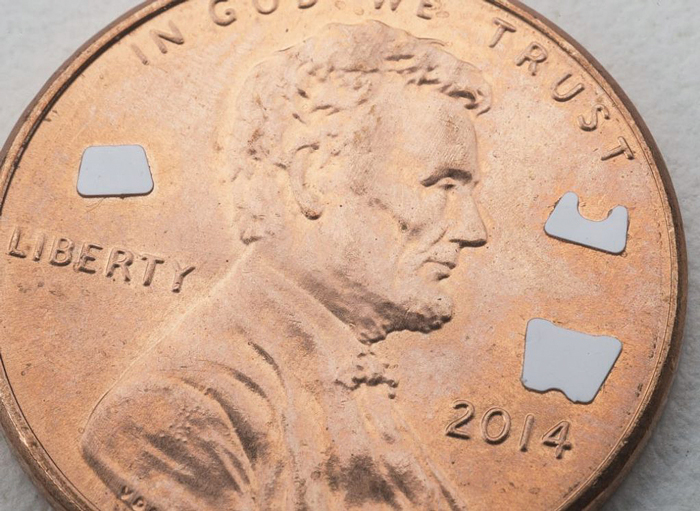
Tiny anti-vibration parts used in HDDs are shown on the penny. The parts are made in a cleanroom from a 0.002-inch thick plastic film that is laminated with a 0.002-inch-thick adhesive. (Photo courtesy QDP Inc.)
During its manufacturing processes, QDP laminates a substrate of either plastic film or a variety of metal foils with various adhesives and then slits it into narrower strips per customer specifications. The company holds 0.001 tolerances on slit metal materials and plus-minus 0.010 on slit film materials, versus the industry standard tolerance of plus-minus 0.030.
When the customers’ requirements call for parts to be stamped from a laminated material, QDP designs and builds the required tooling in-house. All of the processes—laminating, slitting, and stamping—are performed in a cleanroom environment. QDP, with decades of experience, can advise the customer on decisions about films, adhesives, and the proper process to follow. All lamination takes place in a cleanroom to avoid any particulate contamination. QDP states that it has provided the hard disk drive industry with two billion plastic film vibration dampeners.
QDP expanded its manufacturing space in 2000, and in 2019, and now designs and builds all of its stamping dies in-house. For the last 22 years, the company has been expanding its stamping business to include customers in medical, automotive, and electronics. QDP is ISO 9001: 2015 quality certified and focused on long-term, high-volume business.
The company processes copper foils, aluminum foils, stainless steel foils, specialty alloys, laminated metal with adhesive constructions and films, and multi-layer materials. Its production options include reel-to-reel stamping, continuous strip processing, cleanroom packaged finished components, and custom kit packaging.
QDP specializes additionally in slitting and packaging. Its ISO Class 10 cleanroom provides metal and laminate stamping for the medical, electronics, aerospace, and industrial markets.
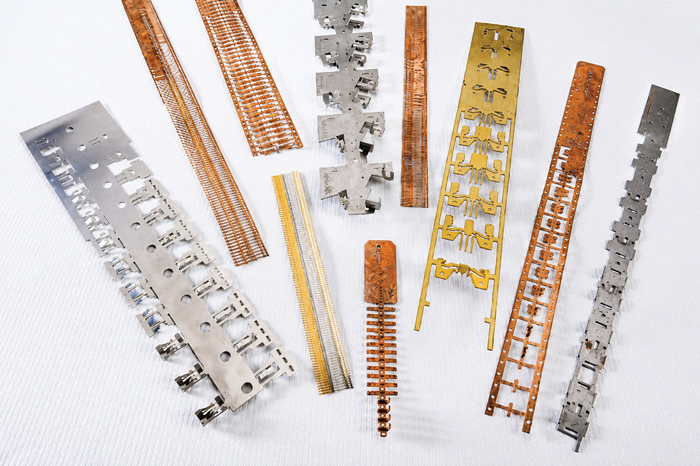
QDP produced these precision-stamped die strips from a variety of materials, including phosphor bronze, brass, copper, cold-rolled steel (CRS), and stainless steel (SST). (Photo courtesy QDP Inc.)
The company also specializes in laminating thin layers of metal and adhesive together for the customer’s purpose, such as making the material more conductive, more flexible, stronger, or more insulative. The laminations could be metal-to-plastic or plastic-to-plastic. The laminated material must meet the needs of electronics, medical, or automotive industries.
In slitting, QDP cuts a wide roll into narrower strips to tight tolerances, with precise edges. Many of these strips are then used in manufacturing that requires demanding tolerances. For many materials, QDP can hold a tolerance of 0.010.
In 2025, QDP helped a customer by suggesting a metal substrate change, which, after testing, lowered the customer’s materials costs by 70 percent. QDP has 31 years of lamination experience, and it happened to have experience with an alternative metal the customer hadn’t considered.
As reported in a case study, QDP was asked to help Geospace Technologies shield a metal with a plastic film laminate. QDP provided advanced prototyping, a materials recommendation, and agile project management. QDP said the customer found through its own testing that the metal QDP recommended not only cost 70 percent less than the one the customer proposed, but the suggested metal also provided better results.
During the project, the client needed to change the part configuration. Because QDP designs and builds all dies in-house, it did the revision to the die in-house, holding down the cost and at the same time delivering the finished products on time.
To illustrate its precision, QDP put two tiny anti-vibration parts used in HDDs on a penny in a photograph. The devices are made in a cleanroom from a 0.002-inch thick plastic film that is laminated with a 0.002-inch-thick adhesive. Each vibration damper is a fraction the size of Lincoln’s head.
For more information about QDP, visit https://www.qdpusa.com/.
Stamping Company News
Cleveland Manufacturer Talan Products Honored Again as One of America’s Fastest-Growing Inner-city Businesses
The ICIC award marks the eighth time the manufacturer of progressive die metal stampings and fabricated aluminum extrusions was recognized for its sustained growth, job creation, and economic impact in an under-resourced community.
CLEVELAND, Ohio—Talan Products, a Cleveland-based manufacturer of progressive die metal stampings and fabricated aluminum extrusions, has once again been recognized by the Initiative for a Competitive Inner City (ICIC) as one of America’s fastest-growing inner-city businesses, the company said in a release.
The latest recognition marks the eighth time Talan Products has earned a place on the prestigious Inner City 100 list, placing the company among a select group of Hall of Fame recipients recognized for sustained growth, job creation, and economic impact in under-resourced communities across the United States.
Since 1999, the Inner City 100 Awards have recognized some of America’s fastest-growing businesses located in under-resourced communities. The program highlights companies that are creating jobs, expanding opportunity, and strengthening local economies through sustained business growth.
For Talan Products, the award represents more than business success. It is evidence that urban manufacturing remains a powerful economic engine when companies invest in people, technology, and long-term partnerships.
“Manufacturing has always been about creating opportunity,” said Steve Peplin, founder and CEO of Talan Products, in the release. “We’ve spent four decades building a company that creates careers, serves customers, and contributes to the community around us. This recognition belongs to our team members, customers, and everyone who has been part of that journey.”
Founded in 1986, Talan Products relocated in 2005 to a century-old manufacturing facility in Cleveland’s Nottingham neighborhood. Since then, the company has continued investing in equipment, workforce development, and operational excellence while serving customers across North America.
From its location in Nottingham, Talan Products demonstrates how manufacturing can remain a source of economic opportunity in urban communities. The company employs more than 100 team members and has built its workforce by investing heavily in training, employee development, and long-term career growth.
In addition to high-volume progressive die metal stampings and fabricated aluminum extrusions, Talan Products also specializes in value-added assemblies. The contract manufacturer serves OEM customers throughout North America and is recognized for its focus on quality, delivery performance, and engineering-driven manufacturing solutions. Today, Talan Products manufactures hundreds of millions of components annually for industries that include building products, renewable energy, electrical infrastructure, transportation, HVAC, lighting, and industrial equipment.
The company’s continued growth stands in contrast to a common narrative that manufacturing in urban America is in decline.
“There’s a common misconception that manufacturing in urban communities is a thing of the past,” said Peplin. “We experience something very different every day. We have skilled people building products, supporting families, and creating value for customers across North America. That’s what this recognition celebrates.”
“This recognition is a great reminder of the journey we’ve been on over the past 40 years and the momentum we’ve built for the future,” said Adam Snyder, president of Talan Products, in the release. “Being named to the ICIC Inner City 100 list for the eighth time reflects the strength of our team, our culture, and our commitment to delivering real value for our customers. As we look ahead, we’re excited about the opportunities to grow, innovate, and continue making a positive impact in the markets and communities we serve.”
The Inner City 100 program was founded by renowned Harvard economist and business strategist Michael Porter, and the Initiative for a Competitive Inner City, to recognize high-growth businesses located in urban communities throughout the United States. Companies are evaluated based on revenue growth and economic impact.
As Talan Products celebrates its 40th anniversary in 2026, the company continues to invest in advanced manufacturing technologies, employee development, and long-term customer partnerships while demonstrating that Cleveland remains a place where manufacturing can thrive.
To commemorate both its eighth ICIC recognition and its 40th anniversary, Talan Products has released a short documentary-style film exploring the company’s Cleveland roots, commitment to workforce development, and the role manufacturing continues to play in creating opportunity in urban America.
The film can be viewed here: https://youtu.be/78l7N4nzMpc