The Heavy-Duty Dynamometer Test Facility is a national resource that will help lower the risk of investments in new technologies for heavy-duty vehicles. The facility integrates real-world research, testing, and simulation to reduce development time and strengthen U.S. freight competitiveness.
LEMONT, Ill.—Building next-generation medium- and heavy-duty vehicle technologies is increasingly complex, costly, and time-intensive. Manufacturers and fleet operators must evaluate new propulsion systems, fuels, automation, and connectivity technologies under realistic conditions. At the same time, they must manage regulatory requirements, capital risk, and compressed development timelines to meet market needs.
The U.S. Department of Energy’s (DOE) Argonne National Laboratory’s Heavy-Duty Dynamometer Test Facility addresses these challenges by providing independent, science-based validation of next-generation heavy-duty vehicle systems. Using a dynamometer, the facility simulates real-world driving conditions in a controlled environment by applying load (the forces a vehicle experiences during driving) to a vehicle’s wheels.
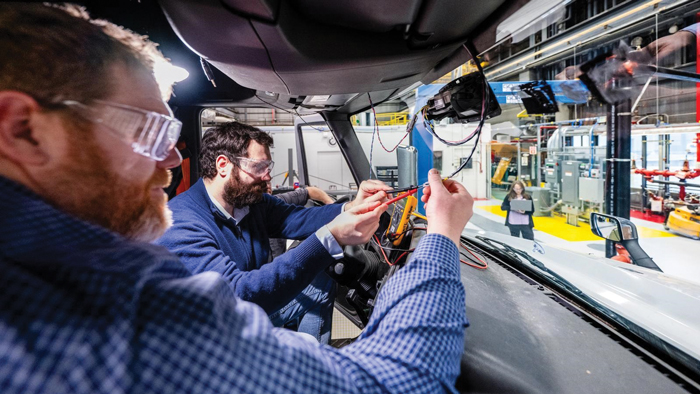
The Heavy-Duty Dynamometer Test Facility enables research connecting real-world components, as seen here, with powerful simulation programs, controls, and modeling. (Image by Argonne National Laboratory.)
The first-of-its-kind facility combines full-vehicle testing with real-time simulation and corridor-level analysis within a single research environment. It features comprehensive energy instrumentation and an automated “Anything-in-the-Loop” workflow—a method that bridges simulation and validation to iterate on technology improvements. This enables industry and government researchers to evaluate performance, efficiency, automation, and system interactions under highly controlled, repeatable conditions that reflect real-world freight operations.
Developed with funding from DOE’s Transportation Technologies Office, the facility will help the freight industry to achieve new efficiencies faster by shortening development timelines and reducing the technical and financial risks of new investments. Even a modest 2 percent to 3 percent gain in freight efficiency creates hundreds of millions of dollars in savings over a decade, with substantially larger returns as these improvements scale across the U.S. fleet.
“Medium- and heavy-duty trucks move our economy,” said Claus Daniel, associate laboratory director of the Advanced Energy Technologies directorate. “With this facility, Argonne delivers the rigorous, repeatable research and testing industry and government need to bring new technologies to the market that reduce transportation costs.”
The facility pairs a state-of-the-art heavy-duty chassis dynamometer with virtual traffic environments, vehicle connectivity tools, real-time simulation platforms, world-leading controls, and modeling expertise. Industry and government users can evaluate and improve propulsion systems, fuels, components, connectivity, and automation technologies under repeatable, real-world conditions, ranging from a single truck to an entire simulated freight corridor.
The facility’s high-power, high-torque research and testing features include:
- Burke Porter Model 4701, 4×2 configuration with four rollers and two centrally located electric machines for maximum flexibility and repeatability.
- Support for Class 3-8 vehicles, with test weights from 10,001 to 82,000 pounds.
- RWD, FWD, AWD vehicle layouts with adjustable wheelbase from 100 to 280 inches.
- Strategic siting within Argonne’s Transportation Complex to leverage existing infrastructure, security, and adjacency to complementary laboratories.
- Scalable electrical, mechanical, and data systems to support future propulsion technologies and automation levels.
Industry partners are invited to engage in early-to-pilot technologies, co-develop test protocols, and shape national validation pathways for emerging freight solutions. Flexible contracting mechanisms are available for collaborative research and development programs.
To explore collaboration opportunities, contact Byungho Lee (byungho.lee@anl.gov).
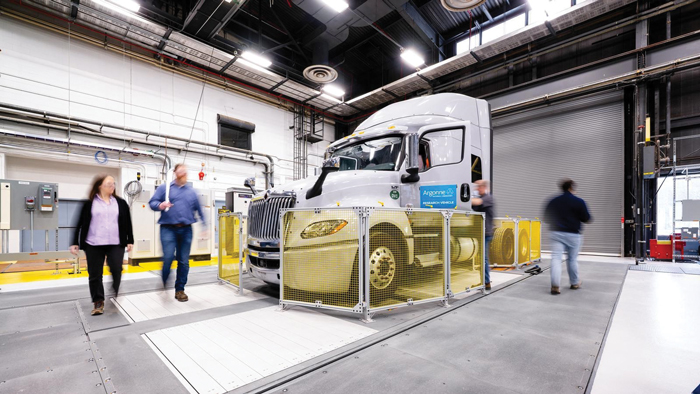
Argonne’s Heavy-Duty Dynamometer Test Facility pairs a state-of-the-art heavy-duty chassis dynamometer with virtual traffic environments, vehicle connectivity tools, real-time simulation platforms, world-leading controls, and modeling expertise. (Image by Argonne National Laboratory.)
Argonne National Laboratory seeks solutions to pressing national problems in science and technology by conducting leading-edge basic and applied research in virtually every scientific discipline. Argonne is managed by UChicago Argonne, LLC for the U.S. Department of Energy’s Office of Science.
The U.S. Department of Energy’s Office of Science is the single largest supporter of basic research in the physical sciences in the United States and is working to address some of the most pressing challenges of our time.
This article originally appeared as a feature story in the online newsroom of Argonne National Laboratory’s website.