
New York-based Becker Electronics is celebrating its 30th anniversary this year, buoyed by a recently awarded AS9100 certification that is opening up new opportunities for aerospace work.
By Mark Shortt
When Joe Lattanza was a young sales engineer in the 1980s, he didn’t envision how important all those factory tours and trips to different companies in the U.S. and abroad would ultimately prove to be. It wasn’t until decades later that he fully realized their significance.

Joe and Paula Lattanza are co-owners of Becker Electronics, serving as president and vice president, respectively. ‘Yes, you can work with your spouse and it can be a successful relationship,’ Joe Lattanza said. (Photo courtesy Becker Electronics)
“I learned so much by just walking through another company’s manufacturing floor, and even their offices, and seeing what was going on in the back rooms of companies and corporations in the United States,” he said in an interview with Design-2-Part. It really did come out of me when I was trying to assemble our company.”
Today, it’s fair to say that Becker Electronics President Joe Lattanza has been living his career dream since he and his wife, Paula, took ownership of the company in 2018. Since then, the Ronkonkoma, New York-based contract manufacturer has made significant improvements to its engineering department, tooling and production capacity, and quality management system. Now well into the fifth decade of his career and counting, Lattanza relishes the whole package of company ownership—the work, the people, the excitement, the growth, and the achievements.
“I love people and I get to meet all types of people, companies, production lines, and new customers all over the world,” Lattanza said. “My wife, Paula, and I have been married for 42 years this month of May, and I love working with my best friend and mother of our three daughters. We just became grandparents, too. What a magical year we’ve celebrated!”
That’s not to say Lattanza hasn’t had his share of doubters along the way. When some of his college buddies heard that he was planning to buy the company, they weren’t shy about offering their opinions on the matter. He heard things like, “Hey, you’re buying a company? You’re almost 60 years old. What are you, crazy? We’re all retiring!”
“It’s that type of thing that, every time I think about it, I laugh to myself,” he said.
Becker Electronics is a build-to-print electronics contract manufacturer that specializes in custom cables, wire harnessing, and assembly. Founded in 1996 and celebrating its 30th anniversary as a business this year, Becker Electronics serves customers from a wide swath of industries—“all markets that require electronic assembly,” according to Lattanza. That includes mission-critical markets with stringent quality requirements for high-reliability components and assemblies.
Now, the company is rapidly gaining steam as it expands its reach into key markets. Last October, the company earned its AS9100D:2016 certification, demonstrating that Becker Electronics meets the requirements of the internationally recognized quality management system (QMS) standard for the aerospace and defense industry.
Calling it a team effort by all employees to focus on the demands of the AS9100 standard, Lattanza said the certification catapults the company into contention for more projects in the military and aerospace arena.
“That really gives us the platform to go to any defense electronics house and look for new business,” Lattanza told Design-2-Part. “I’d been bringing military and aerospace [projects] on board even before we achieved our AS9100, and now it’s growing rapidly.”
Although the corporation owned by Joe and Paula Lattanza is commonly known as Becker Electronics (not Becker Electronics Inc.), its official name is Big Joe Electronics Inc. In December of 2018, Big Joe Electronics Inc., doing business as Becker Electronics, acquired Becker Electronics, Inc. Today, Becker Electronics Inc. no longer exists, as it was dissolved in 2019.
Lattanza named the company Big Joe Electronics Inc. because he’s been called “Big Joe” nearly his entire life. He acknowledged that he likes when people greet him with “Hey, Big Joe!”
“People laugh when I tell them, ‘Yes, the name of the corporation is Big Joe Electronics Inc.,’ and I laugh with them. It’s good.”
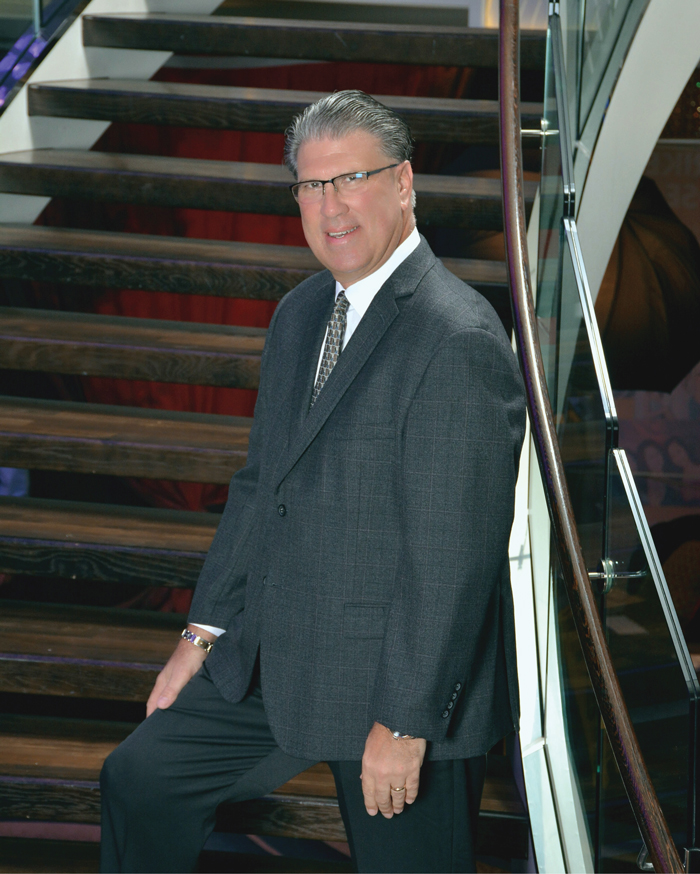
Joe Lattanza’s years of experience with mission-critical industries and the ‘nuts and bolts’ of manufacturing enabled him to hit the ground running when he and his wife bought the company. (Photo courtesy Becker Electronics)
Across the broader spectrum of its business, Becker Electronics handles any type of Class 1 to Class 3 assembly. These class designations refer to IPC categories of electronic assemblies built for products with different performance requirements and life cycle expectations. “Our employees are IPC/WHMA-A-620 certified every two years, and our products are UL approved to meet all the electrical safety standards for the public,” Lattanza noted.
While Class 1 assemblies are used in products such as inexpensive toys that are not required to last long, Class 2 encompasses products like point-of-sale systems and industrial automation panels. Class 2 assemblies typically function for longer periods but they don’t typically pose critical safety risks when they fail to operate.
Class 3 assemblies, however, are needed for high-reliability, mission-critical electronic products, such as those used in the medical, aerospace, and defense industries. Think pacemakers or military weapons systems.
As of 2025, Becker Electronics’ top five markets by volume included, in descending order, the industrial boiler industry; manufacturing and industrial automation; energy and utilities; military and aerospace (mil-aero); and the medical industry. The company also supports the commercial, transportation, instrumentation, and alternative energy sectors.
Forging a Path to Becker Electronics
Lattanza joined the company in 2017 as vice president, before becoming president in 2019. At that point in his career, he had already experienced nearly 40 years of business travel that enabled him to see what he described as “the tremendous need for high-quality, affordable electronic contract manufacturing.”
“The opportunities were everywhere, and my desire to offer companies solutions to their manufacturing needs was endless,” he explained. “I wanted to take my personal workplace experience and provide our employees with all the good I had learned, and be a first-choice place to work on Long Island.”
Prior to joining Becker Electronics, Inc., Lattanza had worked for a handful of different companies, starting on Long Island as an intern at the defense electronics firm Hazeltine Corporation while still in college in 1980. By providing opportunities to work with companies across diverse sectors—including those requiring complex, high-reliability components and assemblies—and immersing him in the “nuts and bolts” of manufacturing and production, Lattanza’s earlier career provided a solid foundation for what he would later undertake at Becker.
“I’ve moved around four or five times and, thank goodness, they were great moves each time,” he told Design-2-Part. “I learned a lot and I was able to take that and compound it into what I have today.”
After graduating college in 1981, Lattanza worked as a design engineer in the R&D department at Hazeltine for about five years. During his tenure there, several people encouraged him to get into technical sales because of his personality.
“I understood the technical issues, I understood the technology, and I’m pretty much an extrovert, an outgoing person,” he said. “I understood the ‘geek’ language, but I wasn’t a geek, and I found that by going into technical sales, I really was able to broaden my career.”
Lattanza went to work for Watkins-Johnson, a company that built RF devices, RF components, amplifiers, switches, and mixers. He covered New York and Upstate New York, as well as Connecticut and New Jersey, as the New York field sales engineer.
“Once a month for a week, I would go to Syracuse, New York and cover Syracuse and Utica where General Electric was, and I covered their ground radar at Carrier Circle,” he said. “I also drove to Utica to call on GE Avionics Systems Division (GE ASD). So, I learned a lot by visiting all these companies, touring their facilities and talking to their engineers, and finding out what their problems were and how we were going to solve their problems.”
From Watkins-Johnson, he went to work for a master distributor in the HVAC industry. There, he became assistant to the president, an opportunity that helped prepare him for his current role at Becker Electronics by training him to critically review and manage financial statements. After working there for 10 years, Lattanza came back to the electronics industry as a manufacturers’ representative.
“I represented companies like AVX Capacitors, Power One Power Supplies, Bussmann Components, and EBM Fans, and learned a lot about all different types of companies and OEMs that needed these products. I also learned a lot about all the different types of manufacturers that we were representing,” he said.
From the manufacturers’ rep job, Lattanza went to BAE Systems and ran the F-16 and F-18 engineering production line for 10 years, working as the engineering production support manager.
“Those were very exciting years for me, especially working on the F-16 with the Air Force and Lockheed Martin, and the F-18 with Boeing and the Navy,” Lattanza recalled. “I learned a lot about manufacturing and the problems in manufacturing, and also documentation control and configuration.”
In 2016, while working as director of engineering with an electronic components distributor, Lattanza met the owners of Becker Electronics Inc. Three years earlier, he had been recruited by the distributor to bring value-added manufacturing to the distributorship.
The distributor wanted to add value to the components it was selling, by either soldering wires onto them or integrating them into a larger assembly. That way, they could change the part number to the assembly part number, and other distributors couldn’t compete on a part number-by-part number basis.
“They (other distributors) wouldn’t know the part for the assembly, and they wouldn’t have the capability to do the labor, the added value that we were doing,” Lattanza said.
By 2016, Lattanza needed to find a source for all the new business the distributor had brought in, and that’s when he met Becker Electronics Inc. He began bringing new business to Becker, to the tune of what would become approximately $2 million worth of new opportunities. It was a diversified range of mostly smaller projects, from customers across the United States that needed cable and harness and electronic assembly projects.
The owners were overwhelmed with all the new business Lattanza was bringing to them. “They asked me, ‘What’s going on here? Nobody just comes to us and brings us $2 million worth of business.’”
“I didn’t give them $2 million in one sitting. I would give them a $25,000 order, then we worked it up to $50,000 and maybe $100,000,” he said. “Then, when we got to $250,000, they said, ‘Stop. Stop everything. What’s going on here? What are you doing? Who are you?’ It was like a scene from Mission Impossible.
“I told them the whole story, and they said, ‘Listen, why don’t you come work for us directly?’ So, I came to work for them.”
At the time, the company’s owners were nearing 70 years of age. They made it clear to Lattanza they were looking to sell the company and wanted to bring him on board to help them boost their sales and help them find a buyer. As Lattanza continued to bring more business to Becker Electronics Inc., the owners entertained approximately a dozen candidates to buy the company.
Three of them made genuine offers. The owners made counteroffers, and one company accepted the counteroffer. But ultimately, the owners decided not to proceed with the offer.
“At that point, I already had planted a seed in my mind that maybe this is my opportunity. Maybe this is my chance to put an offer in,” Lattanza said.
“I knew all the numbers, I had been working there almost 14 months. I came up with a business plan and made an offer to buy the company. The owner accepted the letter of intent. Then we spent another year working with lawyers and accountants and bankers and insurance agents to put the whole deal together. And on December 17, 2018, Paula and I became owners, 50 percent owners, each, of Becker Electronics.”
Opportunity of a Lifetime
Lattanza’s previous experience in markets like electronic devices, HVAC, and military-aerospace (mil-aero) suited him well in his new role with Becker Electronics, as he began expanding the company’s reach into these sectors. Today, mil-aero is a large and growing market for them.
“Defense electronics has pretty much been in my blood since the beginning of my career,” he said. “There was no military and aerospace work at Becker Electronics, Inc., when I first joined them.”
Since 2018, the company has added staff, tools, and equipment to handle the higher volume of projects that have been coming its way. The new business is largely a result of the company’s expansion into high-demand markets for military-aerospace aerospace assemblies, RF coaxial and semi-rigid assemblies, and box and panel builds, as well as large automation cabinets, according to Lattanza.
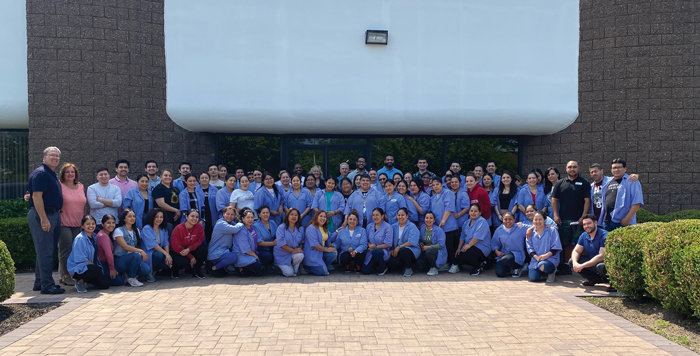
A group photo of the Becker Electronics team. Company President Joe Lattanza credited Becker’s AS9100 certification to ‘a team effort by all employees to focus on the demands of the AS9100 standard.’ (Photo courtesy Becker Electronics)
Lattanza said Becker Electronics’ business with medical customers has been strong for many years, and the company continues to maintain strength in its role as a provider of medical assemblies. “We’ve just been bombarded by an influx of cabinet orders in some of the other sectors,” he said.
Lattanza added that although the company has invested in capital equipment and has automated as many functions as possible, many manual functions are still required in its operations. Today, Becker Electronics employs 100-plus team members, up from 72 when Lattanza and his wife purchased the company.
Building More Than Assemblies
Lattanza’s wife, Paula, is vice president of the company, sharing ownership with him equally. She’s also the human resources manager and handles payroll for Becker’s more than 100 employees.
“She also does all the taxes for the IRS and for New York State,” Lattanza said. “She’s a tremendous asset to the company, as well as a partner.”
Before joining her husband at Becker Electronics Inc. when they acquired the company, Paula Lattanza had worked for 17 years at a local middle school as a special needs teacher’s assistant.
“In 2018, when I got the opportunity to go to work for Becker Electronics Inc., and then finally, to purchase it, I said to Paula, ‘Now come and join me, and we’re going to work together and build something,’” Joe Lattanza told Design-2-Part.
As it stands today, Becker Electronics is a testament to the couple’s dedication and commitment to excellence, as well as their ability to maintain a successful relationship while working together and anchoring the livelihoods of 100 families.
“That is the most satisfying thing about Becker Electronics,” Lattanza said. “Our employees are hard-working individuals who work very hard to support their families here and abroad.”
The company’s growth and success is also a tribute to the couple’s approach to their work, which embraces the inevitable challenges with a mix of tenacity, realism, and frequent doses of humor.
“Work is a four-letter word, but if you enjoy and love what you do, it’s effortless; it’s not work. Yes, some days it’s work, but most days, it’s fun,” Lattanza explained. “I love what we do. I’m sure Paula would rather do something other than payroll on every Monday, but we get it done and then we laugh about it.”
Lattanza said the company, due to the efforts of what he called “a tremendous team,” is extremely fortunate to have doubled its revenues and nearly tripled its floor space since he and his wife purchased Becker Electronics, Inc. in 2018. Today, the company’s 30,000-square-foot facility on Long Island supports more than 30 manufacturing cells.
The key to Becker Electronics’ success, according to Lattanza, is to meet its objective to provide the highest quality products and services, on time, and at the most competitive price. “This is not easy by any means, but we strive to meet this challenge every day,” he said.
Engineers are builders by profession, playing essential roles in planning, problem solving, and orchestrating the manufacturing of parts, components, and assemblies for products, machinery, and equipment. Lattanza, holder of bachelor’s and master’s degrees in electrical and electronics engineering, respectively, is among a select group of engineers whose impact exceeds what has traditionally been expected of people in engineering roles.
Becker Electronics’ growth under his leadership makes sense when you see that his talents as a builder are not limited to technical achievements. His ability to recognize his employees’ strengths, coordinate their skills, and guide team members in working together toward a common goal has been crucial to the company’s success over the last eight years.
When Lattanza joined Becker Electronics, Inc. in 2017, the company employed a part time engineer. Today, Becker Electronics employs a full engineering department consisting of mechanical, electrical, and quality engineers (two of each), as well as an equipment mechanic, senior technicians, and documentation and configuration control personnel.
“As an engineer, I understood the need for this talent, and I started to build this team,” he said.
When asked what strengths he looks for in his engineers, Lattanza replied that he likes proactive engineers that attack problems and follow them to resolution. “Documentation is important once the problem is identified, the solution proven, and the results published so that all of our employees can learn from the exercise,” he said.
Although Becker Electronics doesn’t offer engineering design services, its engineers can—and often do—offer recommendations to its customers’ engineers to improve the manufacturability of their products. Lattanza said he believes “every engineer has that design chromosome in them.”
“Manufacturability is usually the common denominator. When building large volumes, we must have a product that can be built with quality, on a repetitive and consistent basis.”
The company can help prove out designs using a 3D printer. It also provides various means of testing to help ensure quality: customer-specific ATP testing, Cirris testing on high volume jobs, Hi-Pot (high-potential) testing, RF spectrum testing via network analyzer, and 100 percent continuity testing of all products that leave its facility.
Core Manufacturing Capabilities
Becker’s core strength and primary focus is custom cable and wire harness assembly, reflecting an evolution from selling processed wire in Lattanza’s earliest days with the company. Today, Becker Electronics provides panel and box build assembly, integration of cables and harnesses, and large automation cabinets that contain a great deal more than cables, harnesses, and box builds, Lattanza said.
The automation cabinets enclose various materials and products and are built for numerous environments, with Ingress Protection ratings from IP66 to IP68. They can be quite large and heavy, up to 4 feet by 6 feet by 2 feet in volume, he noted. Inside them are power supplies, controllers, PLCs (programmable logic controllers), batteries, fuse and circuit protection, and displays. They also house terminal blocks, DIN rails, and numerous interconnect wires, Lattanza said.
At its 30,000-square-foot facility that supports 32-plus manufacturing cells, Becker Electronics performs a multitude of processes on numerous types of wire.
“We cut, strip, crimp, stuff, twist, solder, heat shrink, mark, label, integrate, test, pot, and mold,” Lattanza said. “We also incorporate PCBs, fans, switches, power supplies, ferrites, and many other components.”
The company can process 10-gauge to 28-gauge wire on its Schleuniger 36S Crimp Centers and can hold tolerances down to 0.06 inches. It can also process heavier gauge wires with other machines and hand tools, including its Thomas and Betts Pneumatic crimpers for battery cables and high-power cables.
One of Becker Electronics’ major strengths is its broad range of tooling, enabling it to handle the industry’s myriad different terminals and crimps for various style connector housings. The company owns more than 100 applicators to handle nearly every connector manufacturer globally, Lattanza said.
“So, no matter what the OEM design engineer comes up with, we can handle it. If on the rare occasion we encounter a new specific terminal, we will invest in the tooling.”
The company recently purchased a Winton Semi-rigid coax bender and cutter, and now offers a full range of services and capabilities for RF and microwave designers on both flexible and semi-rigid coax assemblies, he added.
“It will sound like a cliché, but we’ve worked very hard to become a one-stop shop for electronic assembly,” Lattanza said.
Some of Becker Electronics’ most interesting projects have included harnesses and a power supply module for Steinway’s Spirio II Grand Piano, harnesses for Disney’s Harry Potter Attraction, and high-density 38999 cylindrical connector assemblies for the cockpit of a prominent commercial aircraft. The company has also produced a sensor assembly for a high-volume kidney dialysis pump, and a 70-foot main harness for both a Chevrolet and a Ford school bus, among many others.
During the COVID-19 pandemic, Becker was challenged by a Canadian firm to expedite a harness kit for a ventilator project. The customer needed 10,000 kits, which consisted of approximately 15 assemblies, each in less than 8 weeks or sooner. Among the numerous challenges were material shortages and manpower.
“Our team came together and we worked two shifts, seven days a week for seven straight weeks,” Lattanza said. “We got the job done in less than eight weeks.”
Another project involved the Bossa Nova Robot, a roaming inventory control robot developed by Bossa Nova Robotics that would stroll Walmart store aisles and collect data by taking thousands of photos. Software would then stitch the numerous photos together, using optical recognition to determine inventory counts and what items needed to be restocked the next morning. It would also check prices, overhead stock, and provide a great deal of analytical data. The next morning, the data would be distributed to the Walmart team to restock products and make corrections to pricing.
“We came on board in the concept and design phase, helping the Bossa Nova engineers choose connectors and components,” Lattanza said. “There were 193 cables and harnesses to provide power, signal, ethernet, and HDMI. There were two servers, six cameras, 40 flashes, cooling fans, and many interconnects.”
Becker Electronics won the competitive bid for approximately 90 of the 193 system harnesses. As the fast-paced program evolved, other harness manufacturers couldn’t keep up with the delivery or quality standards required. The company was asked if it could build additional types of cables.
“We entered pre-production supplying over 125 of the cables,” Lattanza said. “By the time we ramped up to full production of 1,500 systems, we had been awarded all 193 cable sets.”
Unfortunately, COVID interrupted the program, and Walmart was forced to cancel the contract with Bossa Nova at 500 systems. “We learned a great deal from this experience since it ran the full course from concept to high volume production,” Lattanza noted. “As with many large-scale projects, there were many changes along the way. Documentation and configuration control were key to our success.”
Lattanza ended his comments about the project by saying that he is grateful to all of Becker Electronics’ suppliers and the manufacturers that contribute to the company’s success. “Without a strong supply chain, contract manufacturers cannot survive and be successful,” he said.
Envisioning More Magic
Becker Electronics’ plans for 2026 include working to increase its visibility and penetration into the semi-rigid coaxial cable market. To that end, the company has invested in new automation equipment that will enable it to bend and build these very specialized assemblies.
As Lattanza remains focused on the company’s goals, he is often asked about the company’s succession plan.
“I get hundreds of emails and texts and snail mail that ask me, ‘Do you want to sell your company?’ The answer that I give everyone is ‘Call me in five years.’ Right now, I’ve got things on my roadmap that I still want to accomplish, things on my bucket list I still want to achieve.
“Again, some days it’s work, but most days, it’s fun. I enjoy planning and I enjoy trying to figure out, ‘Where’s the next area that we’re going to invest money in? What’s the next area we’re going to hire new engineers for?’ Sometimes those questions are hard to answer, but we’re constantly poking to try to find the next opportunity for the company to grow.”
As Joe and Paula Lattanza look toward the future, they see a lot of magic still to come. In addition to the livelihoods that the company provides for its employees, the company is also an investment for their family and the future, Joe said.
“We’re building something. It’s so much fun to build something and see it grow in front of your eyes. It would be a dream come true to see the young managers and leaders in the firm take over the company and continue the legacy.”