Precision Machining Firm Delivers Custom Metal Parts and Assemblies for Mission Critical Applications
Whether it’s machining parts for fuel systems, aircraft cabin interiors, data centers, or drones, Thuro Metal Products applies rigorous, internationally certified quality procedures to every job.
By Mark Langlois
Thuro Metal Products, Inc., of Brentwood, New York, is a 60-plus year-old manufacturer of precision machined metal parts. These CNC milled, turned, and screw machined (multi-spindle and Swiss) parts serve numerous primary national and international markets, segmented into aerospace and defense, and then separately into automotive and industrial.
In addition to shaping metal through these machining processes, Thuro Metal Products provides precision assembly. It prides itself on offering design for manufacturing by working with customers as they design parts to save money on manufacturing.
Among its numerous international quality certifications, Thuro is certified to ISO 9001:2008, a fundamental quality management standard that signals this manufacturer can consistently make high-quality parts on time to meet customer expectations. In addition, the company holds an AS9100D certification to the international aerospace quality standard. A company that wants to bid on parts for aerospace work needs the AS9100 certification to make the bid. Thuro is also compliant with the automotive quality management standard, IATF 16949.
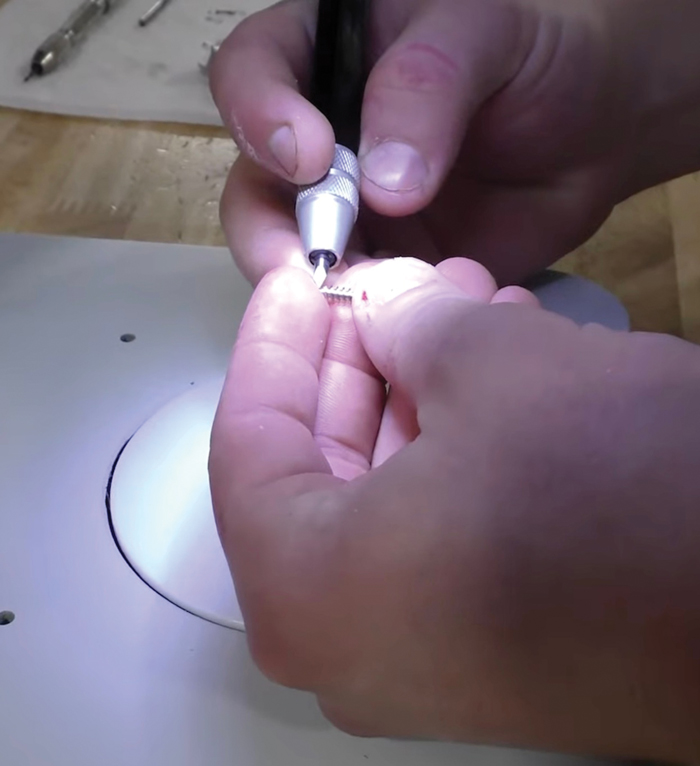
A machined part for a medical application. (Photo courtesy Thuro Metal Products, Inc.)
“We have knowledge and experience with the requirements of Automotive Quality Management systems, such as TS 16949 and the VDA 6.3,” the company’s website stated. “We are able to provide documentation as required under a Level III PPAP (Pre-Production Approval Process).”
In automotive, Thuro specializes in fuel system components, including turned parts under a half-inch in diameter. The company also serves customers in lighting and optics, as well as in medical vision enhancement systems and high-end lighting applications. Thuro employs 56 full-time people, operating in two buildings covering more than 50,000 total square feet.
Parts for New Applications
Company CEO David Thuro said in an interview with Design-2-Part that American manufacturing is going through a bit of a rebirth and renaissance. He attributed this to increased customer demand, increased government support for parts, for worker training and retention, and from new technologies that are expanding manufacturing opportunities. Thuro is making parts for industries that weren’t as prominent a decade ago, such as data centers and drones. Military resupply is a giant growth business.
“We’re starting to see all kinds of different orders from data centers,” David Thuro said. That work includes heating and cooling system components. He said the company’s expertise in aerospace engineering—including work on 737 aircraft turbines—is helping Thuro with data center customers that are now using turbines to generate power. Thuro used to make parts for aerospace turbines, and now it is making parts for turbines used to power data centers. “They’re broadening the applications for turbines,” he said.
Jet engines are helping data centers that must wait to connect to typical utility grids. One published report said data centers were using nearly 5 percent of the nation’s total electricity as of 2023. The new or repurposed jet engines generate power in the same way turbines are used to generate electricity from running water, such as Niagara Falls or the Hoover Dam. They burn natural gas to turn and generate electricity.
Precision Machining for Aerospace and Defense
“For the first time in a long time, we have a front row seat for the U.S. government attempting to reindustrialize,” David Thuro said. “They’re investing in getting manufacturers to train and grow their workforce.”
That is translating into more money for U.S. manufacturers.
“Defense is growing,” Thuro said. Thuro is manufacturing housings and enclosures for drones, both milled and turned. “It was pretty low last year. Twenty-five (2025) was a year of challenges for a lot of people because of the uncertainty. It started to lift by the end of the year, and we got into ’26 strong. Historically, defense is about 15 percent of our business. I see it going up to 25 or 30 percent in the next year. Things seem to have gotten accelerated since the conflict,” Thuro said, referring to both Ukraine and Iran.
Thuro can turn metal parts to as precise a tolerance as 0.0003-inch. It turns numerous metals, including aluminum, steel, alloy steel, brass, and stainless steel. It can turn parts from 0.500-inch to 3.5-inches in diameter, and from 0.500-inch to 12-inches long.
Thuro Metal Products’ ISO 9001:2015 and AS9100 Rev. D certifications ensure the company applies rigorous quality procedures to its machining work, time after time. In CNC milling, Thuro mills to a tolerance of plus or minus 0.0002. The company provides horizontal milling up to 20.1 inch on the X-axis, 20.1 inch on the Y-axis, and 16.1 inch on the Z- axis. It can vertically mill to 40 inches (X-axis) by 20 inches (Y-axis) by 25 inches (Z-axis).
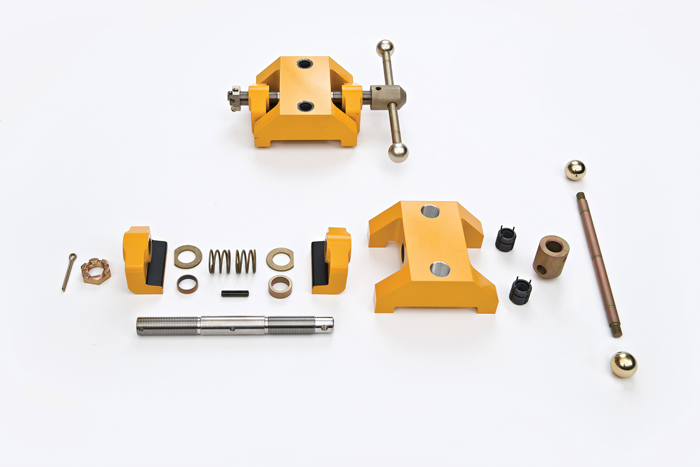
In addition to providing precision machined parts, Thuro Metal Products can assemble those parts into a precision
assembly. (Photo courtesy Thuro Metal Products, Inc.)
Thuro said he believes some U.S. defense spending is inspired by the Ukrainians, who are having success using relatively inexpensive drones to fight Russia. This is changing how militaries are thinking about drone warfare. U.S. manufacturing firms benefit because many inexpensive drones require many inexpensive parts. Other countries are learning the lessons taught in Ukraine. The new technology is creating new opportunities.
An important part that Thuro makes for aerospace is a holding clamp for a helicopter blade. The company makes about 150 of them per year.
The clamp is made from alloy steel 4140, from 15-5 PH steel, aluminum 6061, and cold rolled steel C-1018, using milling cutters, turning tools, drills, reamers, taps, and special assembly tooling and equipment.
“We make a clamp which ultimately winds up holding a helicopter blade during what I must imagine is a maintenance or repair process. The clamp requires extensive milling, turning, outside vendor processing, including Teflon coating and painting, as well as extensive assembly,” Thuro said.
Building a Talent Pipeline
Thuro said a particularly successful government program is the Defense Industrial Base Talent Pipeline Program, or the TPP program. Instead of simply training a new employee on how to run a machine, for example, TPP trains supervisors how to retain workers. That may include taking time to explain expectations, to explain a company’s career path, and outline pay scales. Supervisors are the people at the company who work most closely with new hires, Thuro said, putting them in a position to help retain workers.
Before this program became available, a company might find new workers when the workers’ former employer, a competitor of Thuro’s, failed. But waiting for a competitor to fail isn’t a viable way to find workers or grow a business, David Thuro said.
At the time of this writing, Thuro Metal Products was in the process of buying a building it leases. The company will renovate it to double the capacity of its Swiss turning department. The renovated space will add about 12,000 square feet of manufacturing space and require another 12 to 15 workers.
“You have to find the right person, not just someone you like who wants more money,” Thuro said. “They need to know they have a supervisor who is looking out for them, who will provide them with opportunities to grow, with more recognition, more responsibility, and more pay. Growing people is like growing redwoods. You’ve got to have a minor league system.”
Thuro prides itself on keeping important objectives in mind, including conserving resources, maximizing output, working quickly, and holding down costs. Thuro’s multi-spindle machining cuts small parts by using multiple tools at the same time, a cost-effective way to make many small or medium-sized parts at once. Along with conserving raw materials, Thuro also works hard to limit exposure to lead.
“Over the last several years, the need to eliminate lead from materials and coating in compliance with REACH and ROHS has become important. We have invested in analytical equipment to detect substances such as lead. We have worked with our customers and vendors using no-lead materials and coatings to eliminate risk and ensure compliance,” Thuro said.
By volume, the largest application that the company supports, according to Thuro, is production machining of turned and milled components for fuel systems.
“In the early 1980s, high quality turned components were required to precisely meter fuel used in internal combustion engines,” Thuro said. “We are now a major supplier of precision-turned components used in turbines, both in flight and on the ground. The other major application we support is for aircraft cabin interiors, including air, lighting, and seating solutions.”
Thuro said the customers who fly in private jets don’t want to touch plastic. The cabin interior components are more frequently made of machined aluminum, many of them made at Thuro Metal Products, Inc.