
KULR Technology Group Enters Prototype Battery Development Contract with U.S.-Based Military Drone Manufacturer
The agreement advances domestic drone production and the Pentagon’s drone dominance initiative, the company said.
Pursuant to a prototype development and fabrication agreement with a U.S.-based defense drone manufacturer, KULR Technology Group, Inc., will design, develop, test, and deliver prototype lithium-ion battery packs for unmanned aerial vehicles (UAVs) and handheld controllers, the company said in a June release.
KULR Technology Group describes itself as an energy-systems platform company that enables safe, certifiable deployment of ultra-high-power lithium battery systems for space and defense programs, mobility applications, hyperscale AI data centers, and telecom infrastructure OEMs.

Under a contract with a U.S.-based military drone manufacturer, KULR Technology Group will deliver prototype lithium-ion battery packs for unmanned aerial vehicles (UAVs) and handheld controllers. (Image: KULR Technology Group/Globe Newswire)
Under the agreement, KULR will execute system-level design, battery architecture development, prototype fabrication, functional and safety testing, certification support, and production-readiness activities for the customer’s UAV and ground control station platforms.
Defense and aerospace battery programs typically progress through multi-quarter design, qualification, and production-readiness cycles before generating volume production revenue. Each design-in, including this prototype agreement, establishes KULR as the qualified battery source for the customer’s platform, the company said in the release.
“KULR sits at the intersection of two of the fastest-growing categories in defense: domestic drone production and the advanced battery systems that power it,” said Michael Mo, chief executive officer of KULR Technology Group, in a statement. “This agreement puts KULR engineering directly inside a U.S. drone manufacturer’s UAV and ground control programs, with full responsibility for design, certification, and production readiness.”
The Wall Street Journal reported in May that the Trump administration is pursuing funding arrangements with drone manufacturers, potentially including equity stakes, to accelerate domestic production and reduce costs.
“The initiative aligns with the Pentagon’s $1.1 billion Drone Dominance program, which aims to field 300,000 low-cost attack drones by the end of 2027,” the release stated.
In April, the Pentagon requested $75 billion for drones and counter-drone systems, marking one of the largest year-over-year funding increases across any defense category in the Trump Administration’s proposed $1.5 trillion defense budget. The scale of the request confirms drones as a top national defense priority, creating a powerful demand backdrop for U.S.-based drone supply chains and the advanced battery systems that enable them, the release stated.
According to KULR Technology Group, the global drone battery market is projected to grow at a compound annual growth rate (CAGR) of 17.65 percent from 2026 through 2035, reaching approximately $45.64 billion by 2035. The growth is driven by increasing demand for unmanned aerial systems across defense, commercial, industrial, and logistics applications, the company said.
“As the U.S. accelerates toward fielding hundreds of thousands of drones, KULR’s role as a domestic, safety-certified battery partner becomes more central—and more valuable—to the programs that matter most,” the company said in the release.
X-Bow Awarded Contract for Rapid Delivery of Advanced Drone Technology
The contract is said to validate the company’s ability to ‘build fast, field faster, and deliver now’ to meet urgent defense needs.
Albuquerque-based X-Bow Systems Inc. (X-Bow) reported in April that it won a $12.2 million contract with AEVEX to produce rocket-assisted take-off (RATO) kits for AEVEX’s Disruptor drone.
The contract reportedly calls for X-Bow to deliver hundreds of production kits and thousands of solid rocket motors (SRMs) and components between March and August 2026, demonstrating its ability to rapidly transition from contract award to fielded combat capability in just a few months.
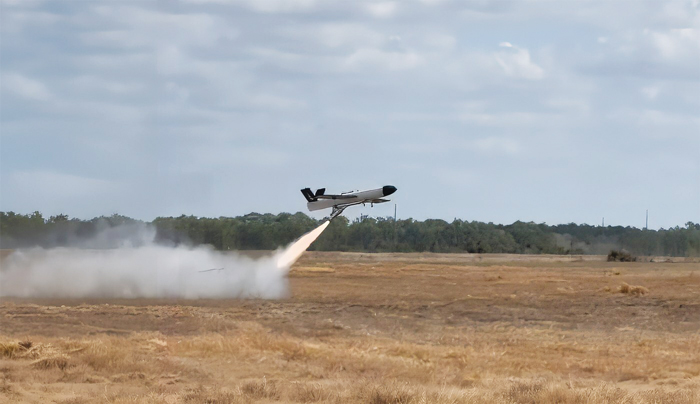
In this photo, X-Bow’s RATO2 motor is launching a Group 3 drone. (Image: X-Bow Systems/PRNewswire)
In an April release announcing the contract, X-Bow Systems described itself as a non-traditional producer of advanced manufactured solid rocket motors (SRMs), sub-orbital launch services, and defense technologies that is helping to spearhead American reindustrialization in the new defense industrial base.
X-Bow’s RATO² (Rapidly Assembled Tactical Option for Rocket-Assisted Takeoff ™) system includes solid rocket motors and launch cradles. By enabling drones to take off from unprepared surfaces and confined spaces, the system significantly expands operational flexibility in modern conflict zones, the company said in the release.
“Our ability to go from contract award to fielded combat capability in just a few months is exactly what today’s rapidly evolving defense landscape demands,” said Jason Hundley, founder and CEO of X-Bow, in the release. “This contract validates our ability to build fast, field faster, and deliver now to meet urgent defense needs.”
X-Bow’s contract is reported to mark the first-ever high-volume use of X-Bow’s patented Additive Manufactured Solid Propellant (AMSP) in solid rocket motors. The unique propellant formulation represents a significant advancement in SRM capabilities, offering potential improvements in performance and affordability for customers, according to the company.
The global military drone market is projected to grow significantly, with increasing demand for systems capable of operating in diverse environments. X-Bow’s RATO² technology addresses this need by enabling drones to operate from a wider range of locations and by potentially extending their payload capacity and range, the company said.
This latest contract caps a series of recent awards for X-Bow, totaling $212 million in the past six months.
“Unlike traditional defense contractors, X-Bow’s agile approach and proprietary manufacturing processes reduce time-to-market for critical defense technologies from years to months,” the release stated. “This rapid turnaround from contract to delivery exemplifies X-Bow’s unique ability to meet the pressing demands of today’s dynamic global security environment.”
Guided by its mission to “build fast, field faster, deliver now,” X-Bow is dedicated to addressing critical munitions shortages and gaps in the defense and space sectors. The company said it plans to expand its product portfolio to address emerging needs aligned with the latest defense priorities. According to X-Bow, this includes hypersonic propulsion and low-cost and advanced missile defense systems, including space-based interceptors and evolved sub-orbital space launch systems.
X-Bow is also said to be enhancing its surge-capable production to meet rapidly evolving defense requirements, particularly in critical munitions and propulsion systems.
X-Bow is headquartered in Albuquerque, New Mexico, with a dedicated R&D facility in Socorro, New Mexico. The company has additional presence in Texas, Mississippi, California, Alabama, Colorado, Utah, Maryland, and Washington, D.C.
U.S. Army Selects AeroVironment’s Portable Loitering Munition for LASSO Program
The award supports the rapid development, delivery, and testing of the company’s ’s Switchblade® 400.
Defense technology company AeroVironment, Inc. (AV) reported in May that it was awarded a prototype agreement from the U.S. Army for the Low-Altitude Stalking and Strike Ordnance (LASSO) program. The award supports the rapid development, delivery, and testing of AeroVironment’s Switchblade® 400 loitering munition, according to a release from AV.
The Switchblade 400 is AV’s medium-range, man-portable, anti-armor loitering munition. The award is said to establish Switchblade 400 as a key component of the Army’s LASSO program, supporting the service’s modernization priorities for rapidly deployable, precision strike capabilities that can operate effectively in contested environments.
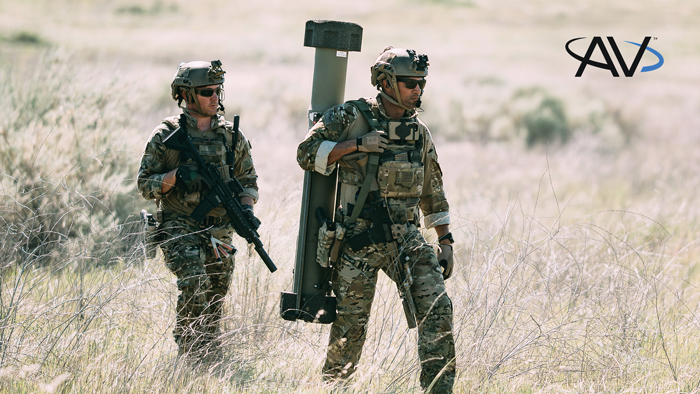
The Switchblade® 400, selected by the U.S. Army for the LASSO program, supports modern battlefield operations by advancing portable precision strike capabilities with AI-enabled targeting and modular design. (Photo courtesy AV)
“This award reflects the Army’s confidence not only in Switchblade 400, but in AV’s ability to deliver at scale,” said Trace Stevenson, president of Autonomous Systems at AV, in the release. “Being selected under the LASSO program positions AV as a long-term partner to the Army as it modernizes its loitering munition capabilities, from development and testing through production, fielding, and continuous capability evolution.”
AeroVironment, an Arlington, Virginia-based defense technology company with a national manufacturing footprint, has built integrated capabilities across air, land, sea, space, and cyber. The company develops and deploys autonomous systems, loitering munitions, counter-UAS technologies, space-based platforms, directed energy systems, and cyber and electronic warfare capabilities. At the core of these technologies is AV_Halo™, which the company described as “a modular, mission-ready suite of AI-powered software tools.”
According to AeroVironment, Switchblade 400 is the first loitering munition purpose-built to operate within AV_Halo™, AV’s modular command-and-control ecosystem. It incorporates advanced, aided target recognition (ATR) and autonomous capabilities to detect, classify, and engage targets, day or night, in denied and contested environments. At the same time, it is said to deliver anti-armor performance comparable to larger systems, like the Switchblade 600 Blk 2.
A Modular Open Systems Approach (MOSA) was implemented in the design of the system to ensure long-term system resilience and relevance. This is said to allow for interoperability, upgradeability, and affordability as missions evolve.
Switchblade 400, known as the “Lightweight Tank Destroyer,” is sized to fit common launch tubes. It is said to enable a sensor-to-shooter concept of operations that allows a single soldier to detect, identify, and engage targets through a unified, networked architecture. This shortens decision timelines while increasing precision, speed, and operational flexibility at the tactical edge. The system includes an all-up round (AUR) that weighs under 40 pounds and provides the soldier with a lightweight, man-portable, anti-tank weapon system, the release said.
“Switchblade 400 is the product of continuous feedback from the field and the soldiers who rely on our systems in real-world operations,” said AV Senior Vice President of Loitering Munitions, Brian Young, in the release. “We are constantly leaning forward, integrating new capabilities, enhancing performance, and reducing the burden on the warfighter. That soldier-driven approach is central to how we develop, test, and deliver capability for the Army.”
The new OTA (Other Transaction Agreement) award under LASSO follows a recent $186 million delivery order from the U.S. Army for Switchblade® 600 Block 2 and Switchblade® 300 Block 20 explosively formed penetrator (EFP) loitering munition systems. That order is part of the Army’s existing five-year, $990 million Indefinite Delivery, Indefinite Quantity (IDIQ) contract under the Lethal Unmanned Systems (LUS) Directed Requirement (DR), which was awarded in August 2024. It was the Army’s first Switchblade order containing EFP payload, delivering enhanced lethality against armored threats, the release stated.
“The Army’s trust in the Switchblade family has been earned through years of real-world use by soldiers who rely on these systems every day,” said AV Executive Vice President of Precision Strike and Defense Systems, Jimmy Jenkins, in the release. “That trust reflects a clear operational need for precision, speed, and adaptability at the tactical edge—capabilities the Switchblade family is designed to deliver as missions and threats continue to change.”
AI-assisted Design and Manufacturing Technology Produces Bipolar Solid-State Batteries for Space Vehicles, Drones, and AI Data Centers
Solidion Technology’s patented, bipolar electrode-to-pack technology provides benefits by increasing battery energy and power densities, the company said.
A patented bipolar electrode-to-pack (BEEP) battery technology, recently unveiled by battery technology company Solidion Technology, Inc., is engineered to power electric vertical take-off and landing (eVTOL) aircraft, drones, robots, AI data centers, and space infrastructure and devices.
Rather than making individual cells and modules, Solidion’s AI-assisted designed BEEP technology entails directly stacking and connecting bipolar electrodes and solid electrolyte layers in series and in parallel, according to a release from the company. The method produces a solid-state battery pack that delivers exceptional power and energy densities, Solidion said in the release.
“Solid-state batteries are expected to revolutionize the electric vehicle and space industries with their inherent safety, fast charging, significantly extended driving or flying range on a single battery charge,” the release stated. “However, two major issues have prevented the wide-spread commercialization of solid-state lithium batteries.”
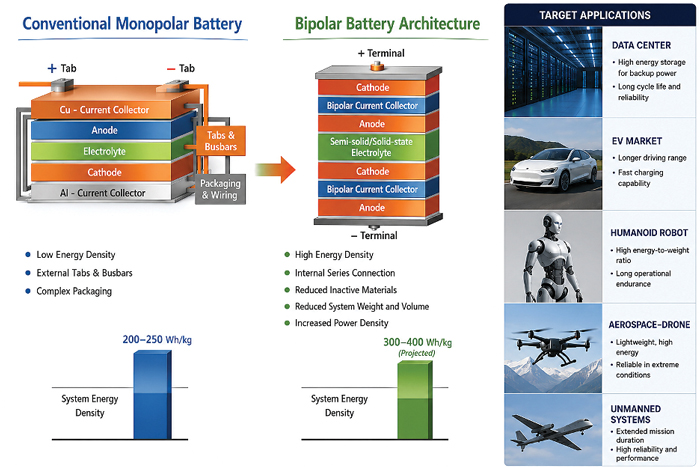
Conventional monopolar battery versus a bipolar battery architecture. (Image: Solidion Technology/PRNewswire)
One is the difficulty and high cost of manufacturing solid-state batteries. The other is the limited space and payload weight available in an EV for ground, sea, air, or space transportation to accommodate a bulky and heavy battery system. Current battery pack designs devote much of that space to fire mitigation, a large number of connectors between cells or modules, and large volumes of protective housing materials, the company said.
Solidion’s BEEP technology is reported to solve this design issue and reduce the manufacturing challenges, while contributing to reduced battery weight, volume, and cost. This is achieved because the BEEP pack requires only one casing and a small number of connectors, instead of the hundreds of housings and connectors in today’s batteries. The bipolar electrode stacking procedure is intrinsically simpler and easier than making individual cells and using external cables to connect multiple pre-fabricated cells, according to Solidion.
“BEEP represents a fundamental rethinking of how battery packs are built,” said Solidion Technology Chief Executive Officer Jaymes Winters, in a statement. “By eliminating the redundant housings, connectors, and fire mitigation systems that burden conventional designs, we’ve created a pathway to batteries that are lighter, smaller, safer, and less expensive to manufacture—precisely the attributes demanded by next-generation eVTOL, space, and AI infrastructure applications. We believe this technology positions Solidion at the forefront of the solid-state battery revolution.”
Headquartered in Dallas, Texas, Solidion Technology operates pilot production facilities in Dayton, Ohio. As a provider of advanced battery technology solutions, Solidion focuses on manufacturing next-generation battery materials and components, and developing high-performance batteries for energy storage. This includes uninterruptible power supply (UPS) systems that serve the AI data center market, electric vehicles, and aerospace applications.
The company said it holds a portfolio of more than 385 patents, covering innovations such as high-capacity, silane-gas-free and graphene-enabled silicon anodes, biomass-based graphite, and advanced lithium-sulfur and lithium-metal technologies.
New Business Division Focuses on NDAA-Compliant Drone Components for American Defense Market
Hoverfly Technologies’ new division is dedicated solely to production of defense drone components, such as drone motors and electronic speed controllers.
A U.S.-based provider of tethered, uncrewed aircraft systems (UAS, or drones) recently introduced a line of drone components that comply with the National Defense Authorization Act (NDAA) and are designed to meet the rigorous demands of defense and commercial drone manufacturers.
Hoverfly Technologies, a Sanford, Florida-based provider of tethered drone systems for defense and security, officially announced the new line in June at Xponential 2026, a trade show for the autonomy (uncrewed systems) supply chain. The high-performance drone components are built by Hoverfly Elements, a new business division and brand of Hoverfly Technologies that focuses solely on components for defense drones, according to a release from Hoverfly Technologies.
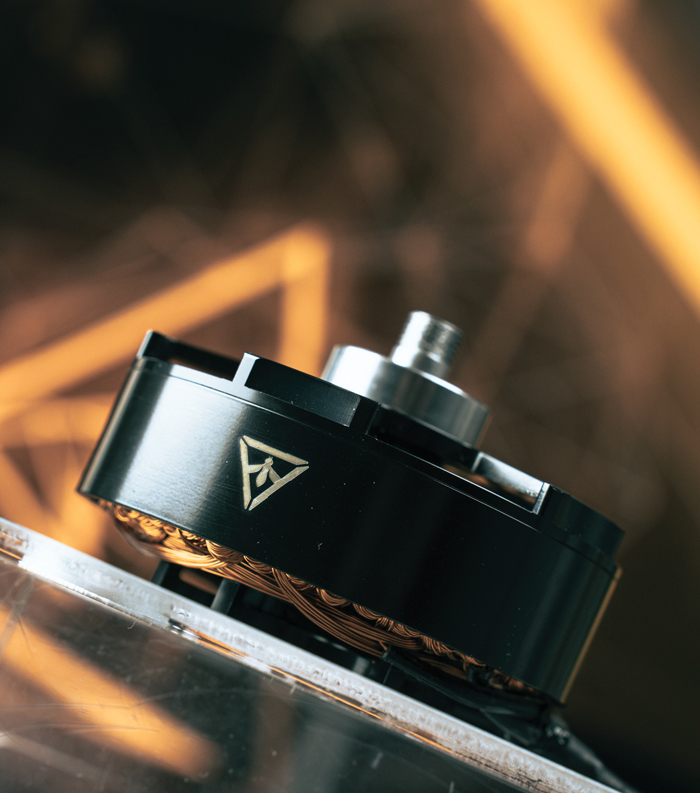
A Stratus class BL8950 Motor from Hoverfly Elements. (Image: Hoverfly Technologies/PRNewswire)
The initial components produced by the Elements division include drone motors, electronic speed controllers (ESCs), and GPS modules. The Elements Motor line is backed by strategic investment and support from Korea Robot Manufacturing (KRM), a prominent manufacturer of high-precision motors, actuators, ESCs, and flight controllers (FCs) for robotics, UAVs, and autonomous systems.
Leveraging a trusted, non-China supply chain and advanced manufacturing capabilities, KRM supports next-generation autonomous platforms worldwide while working to expand its U.S. manufacturing presence. Combining ally-sourced Korean motor manufacturing with Hoverfly’s domestic drone expertise creates a supply chain that is said to be both compliant and credible.
“Expanding globally with localized U.S. manufacturing, KRM brings trusted Korean precision and scalable supply chains to partners worldwide,” KRM’s website stated. ”To meet diverse global demands and support specialized requirements, we are preparing a strategic U.S. site for localized assembly and technical support.”
The GPS modules are “powered by Septentrio,” a Belgium-based designer and manufacturer of multi-frequency, multi-constellation GPS/GNSS positioning technology for demanding applications.
Hoverfly’s launch of its new drone components line and business division reflects the modernization efforts currently underway in the U.S. military, which is prioritizing the production ramp-up of small, precision drones for use in intelligence, surveillance, and reconnaissance (ISR) operations, as well as combat.
“The announcement comes as the U.S. drone components market, valued at approximately $5.9 billion in 2025, is projected to exceed $14.4 billion by 2033, driven in large part by accelerating federal demand for verified, non-Chinese supply chains,” the release stated.
Hoverfly Technologies, headquartered in Sanford, Florida, is on the Blue UAS Cleared List of DoD-approved drone system manufacturers. Its technology enables 24/7 situational awareness and secure communications in the most demanding combat environments.
At Xponential 2026, Hoverfly’s booth reportedly generated immediate and sustained attention from across the drone industry. By drawing in program managers, systems integrators, procurement officers, OEM leaders, and defense technology innovators, it became a hub for substantive dialogue throughout the duration of the event, the company said.
Conversations were said to have ranged from near-term procurement opportunities to long-range collaboration on custom component integration. The common denominator was “consistent enthusiasm around the timing and necessity of a domestically oriented, compliance-first component solution.”
“Xponential confirmed what we already knew: The market is urgently looking for exactly what we’ve built,” said Steve Walters, CEO of Hoverfly Technologies, in a statement. “Industry leaders, potential partners, and key decision-makers came to our booth not just out of curiosity; they came with real problems that Hoverfly Elements is designed to solve.”
Filling a critical gap
According to Hoverfly, the National Defense Authorization Act (NDAA) and recent Federal Communications Commission (FCC) rulings have fundamentally reshaped the drone component landscape. Although previously dominant in the UAS supply chain, Chinese-manufactured components are no longer viable for an expanding class of federal, defense, and critical infrastructure applications. The result is a significant and underserved demand for trustworthy, verified, non-Chinese alternatives.
“Additionally, the recent Drone Dominance Program (DDP) Supply Chain Framework mandates phased, component-level, non-covered-country sourcing across $6.6 billion in sUAS procurement—tightening from NCC assembly in August 2026 to full domestic traceability by August 2027,” the release stated. “Suppliers that cannot demonstrate compliance will be locked out entirely. Hoverfly Elements is built for exactly this environment.”
Motors from Elements are reported to satisfy DDP Supply Chain Framework Phase 2 requirements at launch. An active on-shoring roadmap targets Phase 3 and 4 domestic production standards, laying the groundwork for fully domestic component production at scale. The result is a suite of compliant, high-performance propulsion solutions that are “powered by KRM,” the release said.
Precision navigation
In addition to motors and ESCs, another mission-critical feature for defense UAS operations is reliable positioning. Hoverfly Elements addresses this through a strategic collaboration with Septentrio, a Hexagon company, in the development of high-integrity GPS modules.
“Leveraging Septentrio’s industry-leading chipsets, these modules deliver multi-band, multi-constellation GNSS performance with robust anti-jamming and anti-spoofing capabilities, purpose-built for the demanding environments where defense drones operate,” the release stated. “Concerning the DDP Supply Chain Framework, these GPS modules are engineered for NCC receiver and firmware auditability ahead of the February 2027 deadline.”
The collaboration is described as a cornerstone of the Elements GPS offerings, ensuring that positioning components are not only high-performing but verifiably compliant with NDAA and Blue UAS security standards.
Hoverfly acknowledged that many companies manufacture drone components. However, few have spent more than a decade embedded within the Department of Defense, understanding what compliance, security, and operational reliability actually require.
“Hoverfly Technologies built its reputation by operating within DoD structures, not selling to them from the outside,” the company stated in the release. “That institutional knowledge is the foundation of Hoverfly Elements. The company has deep, first-hand experience with the Blue UAS framework, the DoD’s verification program for trusted, non-Chinese UAS, and is routing all Hoverfly Elements components through this rigorous verification pipeline. Every component that carries the Hoverfly Elements name has been designed with Blue UAS compliance as a baseline, not an afterthought.”
Foundational principles
Hoverfly said its Elements division is built on three foundational principles that reflect what defense and commercial operators need most:
Compliance: Every component is engineered to meet NDAA requirements, FCC mandates, and the Blue UAS verification framework.
Performance: Allied and domestic manufacturing partnerships ensure that compliance does not come at the cost of capability.
Deployment: Speed-to-field matters. Hoverfly Elements is built with supply chain reliability and time-to-delivery as core design constraints, ensuring that operators can get what they need, when they need it, without compromise.
Looking ahead
According to Hoverfly Technologies, the launch of drone motors, ESCs, and GPS modules is only the beginning. The company said it has an active roadmap to expand the Elements product offerings across the full spectrum of critical drone components. Near-term additions currently under development include tether kits, which enable persistent, tethered drone operations that are increasingly in demand for ISR, perimeter security, and extended-duration missions.
“Beyond off-the-shelf components, Hoverfly Elements is built to serve OEM partners directly,” the company said in the release. “The company is actively engaging original equipment manufacturers to offer custom component design and integration services, delivering compliant, performance-verified components tailored to specific airframe and mission requirements. For OEMs navigating NDAA procurement constraints while trying to maintain competitive performance, Elements offers a single, trusted partner with the engineering depth to deliver.”
Drone Manufacturer PDW To Use Series B Financing to Scale Production of Modular Military Drones
The drone technology firm designs, engineers, and mass manufactures AI-equipped, small unmanned aerial systems and mission software for defense, government, and law enforcement.
American drone company PDW Holdings, Inc. (Performance Drone Works®) develops and manufactures, at scale, combat robotic systems and software that provide advanced surveillance, electronic warfare, and strike capabilities for the U.S. and its allies.
In a March release, PDW said it will use the net proceeds from a Series B financing round of more than $110 million to fund future growth initiatives and ramp production of its multi-mission drones, among other strategic programs.
“PDW designs and manufactures at the scale and speed required to meet the demands of today’s rapidly evolving battlefield,” said PDW CEO James Slider, in the release. “Mission-ready small UAS technology is a national security imperative. Our adversaries have proven what’s possible when drone technology is engineered, manufactured, and deployed at scale.”
The drone technology company, headquartered in Huntsville, Alabama, designs, engineers, and mass manufactures AI-equipped, small unmanned aerial systems and mission software for defense, government, and law enforcement customers. It supports contracts with every branch of the U.S. Military, as well as federal, local, and international public safety entities.
The latest financing was led by Ondas and included participation from Hood River, Cedar Pine, Hanwha Asset Management’s venture fund, Booz Allen Hamilton, as well as existing and new investors. The financing brought the total amount funded to more than $110 million.
“PDW isn’t just building better drones, but a domestic production base to meet our nation’s growing demand,” said Ondas CEO and Chairman Eric Brock, in the release. “Their proven technology in real-world environments, growing manufacturing capabilities, and unwavering commitment to mission performance are raising the bar for industry expectations and we’re proud to work alongside them.”
Emerging from the high-octane world of the Drone Racing League, PDW was launched in Huntsville by elite engineers, drone pilots, and U.S. Special Operations veterans. The company said it delivers an integrated portfolio of deployable unmanned systems and software built to expand mission capability and maintain performance in contested environments.
Its portfolio includes the C100 quadcopter, the Attritable Munition strike drone, SIM flight simulator, CORE mission planning software, Multi-Mission Payloads (MMP), Range Extension Kit, and an anti-jam radio.
“The United States cannot afford to fall behind or rely on foreign supply chains,” Slider added. “We are investing in expanded production capacity and a U.S.-anchored supply chain to ensure resilient, domestically built systems delivered at the highest level.”