
Drone Technology Company PDW Secures U.S. Air Force Contract for C100 Tactical UAS
The C100, reportedly capable of 74-minute flight times and 40 mph maximum speed, is said to excel in a variety of missions, including intelligence, surveillance, and reconnaissance (ISR) and electronic warfare.
PDW, a drone technology company aiming to transform small robotics for military and government operations, reported in October that it received its first contract award with the U.S. Air Force for its C100 multi-mission, unmanned aerial system (UAS). The contract marked a major milestone in PDW’s expansion across the U.S. military, according to the Huntsville, Alabama-based company.
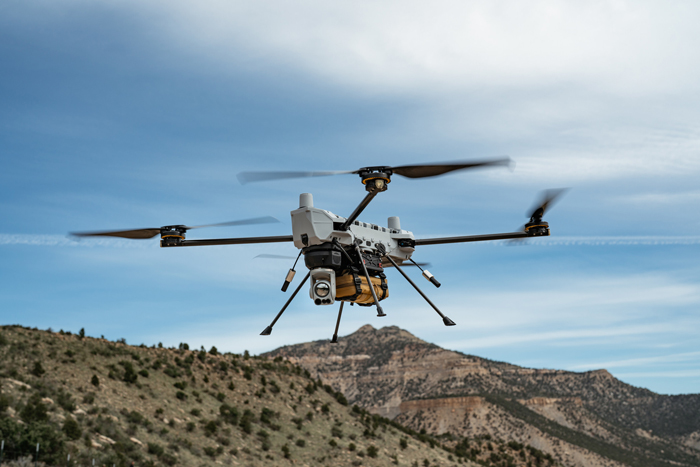
PDW secured a U.S. Air Force contract in October for the company’s flagship, small unmanned aerial system (sUAS), the C100. (Photo: PDW/PRNewswire)
The contract was awarded by the 93rd Air Ground Operations Wing (AGOW). Headquartered at Moody Air Force Base in Georgia, the wing commands four subordinate units supporting diverse Air Force missions across a wide array of operational domains, the release said.
“The U.S. Air Force is seeking advanced, modular solutions to fill a critical gap in rapidly deployable, multi-mission aerial platforms, and PDW’s C100 is the perfect system to deliver on this need,” said Ryan Gury, CEO and co-founder of PDW, in a statement. “The 93rd AGOW’s operational diversity is a perfect match for the C100’s modular payload ecosystem and unmatched performance across a range of mission profiles.”
The C100, PDW’s flagship Group 2 UAS, is engineered for maximum agility, endurance, and tactical flexibility. Described by PDW as “the ultimate force multiplier,” the C100 is reportedly capable of 74-minute flight times, 40 mph maximum speed, and a 10+ km operational range. Offering multi-domain command and control and a modular architecture, it is said to excel in a variety of missions, including intelligence, surveillance, and reconnaissance (ISR), electronic warfare, and kinetic effects.
“The C100’s industry-leading performance and payload modularity enables rapid adaptation and overmatch to evolving threats the Air Force faces across the globe,” Gury added. “We’re proud to help bring that flexibility and scalability to the Air Force’s tactical edge.”
The Air Force award builds on PDW’s recent contract wins from the U.S. Army, including the Medium Range Reconnaissance (MRR) program and the Transformation in Contact Initiative.
Integrating Air and Ground Unmanned Capabilities for Defense, National Security
Hoverfly Technologies and Overland AI are strengthening multi-domain unmanned operations by pairing persistent aerial intelligence with autonomous ground maneuver.
Speeding the development and deployment of integrated unmanned systems for defense, national security, and government customers is the focus of a recently expanded collaboration between Hoverfly Technologies, a Sanford, Florida-based manufacturer of tethered unmanned aerial systems (TeUAS), and Overland AI, a Seattle-based pioneer in autonomous ground vehicle (AGV) technology.
The partnership brings together Hoverfly’s Blue UAS Cleared, persistent aerial platforms with Overland AI’s award-winning autonomy stack for ground systems. By doing so, it is said to create a “tightly coupled air–ground capability that extends sensing, communications, and operational endurance across complex and contested environments.”
“Together, the companies are delivering a remotely operated, multi-domain solution that provides persistent situational awareness and mission resilience,” according to a release from Hoverfly Technologies.
The combined system has been highlighted in demonstrations across the country with organizations such as CAL FIRE, the U.S. Army 82nd Airborne Division, and the Defense Innovation Unit (DIU). These demonstrations have reportedly shown how autonomous ground mobility, paired with persistent tethered aerial sensing, can enhance operational effectiveness in dynamic and contested environments.
Extending autonomy across domains
As the Pentagon accelerates the adoption of autonomous and semi-autonomous systems across formations, the ability for unmanned assets to operate collaboratively across domains has become a priority. Hoverfly and Overland AI’s collaboration directly supports this objective by integrating persistent aerial overwatch and communications with autonomous ground maneuver.
According to Hoverfly, the result is a more resilient and adaptive robotic ecosystem that is designed to operate where traditional platforms fall short.
“Modern operations demand autonomous systems that work together—not in silos,” said Steve Walters, CEO of Hoverfly, in the release. “By partnering with Overland AI, we’re extending the reach and effectiveness of unmanned ground systems with aerial persistence that fundamentally changes how warfighters sense, decide, and act.”
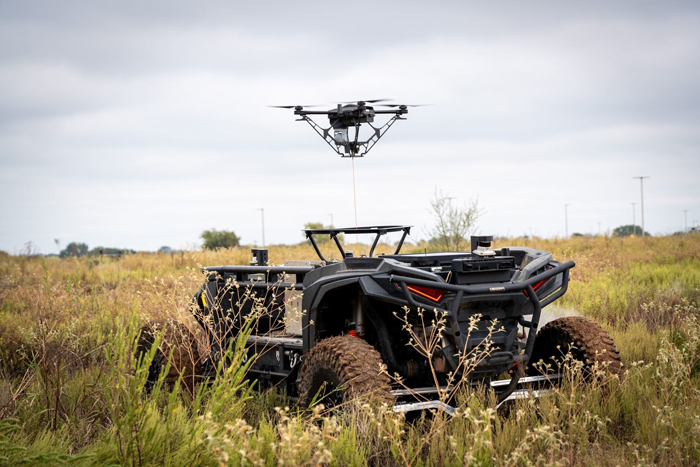
The Hoverfly Spectre TeUAS is deployed autonomously onboard Overland AI’s ULTRA UGV. (Image: Hoverfly Technologies/PRNewswire)
Unlike battery-powered drones, Hoverfly’s tethered UAS provides continuous power and data, enabling hours or days of uninterrupted operation. This is advantageous in command-and-control (C2) extension, perimeter security, and expeditionary missions. When the capability is paired with Overland AI’s autonomous ground platforms, operators are said to gain a decisive advantage in mobility, perception, and endurance.
“Multiple mission sets have been demonstrated through the collaboration, including persistent situational awareness, electronic warfare (EW) sensing, and communications relay,” the release stated. “By combining Overland AI’s autonomous navigation with Hoverfly’s vehicle-mounted TeUAS, operators gain a mobile, elevated vantage point that can remain aloft for extended periods while remaining RF-quiet and logistically efficient.”
According to the release, Overland AI’s ULTRA UGV has consistently demonstrated its ability to project power and sustain autonomous mobility in unstructured environments. Whether supporting intelligence, surveillance, and reconnaissance (ISR), fires, or resupply missions, ULTRA reportedly delivers decisive advantages on the ground for military combatants.
By integrating Hoverfly’s persistent aerial systems, this capability is elevated, transforming the autonomous vehicle into a mobile unmanned platform for extended overwatch and communications retransmission.
“Warfighters need autonomous systems that significantly extend their operational reach,” said Stephanie Bonk, co-founder and president of Overland AI, in a statement. “Our collaboration with Hoverfly delivers a fully integrated, mobile overwatch and communications node to reduce unnecessary risk while sustaining maneuver across the battlefield.”
The Hoverfly–Overland AI collaboration supports key Defense Department priorities, including modular open systems, rapid integration, and scalable unmanned deployment across echelons. The companies’ combined capabilities reportedly address a wide range of operational needs, including extended command-and-control and communications relay; support for autonomous maneuver in complex terrain; and persistent ISR for perimeter security, route clearance, and forward operations. They are also said to reduce the cognitive and manpower burden on operators.
“By emphasizing interoperability and platform-agnostic integration, the partnership aligns with Army and joint initiatives focused on unmanned teaming, multi-domain operations (MDO), and next-generation C2 architectures,” the release said.
The expanded collaboration follows a period of significant momentum for Overland AI. The company recently closed a $100 million funding round, underscoring strong investor confidence in the company’s autonomous ground technology and its role in the future of defense and robotics.
“The investment will support continued growth, advanced research and development, and expanded partnerships—such as the collaboration with Hoverfly—to bring next-generation unmanned capabilities to market faster,” the release stated. “Together, Hoverfly and Overland AI are positioned to help shape the next era of unmanned operations—where air and ground systems operate as a unified, intelligent force.”
As a U.S.-based manufacturer of tethered unmanned aerial systems, Hoverfly Technologies provides persistent intelligence, surveillance, and reconnaissance, communications, and force-protection capabilities for defense, homeland security, and public safety missions. Hoverfly systems are designed for reliability, endurance, and rapid integration across operational environments.
Overland AI, founded in 2022, builds autonomous land systems to defend the United States and its allies. The company is filling a capability gap with off-road autonomy that takes on the critical tasks that put humans at greatest risk. Its products are said to span the full stack across autonomy software, the sensors and control systems that enable perception and maneuver, and in-house manufacturing to deliver autonomous assets rapidly and at scale.
Technology Integration Reported to Extend Aerial Time of Drone Swarms
The joint Scalable Wireless Aerial Recharging Matrix project pairs adaptive intelligence with wireless power beaming to eliminate battery limits on autonomous operations.
Reach Power and Gambit are developing drone swarms that recharge in flight, reducing battery constraints and extending mission endurance.
The companies announced in a June release that their joint Scalable Wireless Aerial Recharging Matrix (SWARM) project was selected for a funding award through the Operational Energy Capability Improvement Fund (OECIF). The fund is sponsored by Air Force Operational Energy and managed by the Office of the Deputy Assistant Secretary of War for Energy Resilience and Optimization.
The OECIF is the Defense Department’s joint operational energy investment program, aimed at funding energy innovations for military applications.
Battery limitations reduce flight times
Group 1 drones, the small, low-cost uncrewed systems increasingly central to modern warfare, typically carry enough battery for about 30 minutes of flight. By the time a swarm is airborne and coordinated, usable mission time is often already reduced. Scaling up with larger batteries defeats the purpose: Cost, weight, and logistics overhead eliminate the advantage of small, “attritable” systems.
“The result is a compounding burden on warfighters,” the release stated. “Before each flight, someone installs batteries in each drone. After every flight, each battery must be removed, charged, and swapped. In contested environments, battery resupply becomes a dangerous logistics problem, and a key reason drone hit rates in active combat zones hover around 30 percent.”
Recharging drones in-flight with power beaming
SWARM addresses this by integrating two emerging capabilities. Reach’s wireless power-beaming technology enables drones to fly to designated waypoints and recharge, mid-mission, without landing and without human intervention. Gambit’s AI-enabled orchestration behaviors, built on its existing autonomous systems framework, enable individual drones to factor battery state, mission profile, and charging availability into real-time decision-making.
Together, the system allows a drone swarm to manage its own energy autonomously by routing aircraft to in-air charging waypoints, sustaining continuous coverage, and freeing combatants from battery logistics.
SWARM is designed to support a range of mission CONOPs where continuous autonomous coverage is critical, including intelligence, surveillance, and reconnaissance (ISR), counter-UAS (c-UAS), border security, air defense, and force protection.
“OECIF’s early investment in power beaming is yielding significant strategic dividends as the battlefield shifts toward autonomous operations,” said Operational Energy and Power Projection Portfolio Lead, Christopher DePuma, in the release. “By enabling remote sensors and drones to maintain persistent ISR, this technology unlocks their true potential—eliminating the tether of battery swaps and constant recharging to provide an unblinking eye on the target.”
Chris Davlantes, founder and CEO of Reach, said that drone swarms are “only as persistent as their batteries,” but SWARM changes that equation.
“When a drone can recharge itself in the air without human intervention, the full potential of autonomy and swarming is unleashed from battery limits,” he said in the release. “OE-I has been an outstanding partner in helping advance this vision, and this OECIF funding award validates that the Department of War is prioritizing ways to fundamentally enable true drone autonomy.”
Josh Giegel is CEO of Gambit, headquartered in Los Angeles. He noted that the current limitation isn’t just about endurance.
“It’s the operational burden that comes with it,” he said in the release. “By enabling systems to manage energy and coordinate behavior autonomously, SWARM allows operators to focus on the mission instead of sustaining the systems.”
SWARM is designed to support a range of mission CONOPs where continuous autonomous coverage is critical, including intelligence, surveillance, and reconnaissance (ISR), counter-UAS (c-UAS), border security, air defense, and force protection.
Reach, based in Redwood City, California, develops wireless power-beaming systems that deliver safe, targeted RF energy over distance. These systems are reported to keep drones, unattended ground sensors, ground robots, and other electronic systems continuously operational without cables or battery swaps. “The technology reduces logistics burden and supply chain risk across defense, public safety, and industrial markets,” the release stated.
Gambit Defense describes itself as “an AI-first software company” that delivers multi-domain, collaborative, behavior-based intelligence for autonomous systems. Its platform is domain- and platform-agnostic, enabling heterogeneous robotic teams to operate as coordinated units in complex and contested environments.
“Gambit allows operators to task robotic systems as they would human teammates by defining the mission space and assigning behaviors, while its unifying intelligence layer translates operator intent into distributed, real-time execution across fleets,” the release said. “The intelligence lives at the edge, enabling adaptive, resilient mission execution without increasing operator burden.”