
The startup is testing ship-based interceptor systems built for manufacturability to close the cost and scale gap in defensive munitions.
LOS ANGELES—Furientis is a defense technology startup aiming to develop cost-effective defensive munitions. The company came out of stealth mode in May and is actively flight-testing ship-based interceptors designed for scalable production to supplement high-cost systems produced in limited volumes, according to a release from Furientis.
As it emerged from stealth, the company announced a $5 million pre-seed fund raising. The round was led by Silent Ventures with participation from Bessemer Venture Partners, SV Angel, and others, including repeat founders of companies such as Anduril, Erebor, and Armada.
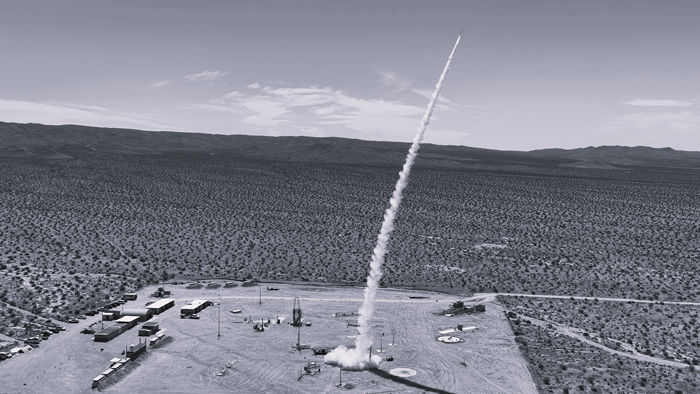
Aerial photograph from a recent Furientis test flight of its low-cost interceptor missile in April 2026. (Photo: Furientis/GlobeNewswire)
Founded in 2025, Furientis is led by co-founders Brody Franzen and Aris Simsarian, who each bring a decade of experience in rocket design and testing at high-growth aerospace companies. Simsarian previously served as a propulsion engineer and manager of Rocket Engine Test at Virgin Orbit. Franzen held roles that included deputy chief engineer at Virgin Galactic and, most recently, as a senior engineer at Castelion, a defense startup that builds hypersonic missiles.
“During the 2024 Red Sea crisis, the U.S. Navy used more than 200 interceptor missiles to defend ships against Iranian-backed threats,” Franzen said in a release. “That matters not only because of the cost imbalance—using $4 million missiles to intercept $40,000 drones—but also because of the scale challenge, with only around 200 of these interceptors delivered annually versus their thousands per year. Our desire to build cost effective, scalable, and reliable interceptor systems en masse to address this deficiency is what inspired us to start Furientis.”
Furientis operates a 9,000-square-foot facility in Los Angeles and follows a rapid, end-user-driven spiral development model. Over the past six months, the company has conducted six flight tests and 10 static-fire tests of its demonstrator missile platform, reflecting a high cadence of development for early-stage defense systems, according to the release.
“To meet the demand stemming from recent stockpile shortfalls and to support long-term U.S. magazine coverage objectives, Furientis is rapidly building and testing its interceptors,” said Jackson Moses, managing partner of Silent Ventures, in the release. “Brody and Aris have significant experience across design, propulsion, and testing, and they’ve structured the company around quick iteration in lockstep with end users. This combination gives them a legitimate path to scale production. Their low price point provides a credible pathway to procurement.”
Furientis has established multiple partnerships with the U.S. Navy and U.S. Army. Earlier this year, the company was selected as one of five finalists, alongside Anduril and Kratos, in the Tactical Missile Innovation Challenge led by the Naval Postgraduate School (NPS) in collaboration with the Office of Naval Research.
The company also recently signed a Cooperative Research and Development Agreement (CRADA) with the NPS, focused on maturation of their system and refinement of government reference architectures. Furientis is continuing to develop its products in close coordination with end-user feedback, the company said.
“Current conflicts continue to highlight the mismatch between the cost, availability, and scale of defensive systems and those of the threats they are designed to defeat,” said Major Dillon Pierce, Ph.D., chief engineer, Marine Corps Rapid Capabilities Office, in a statement. Major Pierce is also a research assistant professor at the Naval Postgraduate School. “Forming CRADAs with industry partners like Furientis allows us to address that gap at the NPS through testing and rapid iteration of viable solutions. It also broadens the defense industrial base to deliver capabilities at greater speed and scale—a win-win.”
Furientis said it will use the funding to expand initial production, accelerate testing of its interceptor system, and grow its team across engineering, manufacturing, and operations.