
PTC’s new system is said to enable a complete system of record for asset data by connecting and contextualizing information from various enterprise systems into a single, unified view.
BOSTON—A new cloud-native asset intelligence system from PTC is reported to “close the gap between the product as designed and the asset as maintained.”
PTC Orbit connects product lifecycle management (PLM), enterprise resource planning (ERP), customer relationship management (CRM), internet of things (IoT), enterprise asset management (EAM), and field service management (FSM) systems into a single, unified asset record. In doing so, PTC Orbit applies AI to make asset information accessible, explorable, and actionable across engineering, quality, and service teams and extends the value of the Intelligent Product Lifecycle, according to a company release.
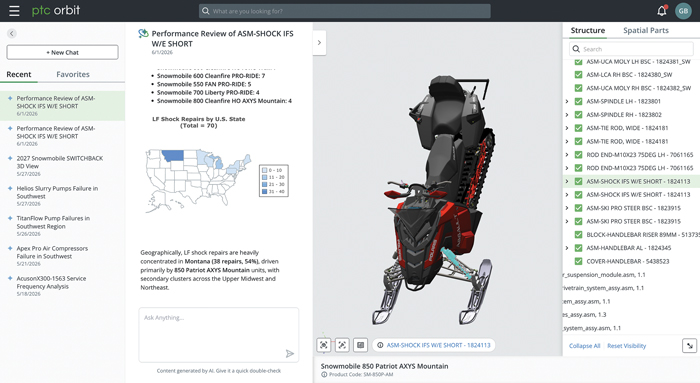
AI-powered PTC Orbit. (Image courtesy PTC)
Manufacturers invest heavily in managing the product lifecycle from design through manufacturing, the company said in the release. Every revision, configuration, and change order is tracked in PLM. But once a product ships, structured visibility ends, and the as-maintained state of each asset becomes fragmented across disconnected systems.
PTC Orbit is reported to fill this gap by serving as the as-maintained system of intelligence, enabling every team to work from the same accurate, current asset view driving closed-loop product reliability, proactive service readiness, and support for aftermarket revenue programs.
“Asset data fragmentation is one of the most persistent barriers to operational efficiency in manufacturing,” Eric Kaese, field service management lead at Deloitte, in the release. “With products like PTC Orbit, organizations have the opportunity to deepen capabilities, moving them from reactive decision‑making entities to more scalable, insight‑led operations.”
“With more than 25 percent of our sewer level monitoring devices offline at any given time, we needed a single, coherent view of network condition and risk across our operations,” said Andrew Oliver, head of operational technology platforms at Southern Water, in the release. “PTC Orbit gave us that capability and the ability to prioritize high-risk areas, optimize field activity, and make more informed investment decisions at scale.”
According to the release, PTC Orbit supports three primary functions:
- Asset data consolidation: It connects and reconciles asset data from PLM, ERP, CRM, IoT, EAM, FSM, and other enterprise systems to create a unified, as-maintained view of each asset, closing the visibility gap that opens when products ship.
- AI-powered lifecycle intelligence: PTC Orbit applies AI to detect service patterns and failure trends, calculate asset health scores, and forecast service and maintenance demand by asset group, account, and region.
- AI‑assisted access and interaction: It enables teams across the enterprise to interact with asset data through an AI canvas that surfaces insights dynamically based on user context, going beyond static dashboards to deliver relevant information on demand.
“Asset data has always existed everywhere, but nowhere could it truly be used,” said PTC General Manager of SLM and AI Strategy, Joseph June, in the release. “With PTC Orbit, we built a new AI-first solution from the ground up to be the system of record for asset intelligence. With this new solution, we’re shifting asset data from something teams manage after the fact to something they can use proactively across the entire product lifecycle.”
PTC is a global software company that enables industrial and manufacturing companies to digitally transform how they design, manufacture, and service the physical products that the world relies on. With PTC Orbit and the rest of its portfolio, PTC is working to deliver on its vision for the Intelligent Product Lifecycle: enabling manufacturers and product companies to build a product data foundation, extend the value of that data across their enterprise, and accelerate AI-driven transformation.
“Broader use of product data enables companies to bring higher quality products to market faster, better manage product complexity, meet regulatory and compliance standards, and much more,” the company said in the release.
Headquartered in Boston, PTC stated that it employs more than 7,000 people and supports more than 30,000 customers globally.