Tight-tolerance Machining Brings Out the Best in Forgings and Castings
Fermer Precision specializes in post-processing machining that gives forged and cast parts the surfaces and precise details they require.
Fermer Precision has manufactured precise metal parts for automotive, pump and compressor, firearms, electric, and optics markets since the end of World War II. Among its specialties is machining both ferrous and non-ferrous castings and forgings, for a wide range of industries.
Fermer Precision has evolved from its roots as a tool and die shop into a high production CNC parts manufacturer with over 90 CNC machines, 80,000 square feet of space, and a full-time staff of certified tool makers experienced in the design, build, and maintenance of new or existing tool and fixture programs. The tool makers ensure seamless transitions of tooling and fixtures from other locations to Fermer. They can reproduce or modify existing tools to accommodate product revisions or productivity increases.
Fermer has more than 75 years of experience in machining valve housings and sensor components, including housings, bodies, collars, cooler bodies, valves, stems, and more.
Because of the company’s size and its numerous CNC metal fabrication machines, it creates what it calls “part family” cells, where similar parts can be manufactured nearby, giving workers time to focus on improving their manufacturing techniques through cooperation. “We rely on the skill, dedication, and experience of our manufacturing team to produce results that meet our standards for quality, reliability and efficiency,” Fermer said.
With more than 75 years of turning experience, Fermer turns electrical parts, including connectors, ferrules, tools, pins, push rods, and more to extremely tight tolerances. The company’s CNC machining capabilities include 4- and 5-axis machining, and pallet changers for dedicated set-ups, to minimize changeovers and increase productivity. It uses its in-house abilities to create specialized fixtures and tooling for multi-piece machining. “We have high-precision wire EDM capabilities for producing intricate profiles and tight radius contours,” the company said.
Fermer is IATF 16949-2016 certified for automotive parts production, as well as ISO 9001: 2015 quality manufacturing certified, and it is a federally licensed manufacturer of firearms. Fermer’s engineering department is tasked with the job of continuous improvement.
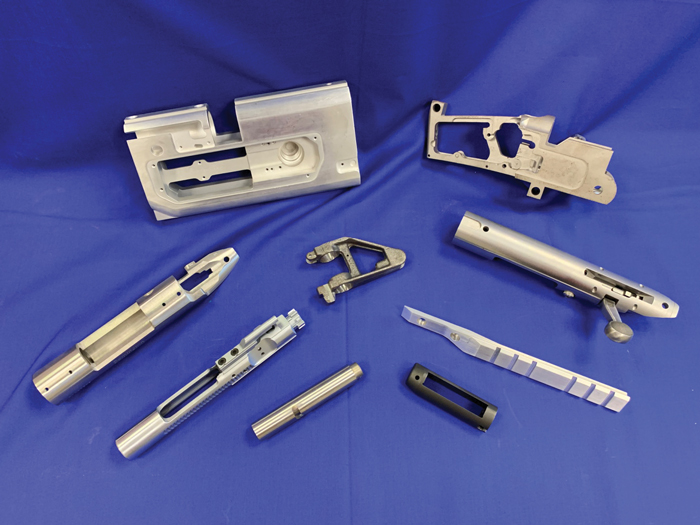
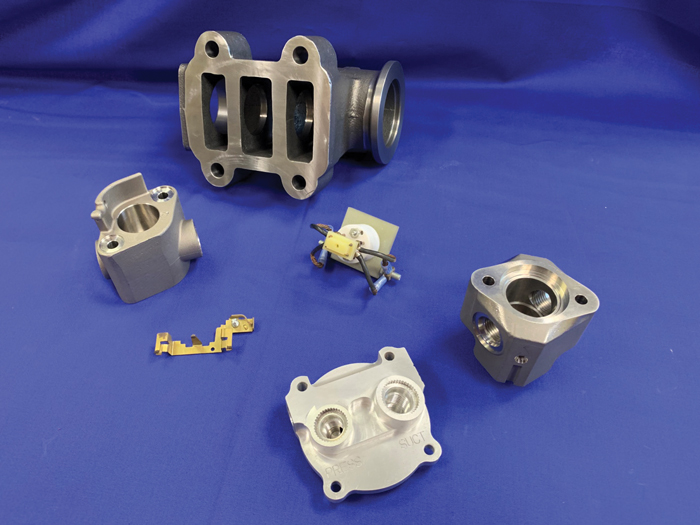
Fermer Precision Inc. has more than 75 years of experience in machining valve housings and sensor components, including housings, bodies, collars, cooler bodies, valves, stems, and more. The company manufactures precision metal parts for the automotive, pump and compressor, firearms, electric, and optics markets, among others. (Photos courtesy Fermer Precision)
“At Fermer Precision, the role of our Engineering team is to develop processes that are efficient, repeatable, and, most importantly, capable of meeting or exceeding the quality requirements of our customers,” the company said.
“The core of our business is precision machining. With over 75 years of experience, we have developed broad capabilities across multiple disciplines, including CNC Swiss Turning Centers, CNC Multi-Axis Mill-Turn Machines, 5-Axis Palletized Machining Centers and wire EDM,” Fermer said. “We are experts in the machining of castings from all ferrous and non-ferrous materials. Whether it is ultra-precise turning of tiny fiber optic connectors or complex 5-axis milling of parts for the automotive industry, we rely on the skill, dedication, and experience of our manufacturing team.”
Machined Forgings and Castings
Castings and forgings must be machined to reach the tight tolerances and accuracy required for the part. Molten metal shrinks, shifts, and cools, and its surface finish may not meet the customer’s standards. When Fermer uses its CNC mills and lathes, it is providing the proper surface and adding precise details the part requires that couldn’t be cast, such as threads, bearing bores, and alignment holes. Post processing can also remove flashing (thin waste metal that slipped between the two mold halves).
For the firearms industry and working as a federally licensed firearms manufacturer, Fermer has experience making firearms components, including frames, slides, barrels, firing pins, bushings, grip screws, and seat pins, among other parts.
“Fermer’s deeply experienced team would welcome the opportunity to work with your team on any current or future projects whereby our deep milling and turning machinery expertise can be of benefit,” Fermer said.
For more information, visit Fermer Precision Inc. at https://fermerprecision.com.
New Roadmap for Modernizing Casting and Forging Aims to Strengthen U.S. Defense Manufacturing
The Casting & Forging Digital Fabric Roadmap released by MxD emphasizes that modernization efforts must integrate technology investment with workforce development, while establishing stronger digital foundations and supply chain visibility.
CHICAGO—In June, MxD released the Casting & Forging Digital Fabric Roadmap, a new report outlining a five-year strategy to modernize one of the most critical sectors supporting the U.S. Defense Industrial Base (DIB).
Developed through extensive research and collaboration with industry, government, academic and workforce stakeholders, the roadmap identifies practical, digitally enabled solutions to strengthen the resilience, productivity, and long-term competitiveness of the U.S. casting and forging (C&F) industry, according to a release from MxD.
MxD (Manufacturing x Digital) describes itself as a “government-funded, industry-led organization determined to boost manufacturing efficiency, instill workers with new digital skills, and enhance our national security.” It is one of the 18 institutes known collectively as Manufacturing USA, a network of regional institutes, each with a specialized technology focus. The institutes share a common goal of securing the future of manufacturing through innovation, collaboration, and education.
Casting and forging operations produce essential components used across military platforms, critical infrastructure, and advanced defense systems. Yet the industry faces mounting pressures, including aging equipment, workforce shortages, supply chain vulnerabilities, and decades of offshoring that have eroded domestic manufacturing capacity.
“This roadmap provides a practical blueprint for how digital manufacturing technologies can help modernize the industry, strengthen supply chain resilience, and prepare the workforce needed to meet future defense demands,” said MxD Chief Technology Officer Clark Dressen, in the release.
The report was developed over four months and informed by more than 100 industry reports, 65 research sources, three multi-stakeholder workshops, and more than 25 stakeholder interviews. The effort engaged 60 participants representing government, industry, academia, trade associations, and small manufacturers to identify the most pressing challenges facing the sector and develop actionable modernization strategies.
The roadmap outlines 24 scalable projects organized across four strategic focus areas: Smart Factory & Automation; Workforce & Talent; Supply Chain & Production; and Standards & Compliance.
Among the initiatives recommended are sensor retrofits for legacy equipment; digital twins for foundries and forge shops; workforce upskilling programs; model-based procurement standards; and supply chain visibility platforms designed to improve readiness and resilience across the industrial base.
The report includes the following key findings:
- The number of U.S. foundries and forge shops has declined significantly since 2000, contributing to reduced domestic industrial capacity.
- Many facilities continue to rely on aging infrastructure and outdated technical data, limiting productivity and slowing digital adoption.
- Workforce shortages and skills gaps remain major barriers to modernization and long-term sustainability.
- Supply chain fragmentation and limited visibility into lower-tier suppliers create significant operational and national security risks.
“The roadmap emphasizes that modernization efforts must integrate technology investment with workforce development while establishing stronger digital foundations and supply chain visibility across the ecosystem,” the release stated.
The Casting & Forging Digital Fabric Roadmap was developed with support from the Office of the Under Secretary of Defense for Research and Engineering, Strategic Technology Protection and Exploitation, Defense Manufacturing Science and Technology Program.
Forged Solutions Group Completes Acquisition of Custom Alloy
Forged Solutions Group, Inc. (FSG), a provider of high specification forgings for the aerospace, defense, and space end markets, recently completed its acquisition of Custom Alloy Corporation (CAC), a manufacturer of forged components headquartered in High Bridge, New Jersey, the company said in a release.
Custom Alloy Corporation is a vertically integrated provider of highly specialized forgings, fittings, and pipe to defense and industrial end users. The company is reported to have developed a strong reputation for quality, on-time delivery, and an ability to manufacture in more than 170 alloys. Its open and closed die forging expertise is further complemented by its in-house conversion, machining, heat treatment, and testing capabilities, according to the release.
As a Level 1 qualified U.S. Navy manufacturer for nuclear forgings and fittings, CAC is a critical supplier to the naval supply chain for key subsurface and surface programs.
“The acquisition of CAC strengthens and diversifies the FSG platform by adding attractive U.S. nuclear navy exposure,” said Alex Harman, managing partner at JFLCO, in the release. “We believe the company is well positioned to support the U.S. Navy’s fleet modernization efforts and the renewed prioritization of and investment in the shipbuilding supply chain.”
Forged Solutions Group Chief Executive Officer Olivier Jarrault said that FSG is delighted to welcome CAC into the FSG family.
“This combination further enhances FSG’s reputation as a world-class provider of high-specification forgings and presents opportunities to cross leverage forging process IP across both companies to further optimize operational capacity,” Jarrault stated in the release. “We look forward to supporting CAC’s continued growth under FSG ownership.”
In support of global OEM and Tier 1 customers, Forged Solutions Group maintains vertically integrated rolled rings, closed die, extrusion, and open die forging capabilities across a range of alloys. These alloys include nickel, titanium, steel, and aluminum. The company is headquartered in Sheffield, U.K., and operates manufacturing facilities across the U.K. and the United States.
Forged Solutions Group is a portfolio company of an affiliate of J.F. Lehman & Company, LLC (JFLCO). Founded in 1992, J.F. Lehman & Company focuses exclusively on investing in the aerospace, defense, government, maritime, environmental and infrastructure industries. The firm stated it has more than $9 billion in AUM across its private equity and credit strategies and offices in New York and Washington, D.C.
The Metallurgy Behind Next-Generation, High-Strength Forged Wheels
DENVER, Colo.—The high-performance automotive market is undergoing a quiet but profound shift. Today’s enthusiasts are no longer satisfied with simply selecting wheels from a catalog. Instead, according to a release from Globalso, modern drivers want the freedom to express their identity through engineering, embracing a new philosophy: “Be the designer of your own wheels.”
This mindset is said to reflect a broader evolution in automotive culture. Performance vehicles have become personal statements, and the components that define them—especially wheels—are no longer just accessories but critical elements of both design and performance.
At the center of this transformation lies advanced manufacturing technology, particularly high-pressure forged wheels, which provide the structural foundation required for both performance and creative freedom.
Unlike conventional manufacturing methods that restrict design flexibility and structural efficiency, high-pressure forging compresses solid aluminum under high force to produce a denser and stronger material structure. This process enables engineers to explore bold geometries, thinner profiles, and complex spoke designs without sacrificing durability.
According to the release, wheel manufacturer RVRN positions itself at the intersection of engineering and personalization. Rather than functioning solely as a wheel manufacturer, the company operates as an engineering platform where vehicle owners collaborate with specialists to transform ideas into functional mechanical components.
“Each project becomes a technical dialogue, replacing the impersonal nature of mass-production with a hands-on design experience. In this environment, customization is not simply a feature—it is the foundation of the entire process,” the release stated.
The Science Behind Forged Wheel Strength
The performance characteristics of forged wheels begin with materials science. RVRN uses 6061-T6 aerospace-grade aluminum, a high-strength alloy widely recognized for its balance of strength, weight, and corrosion resistance.
To maximize the potential of this material, RVRN employs advanced forging technology, including high-capacity 12,000-ton forging equipment. During the forging process, immense pressure compresses the aluminum billet, refining and aligning its internal grain structure.
This contrasts sharply with traditional casting methods. In casting, molten aluminum cools within a mold, a process that can produce microscopic air pockets and irregular grain patterns within the material. These inconsistencies may create stress concentration points that reduce structural resilience under heavy loads.
“Forging avoids these issues by physically compressing the material rather than pouring it. The resulting grain alignment produces a denser, stronger structure with improved resistance to impact and fatigue,” the release stated.
This strength advantage is said to allow engineers to safely reduce material thickness where appropriate, enabling meaningful weight reduction without compromising durability. Lower wheel weight reduces unsprung mass, the portion of a vehicle’s weight not supported by its suspension.
“Reducing unsprung mass helps improve vehicle dynamics, contributing to sharper acceleration response, improved braking efficiency, and more precise suspension feedback. These advantages explain why forged wheels are widely used in motorsport and high-performance automotive engineering,” the release stated.
Durability as a Long-term Asset
High-quality forged wheels are not simply aesthetic upgrades—they represent a long-term engineering investment, according to the release.
Because of their dense grain structure and structural integrity, forged wheels are built to withstand demanding driving conditions over extended periods. This durability means that they function less like disposable accessories and more like enduring performance components within a vehicle’s architecture.
From a value perspective, the benefits extend beyond mechanical performance. Fully customized wheels provide owners with a level of personalization that cannot be replicated by off-the-shelf products. Each set reflects the unique combination of vehicle platform, driving style, and visual identity chosen by the owner.
“The result is a component that delivers both tangible and intangible returns: improved performance, long-term reliability, and the satisfaction of owning something engineered specifically for one machine and one driver,” the release said.
For modern high-performance vehicles, structural wheel strength is not optional—it is essential.
Sports cars from brands such as Ferrari, Chevrolet Corvette, and Porsche place enormous forces on wheel assemblies through rapid acceleration, heavy braking, and high-speed cornering. These demands require wheels capable of maintaining structural integrity under extreme mechanical loads.
RVRN forged wheels are engineered with these environments in mind. The combination of aerospace-grade materials, high-pressure forging, and precision CNC machining creates wheels capable of supporting both track-level stress and everyday driving demands.
At the same time, visual design remains central to the ownership experience. Each wheel is finished with carefully applied coatings and surface treatments designed to deliver both durability and refined aesthetics.
“RVRN brings together advanced materials science, aerospace-grade aluminum engineering, and personalized customer collaboration to redefine what modern wheel design can be,” the release stated. “By integrating 6061-T6 forging technology, precision CNC manufacturing, and a concierge-style customer experience, the company empowers drivers to take full control of their wheel design. The result is a product that combines structural performance with personal expression.”