AirBoss of America
From custom rubber compounding to precision molded vibration dampeners, AirBoss of America offers automotive manufacturers an impressive depth of capabilities.
AirBoss of America Corp. is a specialist in custom automotive-market rubber compounding and shaping. It’s also an innovator in anti-vibration compounds and a leading provider of survivability technology solutions. The company has a manufacturing facility in Auburn Hills, Michigan, and a compounding facility in Kitchener, Ontario, Canada.
AirBoss has three divisions: AirBoss Defense Group, AirBoss Rubber Solutions, and AirBoss Engineered Products.
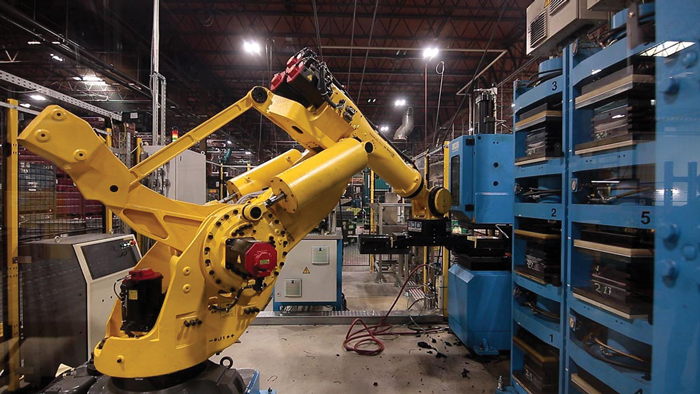
An automated robotic molding machine operates in AirBoss Engineered Products’ Auto Cell, an automated injection molding station that improves efficiency and safety. (Photo courtesy AirBoss Engineered Products)
The AirBoss Defense Group (ADG) manufactures wearable respiratory and personal protective equipment that “enable users to conduct mission critical activities in the most hazardous of environments,” according to the company’s website. In addition to helping soldiers survive in threatening and dangerous environments, its products protect personnel working in high-risk environments in the healthcare, medical, and first responder communities.
The ADG division also provides vehicle protective equipment to allow explosive removal and remediation. In addition, the division supplies the flexible and explosive Bandolier strap used to remove obstacles.
“Our products are designed to offer individuals operating in the world’s most hazardous environments the ability to give their full attention to the job at hand,” the company stated on its website. “We believe dangerous operating conditions should never be a limiting factor to mission accomplishment.”
AirBoss Rubber Solutions (ARS) mixes custom compounded rubbers and elastomers. It has provided contract manufacturing services to the automotive industry since AirBoss was founded in 1989. Today, AirBoss Rubber Solutions is a custom rubber compounder with 500+ million turn compounds of annual capacity for the automotive market and anti-vibration market.
In addition to custom molded parts, AirBoss Rubber Solutions supplies compounded raw rubber for the automotive industry and other industries. AirBoss Rubber Solutions offers cutting edge compounds that improve the finished parts for the automotive and other industries that it supplies.
AirBoss Engineered Products (AEP), the third division, manufactures precision molded components and assemblies for automotive, defense, industrial, and transportation uses. It also manufactures anti-vibration technology for the North American automotive market. AirBoss is IATF 16849 certified, the quality management certification globally recognized by the automotive industry.
“We meet the strict quality expectations of OEMs and Tier-1 suppliers through disciplined systems, data driven processes, and third-party certifications,” AirBoss stated on its website. “Our recognitions include quality awards from Chrysler, Ford, General Motors, and other key partners. As an IATF 16949–registered facility, we maintain a continuous focus on quality control and improvement.”
For prototyping and testing, AirBoss uses in-house equipment, such as 3D prototyping and cutting edge presses that enable quick turnaround on design iterations and functional samples. This supports faster development and faster lead times from design to part.
AirBoss’s in-house mold design, tool shop, testing, and assembly ensure the production workflow is quick and under control. AirBoss creates proprietary mold designs using CAD-based tooling and simulation. It validates tool design in lab and field conditions, and it manages most assembly in house for tighter integration and higher quality.
Additional quality management certifications include ISO 9001, ISO 14001, BIQS, VDA 6, MMOG, and CQI-23. ISO 9001 is the internationally recognized quality management system. It focuses on setting up clear steps for quality manufacturing, error correction, and continuous improvement—all of which make customers happy.
The 14001 certification is for an effective environmental management system. BIQS is a quality supply standard used by General Motors. It is achieved after evaluating quality, field actions, disruptions, and an assessment across about 30 manufacturing metrics. The VDA 6 standard is a quality management standard set up by the German Automotive Industry to measure supplier quality.
MMOG is a global automotive supply chain management tool. Aligned with IATF 16849, MMOG is used to measure the quality of a parts manufacturer. The CQI-23 is a quality standard used to test, verify, and improve manufacturing operations.
For customers in new industries, such as electric vehicles, AirBoss is building high-performance anti-vibration mass dampeners. These dampeners absorb resonant frequency, which may cause vibration. Vibration in vehicles and machinery may increase wear and add additional maintenance costs.
Based on a customer’s requirements, AirBoss Rubber Solutions can coat rubber and formulate it as requested. AirBoss works with thickness tolerances from 0.025-inch to 0.5-inch thick.
The company’s calendar machine custom-shapes rubber in different widths and thicknesses, and it also coats fabrics, “two processes that are integral in producing high-quality products, such as tires, tracks, and conveyor belts,” the company said on its website.
AirBoss Rubber Solutions is a one-stop shop for custom-mixed and custom-shaped extruded rubber profiles in various viscosities and thicknesses. The maximum speed of extrusion is 75 feet per minute. These bespoke rubber profiles cater to the client’s requirements for shape and size. The extrusions can range in thickness from 0.025-inch to 1-inch. They can range in width from 1.2-inch to 20-inch, with a tolerance of plus or minus one-eighth inch.
For more information about AirBoss, visit https://airboss.com.
Continental Industries
Automation plays a central role in Continental Industries’ array of sheet metal manufacturing and inspection technologies, enabling it to keep pace with innovations in the automotive and other industries.
Continental Industries has spent decades fabricating precision sheet metal components in Anaheim, California. Today, some of the company’s biggest opportunities are coming from rapidly expanding technology markets, including data centers and artificial intelligence infrastructure, electric vehicles, advanced cooling systems, and electronic enclosures.
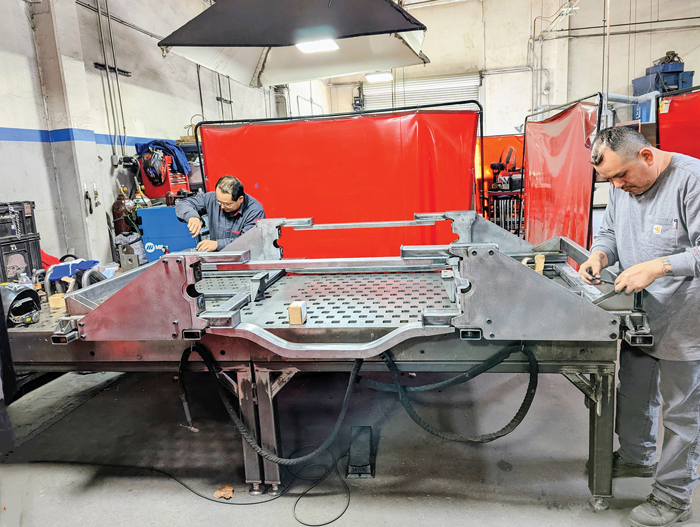
Team members at work at Continental Industries. (Photo courtesy Continental Industries)
Employing approximately 60 people and operating from roughly 40,000 square feet of manufacturing and warehouse space, Continental produces components and assemblies primarily from steel, stainless steel, aluminum, and galvanized material. Its capabilities include laser cutting, turret punching, press brake forming, MIG, TIG, spot and laser welding, hardware installation, design support, and assembly.
Automation plays an important role in the operation. Continental’s Amada 6kw fiber laser processes material ranging from thin sheet to heavy plate and is equipped with an automated cycle loader and multi-shelf material tower that supports lights-out production.
Its Amada EMK 3610 NT turret punch press features a 58-station turret with four auto-index stations and automated material loading and unloading. A Vipros 358 hydraulic turret punch provides additional capacity for punching and forming features in heavier materials.
In the forming department, multi-axis back gauges, advanced press brake controls, and offline programming help produce accurate, repeatable components. Three-dimensional bending software allows jobs to be programmed before reaching the machine, reducing setup time and improving efficiency. Continental can form components up to 120 inches long in a variety of materials and thicknesses.
Welding capabilities include MIG, TIG, spot, and laser welding for sheet metal, bar stock, and tubing. Laser welding is particularly useful for applications where consistent weld quality and minimal distortion are important.
Continental also gets involved before a project reaches the manufacturing floor. The company provides new-product design support, design for manufacturability, prototyping, and production manufacturing. Its designers can work from existing drawings or become involved earlier in product development, including visiting customer facilities to better understand how a product will be used or assembled.
The objective is to identify manufacturing challenges before production begins and find opportunities to simplify designs, reduce costs, and improve manufacturability.
Quality control is supported by automated, non-contact laser inspection technology used for first article and in-process inspections. The system can compare finished parts with design data, reverse-engineer two-dimensional components, and generate statistical process control reports. Automating portions of inspection helps reduce inspection time while improving consistency and limiting human error.
Those capabilities support customers across a variety of industries. Automotive manufacturing represents approximately 10 to 15 percent of Continental’s business. One customer converts light- and medium-duty vehicles, including delivery trucks, small school buses, and shuttle buses, from gasoline or diesel powertrains to electric.
The original powertrain is removed and replaced with an electric system engineered for the specific make and model. Continental fabricates components used in the conversions, including battery containment structures, electronic enclosures, and other sheet metal parts.
“The EV market is strong,” said Michael Moss, director of sales, noting the level of EV activity in Southern California.
Continental also supplies automotive manufacturers producing carburetor rebuild and fuel-injection conversion kits, high-performance Volkswagen and Porsche components, suspension modification products, and parts for off-road vehicles.
Some of the company’s largest opportunities, however, come from data centers and AI infrastructure.
Although the growth of artificial intelligence has brought increased attention to data center construction, the market is not new to Continental. The company began supporting a southern California data center manufacturer about a decade ago. What has changed is the scale and variety of products being produced.
“There’s so much of it now, and so many network and storage racks, cooling systems, and related products that rely on fabricated sheet metal and tubular welded assemblies,” Moss said.
Individual data center programs can require thousands of fabricated components, placing a premium on manufacturing capacity, automation, repeatability, and scalability.
AI is also changing the infrastructure inside data centers. Server cabinets and racks require fabricated panels, structural components, and assemblies, while increasingly powerful computing equipment is driving demand for more sophisticated cooling systems. Those systems can require large, fabricated enclosures, frames, panels, and welded assemblies.
For Continental, that demand is closely aligned with capabilities already on its manufacturing floor. Automated laser cutting and punching, precision forming, welding, inspection, and design support allow the company to move projects from early prototypes and design refinement into production.
As investment continues in data centers, AI infrastructure, electric vehicles, and other technology-driven industries, the products may be changing, but they continue to rely on a familiar manufacturing foundation: precisely cut, formed and welded metal.
For more information about Continental Industries, visit https://www.continental-ind.com
GC International
With expertise in casting and machining, and a commitment to achieving ‘the shortest lead times possible,’ GC International makes a strong case as an economical source for complex manufacturing projects.
GC International (GCI), of Camarillo, California, is a casting and machined parts supplier to leading aerospace, medical, defense, and high-tech firms. The company operates its business steeped in core values designed to benefit its customers: cost-efficient, economical manufacturing; responsive and proactive customer service; strict quality assurance; and the shortest lead times on parts deliveries.
According to GC International, its ability to offer both casting and machining of parts make it an economical choice for parts manufacturing projects. Its goal of building long-term relationships with customers pays off with open collaboration, responsiveness, and proactive communication. Its commitments to defect-free manufacturing and continuous improvement are evident in its AS9100:2016 Quality Management System Certification.
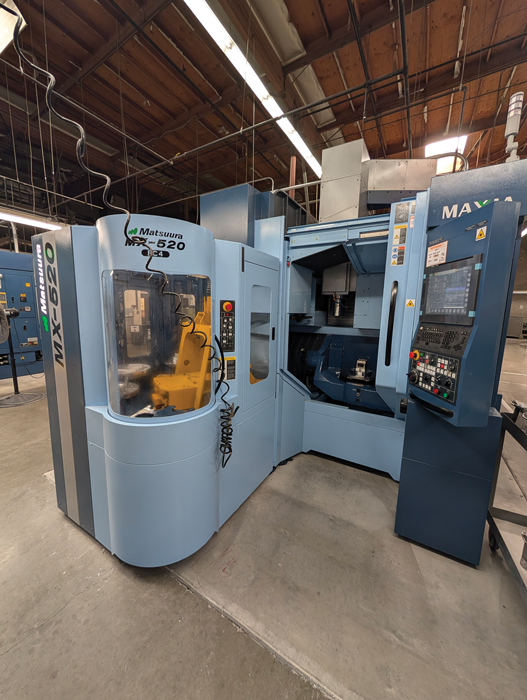
A Matsuura MX-520 5-Axis Vertical Machining Center at GC International. (Photo courtesy GC International/A.L. Johnson Company)
Permeating all of its work is its dedication to achieving the shortest lead times possible. “We strive to provide fast turnaround, on-time deliveries and repeatable high quality on low volume and JIT releases. Getting you to market fast/first is our #1 goal,” GCI’s website states.
GC International arose from A.L Johnson Company, which was founded in 1954 as a metal caster using a modified version of the Antioch method of casting for aluminum and zinc parts. The casting process GC International developed is called the rubber plaster mold (RPM) system. GC International calls its RPM molding system ideal for low volume, high-mix, complex aluminum parts.
Low-cost tooling, consisting of pattern and master mold, can usually be completed in a few weeks. Changes, when necessary, are inexpensive and can be made in a matter of days. Lightening cavities and uniform wall, normally found in die castings, are not required. In many instances no draft is required.
“From prototype to production, manual to CNC, our highly skilled team is dedicated to developing defect-free, difficult-to machine parts from billet that meet aerospace and medical industry demands,” GC International states on its website.
According to GC International, its ability to provide quick deliveries satisfies customers’ needs for engineering prototypes, as well as prototypes used for marketing purposes. RPM castings can be fabricated and incorporated into a customer’s product long before mass production parts are available.
One of GCI’s specialties is milling a part out of a solid block of metal. Another specialty is casting a part using molten aluminum metal. In both cases, GCI creates tight tolerances with CNC machining and other metal finishing processes called for by the customer, and the needs of the part.
GC International’s foundry and precision machine shop in Camarillo, California make quick turnaround, precise aluminum and zinc parts from a few ounces in size up to 20 pounds, with a tolerance of 0.010-inch. The company uses a rubber plaster mold process with low-cost tooling, no draft, thin wall, and smooth surface. The castings are machinable.
“We are experts in machining complex aluminum castings,” the company’s website states. “We are happy to collaborate with other foundries to provide a comprehensive set of machining processes for especially challenging, thin wall castings in RPM, sand, die, permanent mold, and investment.”
According to the company, pattern and mold making are the first steps to close tolerances. Attention to detail in manufacturing and diligent quality controls are said to ensure that RPM castings are delivered to the tolerances quoted.
GC International described its RPM aluminum casting method as being superior to many other casting methods. For example, it produces a surface finish of 63 RMS, and it is economical for short runs. Similar to die casting, the method offers near net shape with a minimum of finishing and can serve as a bridge to high volume production.
In 1975, Richard Carlson and F.W. Griffith II purchased A.L. Johnson Company (ALJ) and formed GC International Inc. In 1999, the company, now referred to as GCI International Inc. DBA (doing business as) A.L. Johnson Company, bought its first Haas machine, adding machining to its casting process.
GC International has since added numerous CNC machines, including five-axis and multi-pallet lights out, advanced machining centers. It earned AS9100 (aerospace) certification in 2012, and has since achieved ISO 14001 environmental certification and NIST 800 registration and compliance (protecting controlled, unclassified documentation). The company also maintains registration with ITAR (International Traffic in Arms Regulations).
According to GC International’s AS9100:2016 Certificate of Conformance, the company’s quality management system certification applies to “precision manufacturing of parts using CNC machining, and the production of aluminum and zinc castings using the rubber plaster mold process.”
GC International offers a variety of finishing services, mechanical assembly, and kitting. It also offers Nadcap accredited heat treating, hardness testing, non-destructive testing, liquid penetration inspection, magnetic particle inspection, and radiographic inspection, according to the company.
For more information about GC International, visit https://gcinternationalcorp.com.
Pro-CAM Services
By focusing on systems rather than just the machines, Pro-CAM Services has engineered consistently high quality parts by conscientiously building reliability into its manufacturing processes.
Pro‑CAM Services, a precision CNC machining company based in Zeeland, Michigan, operates a fully modernized 38,000‑square‑foot facility built for speed, accuracy, and repeatability.
Established in 1995, the company has spent more than 31 years refining a manufacturing philosophy centered on engineered consistency, and a system‑driven approach that delivers reliable quality whether the job is a single prototype or a high‑volume production run.
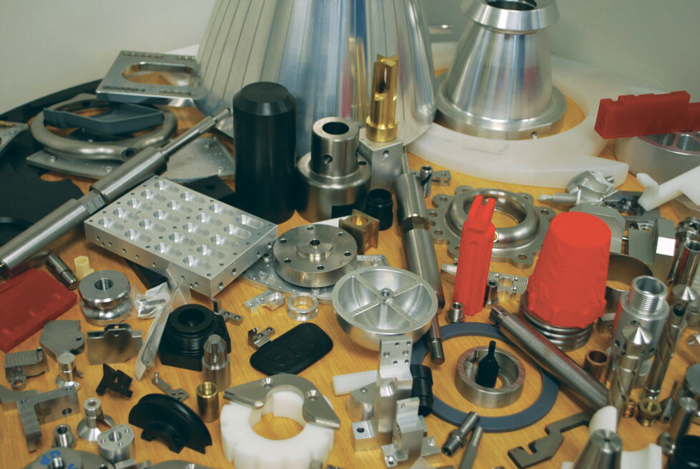
ProCAM Services uses a variety of CNC milling, turning, and routing machines to produce machined parts for numerous industries. (Photo courtesy ProCAM Services)
Pro‑CAM serves a wide range of industries, including automotive, aerospace, automation, furniture, industrial equipment, oil and gas, consumer products, food processing, conveyor systems, and specialty machinery. As a true job shop, the company machines everything from complex 5‑axis components to large aluminum plates up to 80 inches × 144 inches, along with precision metal and plastic parts across nearly every material category.
“Our success has been rooted in our on time delivery, exceptional quality, and our ability to work with our customers to find cost effective and turnkey solutions to meet their needs,” the company’s website states. “We recognize that every customer has unique needs and we are committed to providing each customer with a tailored solution.”
Whereas many shops focus on machines, Pro‑CAM focuses on the systems that make those machines perform at their best. The company standardizes tooling, documents workflows, controls processes, and eliminates variables before they become problems. This intentional structure ensures that parts run the same on Monday morning as they do on Friday afternoon at a level of repeatability that customers rely on.
Pro‑CAM invests early and intentionally in technology that moves bottlenecks and improves throughput. Strategic additions such as 5‑axis machining capability, Zoller shrink‑fit tooling, and Zoller tool presetting have increased accuracy, improved surface finishes, reduced tool spending, and accelerated delivery times. These investments aren’t for show—they’re chosen to make the shop run smarter, according to Pro-CAM.
When challenges arise, Pro‑CAM solves them at the root. Instead of patching symptoms, the team asks: Why did this happen? What system allowed it? How do we prevent it from happening again? This mindset eliminates firefighting and builds long‑term reliability into every process.
Pro‑CAM’s machining capabilities include 3- , 4- , and 5‑axis milling, CNC turning, large‑format aluminum plate machining, rapid prototyping, and precision production runs. The company machines aluminum, plastics, stainless steel, carbon steel, brass, bronze, copper, titanium alloys, Inconel, and other specialty materials.
The company offers three levels of service based on customer urgency: fast track, rush, and standard. This speed is possible because the shop is engineered for consistency, not chaos, allowing rapid response without compromising quality.
Pro‑CAM doesn’t simply ask, “Can we make this part?” The team asks, “How do we build a repeatable, profitable, reliable process around this part?”
That philosophy is why customers stay, why investments pay off, and why the company’s work remains consistent across the automotive and other industries and complexity levels.
Pro-CAM serves the automation industry with custom machined automation parts. These parts have included aluminum plates, dial plates, panels, mount plates, pallets, gussets, locating blocks, stand-offs, fixture bases, and more. For the engineering industry, the company has produced prototypes, as well as fast delivery of small batch, custom machined parts.
For customers in the automotive industry, Pro-CAM has provided tooling and fixtures, along with rapid prototyping and other projects.
For the conveyor industry, Pro-CAM has provided custom, made-to-order components and quick-turn replacement parts. For the tool and die industry, the company produces mold blocks, die blocks, and any machined component. It states that it has developed and perfected the finish machining process on 3D printed details, because many 3D printed parts require tight tolerances, threads, and sealing that isn’t achieved in the printing process, but in the finishing process.
The manifold and fluid power industry turns to Pro-CAM machining for manifolds, for various ports, deep hole drilling, de-burring intersecting holes, achieving proper sealing surfaces, and machining the parts to customers’ specifications. The company has provided the furniture industry with furniture-grade tabletops, panels, legs, drink holders, and in-house fixturing, all from a wide range of materials.
Pro-CAM’s rapid prototyping team is reported to turn around prototypes in as little as one day. The foundry and casting industry turns to Pro-CAM for finish turning, finish milling, and for drilled, tapped, and reamed holes to deliver finished products to the customer in both small and large volumes.
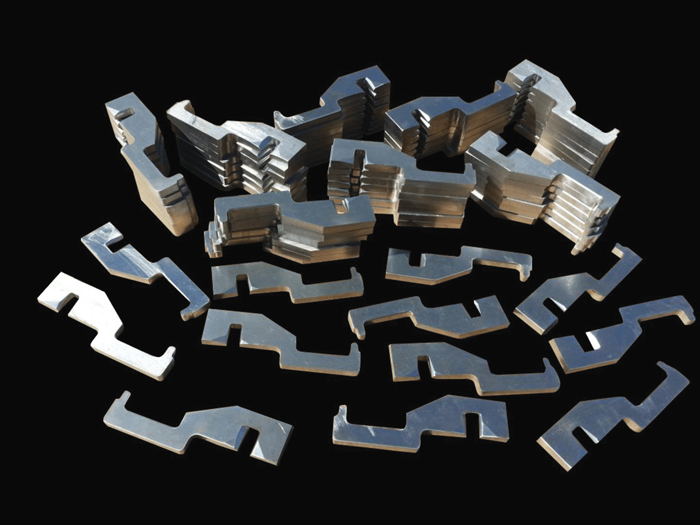
A sampling of precision machined parts from Pro-CAM Services. (Photo courtesy Pro-CAM Services)
Pro-CAM has also provided the food processing industry with food-grade rollers, pulleys, belts, guides, gussets, spacer shafts, bearing housings, panels, sprockets, and a wide range of custom machined parts. These parts were made from a range of plastics, stainless steels, and aluminum.
For more than three decades, Pro‑CAM has proven that consistency isn’t an accident—it’s engineered.
“Our core commitment is to exceed all other machine shop standards with appearance, quality, and delivery at a competitive price,” the company states on its website.
To learn more about Pro‑CAM Services or to discuss an upcoming project, visit www.procamservices.com, email info@procamservices.com, or call 616‑748‑4200.