Manufacturing Challenges Take Center Stage at ORNL Forum
The two-day working forum focused on aligning manufacturing research with industry priorities.
Challenges facing the manufacturing industry took center stage as more than 350 leaders from industry, government, and the research community gathered on August 19–20 at a forum hosted by the Department of Energy’s (DOE) Oak Ridge National Laboratory (ORNL).
The two-day forum, Materials and Manufacturing Innovation Days (M2IND), brought out discussions focused on barriers slowing the deployment of advanced manufacturing technologies. It also featured discussions of how national laboratory capabilities and partnerships could help move those technologies toward production, according to a news release from ORNL.
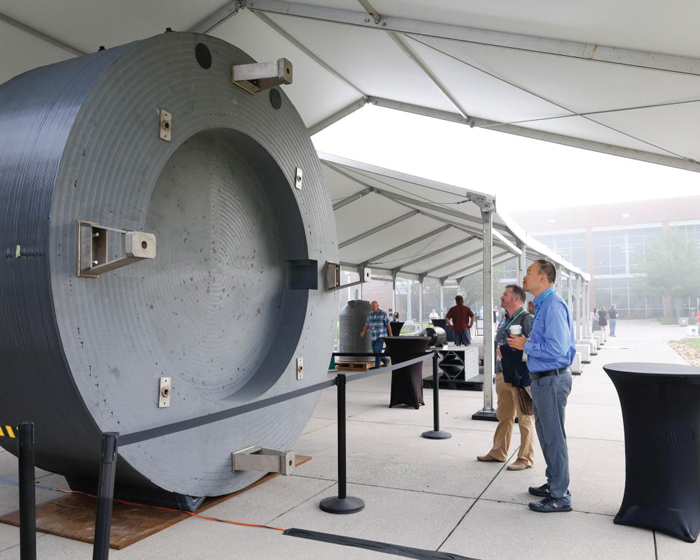
Carey Chen and Joshua Burgess view a full-scale, 3D-printed mockup of an impact limiter for spent nuclear fuel transportation during M2IND at ORNL. (Photo courtesy Carol Morgan/ORNL, U.S. Dept. of Energy)
“We want to make sure we have input from industry to help guide our research and ensure that the work at Oak Ridge and the Manufacturing Demonstration Facility (MDF) is valuable to U.S. manufacturers and takes into account the supply chains needed to commercialize new technologies,” said MDF Director Ryan Dehoff, in the release.
The event brought together representatives from four DOE offices—Advanced Materials and Manufacturing Technologies Office (AMMTO), Building Technologies Office, Hydropower and Hydrokinetic Office, and Office of Nuclear Energy. Also represented were the Pentagon’s Office of Industrial Base Resilience and organizations spanning nuclear energy, hydropower, oil and gas, critical materials, manufacturing, defense, and technology development.
The discussions, according to the release, identified a shared set of obstacles. These include limited domestic capacity for large castings and forgings; long lead times for specialized components; a shortage of workers with manufacturing, automation, and digital skills; inconsistent data formats; and qualification and certification requirements that can slow adoption even after a technology has been demonstrated. A participant from the hydropower industry noted that lead times for major components extend a decade or more.
“M2IND has brought folks together across the spectrum who have different reasons for being here and bring a different point of view, but ultimately are aligned around the idea that there’s urgency to accelerate our domestic manufacturing capabilities,” said Kiley Naas, vice president of the public sector at Rescale, in the release.
Additive manufacturing for nuclear energy applications
Among the items displayed during M2IND were two large structures from additive manufacturing projects related to nuclear energy: a glass-fiber-reinforced polymer mockup of an impact limiter for spent nuclear fuel transportation, and a closed steel pressure vessel produced using multirobot wire-arc additive manufacturing.
“Impact limiters are massive structures attached to both ends of a shipping cask to protect it in the event of an accident,” the release stated. “Traditionally made from wood, they can span 12 feet and weigh many thousands of pounds. Working with the University of Maine, MDF researchers recently 3D printed the mockup using glass-fiber-reinforced polymer to explore new materials and manufacturing approaches for this application.”
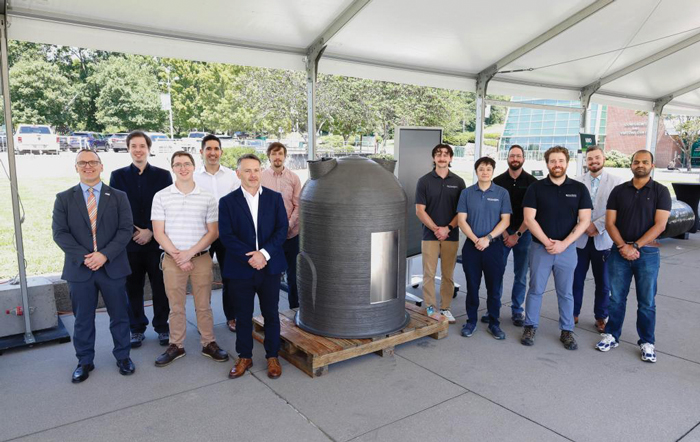
ORNL manufacturing researchers gather beside a 3-by-5-foot steel pressure vessel produced using multirobot wire-arc additive manufacturing and displayed during M2IND. (Photo courtesy Carol Morgan/ORNL, U.S. Dept. of Energy)
The pressure vessel project explored a different nuclear manufacturing challenge. Using MedUSA, a large-scale wire-arc additive manufacturing system that coordinates three robotic arms, MDF researchers produced a 3-by-5-foot closed steel pressure vessel with complex domed geometry. Future research will focus on understanding qualification of the component for nuclear service, according to the release.
Reactor vessels are traditionally made using large-scale forging and welding, processes constrained by limited domestic capacity. The vessel produced in this study provided a test case for examining whether additive manufacturing could offer an alternate route for producing large components.
Establishing a manufacturing route, however, is only part of the path to deployment. Forum participants also discussed the importance of process monitoring, defect detection, and digital engineering in documenting how a component is made, tracking quality throughout production and generating the data needed to support qualification and confidence in performance.
To examine that challenge across facilities, ORNL and Idaho National Laboratory announced a laboratory-directed research and development collaboration during M2IND. By aligning manufacturing parameters, running comparable builds, and sharing results, the researchers will test whether sensing, data, and qualification methods remain reliable across different manufacturing systems and locations.
Partnerships aimed at industrial deployment
Among the new agreements announced during M2IND were cooperative research and development agreements with DMG MORI Federal Services and Lincoln Electric. Both projects connect ORNL research capabilities with industrial experience and routes to market.
The agreement with DMG MORI combines ORNL’s advanced manufacturing, modeling, sensing, and AI capabilities with the company’s machine tool technologies. The collaboration will advance machining, additive manufacturing, and intelligent digital production systems with the goal of moving laboratory innovations toward factory use more quickly.
The agreement with Lincoln Electric focuses on large-scale wire-arc additive manufacturing. The collaboration aims to improve process reliability, accelerate qualification, and strengthen domestic capability to manufacture critical components for energy infrastructure.
Technology licensing provided another route for moving laboratory research toward industrial use. During M2IND, Chattanooga-based Branch Technology licensed an ORNL-developed plant-based insulation foam. Designed for use in building envelope panels with lightweight 3D-printed structures, the foam can be poured into wall panels to insulate buildings, reducing heat loss and offering an affordable insulation option made from abundant, domestically available materials.
The forum also highlighted an ORNL hybrid manufacturing process licensed to A.J. Tuck Company. The process combines 3D printing and electroforming to produce complex hot isostatic pressing (HIP) cans—sealed containers used to form high-performance metal parts from powder under heat and pressure. The approach could streamline production of critical components for energy and defense applications while reducing reliance on constrained supply chains.
Hybrid Process Targets Nuclear Manufacturing Bottlenecks
The process combines electroforming and 3D printing to produce leak-free components.
By Tina M. Johnson
OAK RIDGE, Tenn.—In partnership with A.J. Tuck Company, scientists at the U.S. Department of Energy’s (DOE) Oak Ridge National Laboratory (ORNL) have developed a new manufacturing approach that could simplify production of critical components for advanced nuclear reactors and other energy and defense applications.
The method combines 3D printing and electroforming to produce complex, leak-free hot isostatic pressing (HIP) cans, sealed containers used to form high-performance metal parts from powder materials under high heat and pressure. This approach for making HIP cans could speed up production and reduce reliance on constrained supply chains.
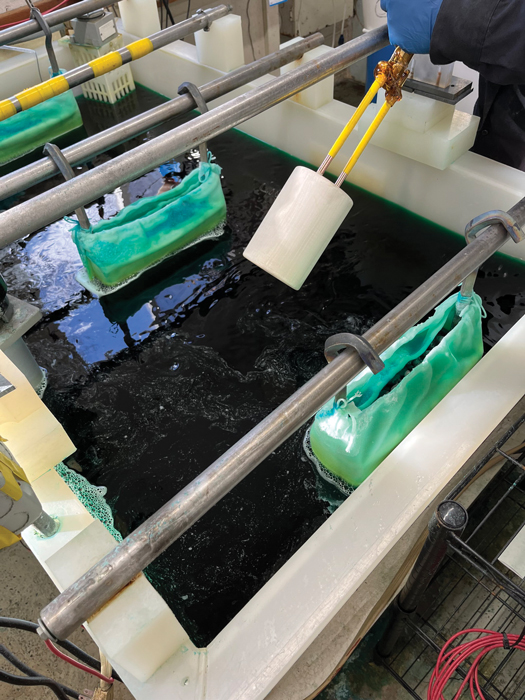
A.J. Tuck Company electroforms a leak-free HIP can using a 3D-printed polymer form and nickel bath as part of a hybrid manufacturing process developed with ORNL. (Photo courtesy A.J. Tuck Company)
This research is part of a cooperative research and development agreement and subsequent licensing agreement with A.J. Tuck Company (Brookfield, Connecticut), which provided expertise in electroforming and metal processing and conducted the electroforming activities for the project. A.J. Tuck and ORNL celebrated their partnership at Materials and Manufacturing Innovation Days, held August 19–20 at the lab.
The hybrid technique enables high-precision, multi-material components while simplifying how complex reactor parts are manufactured. It also reduces reliance on traditional supply chains for forging and casting—processes that shape metal using high heat and force, often requiring large, specialized facilities and long production times—which are now largely concentrated outside the United States.
To deliver these capabilities, the novel approach combines 3D printing and electroforming in a single streamlined process. A polymer form is first 3D printed, enabling complex geometries that would be challenging to manufacture using conventional methods. The form is then placed in an electrolyte bath, where electroforming uses electricity to build up a dense metal shell that precisely replicates the printed geometry.
“This project shows that electroforming can successfully produce leak-free HIP cans for advanced nuclear energy applications,” said Vanshika Singh, ORNL research associate staff scientist. “This approach could make it easier to produce these components in the U.S., reducing supply chain challenges for advanced nuclear energy systems.”
As demand grows for advanced and small modular reactors, so does the need for new manufacturing approaches. Nuclear energy provides approximately 20 percent of U.S. electricity, yet limited domestic forging capacity poses a challenge to producing the required large-scale components.
To address these challenges, the approach builds on powder metallurgy hot isostatic pressing (PM-HIP), a manufacturing method in which metal powder is sealed inside a container and then exposed to high heat and pressure, causing the powder particles to fuse together into a fully solid piece. While PM-HIP creates parts that are close to their final shape, producing HIP cans typically involves several fabrication and assembly steps. The new method streamlines this process using electroforming and enables greater design flexibility for complex components.
In this approach, a polymer mandrel, or form, is first 3D printed to define the final component shape. Nickel builds up on the form in the electroforming bath, creating a uniform metal shell approximately 2–3 millimeters thick. The form is then removed—in this case, dissolved with acid—leaving a hollow structure that is then filled with metal powder, sealed, and processed using HIP, which applies heat and pressure to form a solid component.
Using polymer-based additive manufacturing for the initial form reduces material strain and distortion because the process works with plastic rather than directly printing metal at extremely high temperatures. It also lowers material and equipment costs, enables rapid design improvements, and requires less post-processing compared with metal-based additive manufacturing systems.
“Electroforming allows us to rapidly create very detailed shapes with high precision while avoiding many of the challenges of traditional manufacturing methods,” said ORNL mechanical engineer Amiee Jackson. “Because the process depends mostly on how thick the metal layer needs to be—not how large the part is—we can scale production efficiently and even batch multiple components in a single process.”
The technology is well-suited for a range of energy applications requiring large, high-precision metal components, including reactor pressure vessels, valves and turbine systems. This capability makes it particularly relevant for advanced nuclear reactors and other energy infrastructure.
“Working alongside ORNL allowed us to bring our deep electroforming expertise into an entirely new domain,” said Dara Williams, president of A.J. Tuck Company. “Demonstrating that this process can produce leak-free HIP cans at this level of precision opens real doors for domestic nuclear manufacturing—and we’re just getting started.”
In the first phase of the project, the team used electroforming to produce five leak-free cylindrical HIP cans measuring 6 inches tall and 4 inches in diameter. The team also developed an integrated port design that eliminates the separate welding of process tubes—a common source of failure during the HIP process—resulting in a more robust and streamlined approach.
In the second phase of the project, currently underway, the team will apply the process to a more complex geometry: an impeller—a rotating component used to move fluids in systems like pumps and turbines—or a valve relevant to nuclear energy systems.
Other ORNL scientists on the project include Srikanth Allu, Rangasayee Kannan, Peeyush Nandwana, Amirkoushyar Ziabari, Parans Paranthaman, and Brian Post, along with Dara Williams, Tracy Yoho, Brandon Yoho, and Jared Williams from A.J. Tuck Company. An invention disclosure and provisional patent have been filed.
The Manufacturing Demonstration Facility, where the ORNL portion of the work was performed, is supported by DOE’s Advanced Materials and Manufacturing Technologies Office and acts as a nationwide consortium of collaborators focused on innovating, inspiring, and catalyzing the transformation of U.S. manufacturing.
Tina M. Johnson is a writer for Oak Ridge National Laboratory.
This article originally appeared online on the ORNL News Desk.
Source:
https://www.ornl.gov/news/hybrid-process-targets-nuclear-manufacturing-bottlenecks