From sheet metal fabricators to providers of custom busbars, specialty manufacturers are combining high quality with fast deliveries to keep up with exploding demand from data centers.
By Mark Shortt
The proliferation of AI, cloud services, and intensive, real-time data processing is fueling the rapid rise of hyperscale data centers across the country. These new structures, many of them massive, require next-generation chips and large amounts of hardware, market research has confirmed.
Today, demand for AI and data center infrastructure—including server racks, busbars, power distribution units (PDUs), cable and wire harnesses, heat exchangers, and cooling technology—is skyrocketing. For data center OEMs and equipment designers, finding the right specialty manufacturer to make what is often called “AI infrastructure” is critical to the success of their projects.
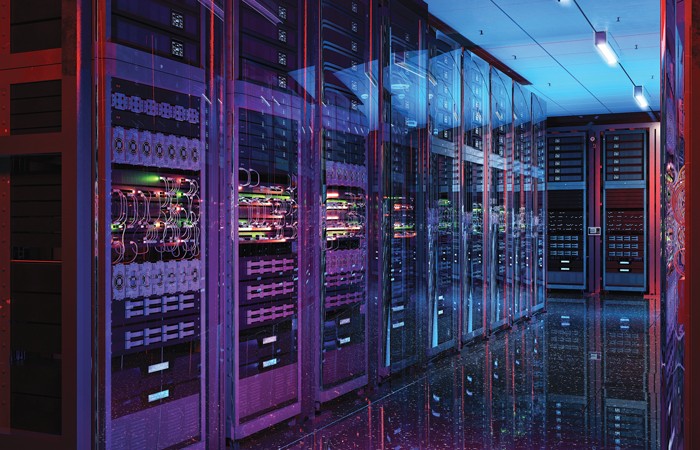
Photo shows data center server racks in a modern data storage center. (Image courtesy quantic69/iStock via Getty Images Plus)
Mike Moss, sales director for Continental Industries, a precision sheet metal fabricator in Anaheim, California, told Design-2-Part recently that although data centers have been a growth market for some time, he has witnessed strong customer demand from data center clients as the industry has accelerated in recent years. Orders have gone from a few hundred server racks at a time to a thousand or more.
“It’s grown a lot in the last couple of years, especially as AI becomes more relevant in various fields,” Moss said in an interview with Design-2-Part. “We did a lot of business with one particular company in the data center industry, and we helped them fabricate their storage racks. Now, with AI, we’re involved with multiple companies, multiple products within that same arena. We’re doing hot aisle, cold aisle, cooling systems, rack storage, and the volumes have just increased tremendously.”
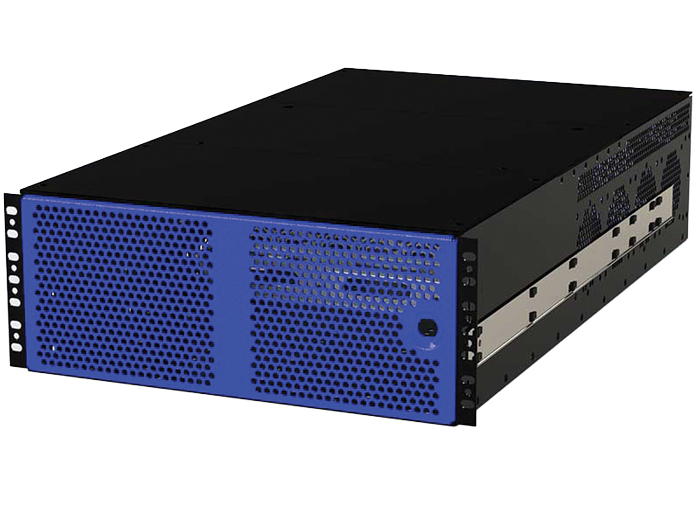
This 4U rackmount enclosure was fabricated by Continental Industries for a data storage and processing application. (Photo courtesy Continental Industries)
Moss noted that power distribution units (PDUs) are also among the precision components and assemblies that Continental Industries fabricates for AI and data center infrastructure. He was firm in his assessment that the widespread emergence of AI has been the factor most responsible for the growth in manufacturing for data centers.
Continental’s fabrication capabilities include fiber and CO₂ laser cutting, supported by automated multi-shelf tower systems, turret punching, and automated sheet loading and unloading to maximize throughput and consistency.
“We maintain strict quality control through laser inspection technology and comprehensive SPC reporting, ensuring repeatability and traceability throughout production,” Moss said. “Our forming capabilities include six press brakes equipped with eight-axis back gauges to support complex geometries and tight tolerances.”
Continental also provides certified MIG, TIG, spot, and laser welding to deliver fully integrated fabrication solutions.
“I would say AI has the biggest effect. Everybody—from hospitals to colleges to casinos—needed to store data and they had to have their space within these data storage centers. These places have grown tremendously because now, with the integration of AI, there’s a lot more information that’s being stored. The AI platforms themselves are building tremendous data centers with enormous facilities, racks, and everything that’s involved. It’s just growing exponentially.”
In his travels, Moss has seen first-hand the size and magnitude of the AI build-out currently sweeping the nation. In cities such as Phoenix and Las Vegas, he said, companies have built five-story data centers that are longer than they are high—appearing more horizontal than vertical—and built side-by-side.
“They are two twin buildings, five stories each. That’s 10 stories worth of data center for just one project.”
Within the data center industry, what are customers looking for from a contract manufacturing partner? Moss said that for the most part, it’s speed and accuracy, and the ability to keep up with demand.
“The cabinets, or the parts that we make for the cabinets, are needed by the hundreds or thousands. So, we have to be able to put out X number of parts a day in order to meet their scheduling. Instead of having projects that we build and fabricate and deliver at the end, we’re making daily deliveries so that they can keep up with their assemblies.”
Continental Industries’ turret punch, laser cutting, and lights-out automation capability enable the company to run parts through the laser and the punch presses overnight, and then do the forming the next morning. “This allows us to keep ourselves on track and one step ahead,” Moss said.
Moss said that as the data center industry has grown, thermal management technologies have changed, going from fan systems to liquid cooling and other methods. The need for effective cooling technology has also had an impact on sourcing, in some cases.
“I’ve seen where some data centers are contracting manufacturers with the big HVAC companies to develop new technology. Where we would manufacture fan racks and other items to cool the data centers, now they’re contracting with large HVAC companies to come up with a more effective solution because these centers are generating so much heat.”
As a precision sheet metal fabricator, Continental Industries serves a diverse range of technology driven and industrial markets in addition to AI and data center infrastructure.
“We manufacture precision sheet metal component parts and complete mechanical assemblies for OEMs and product manufacturers serving the defense, homeland security, aerospace, commercial electronics, and medical sectors,” Moss said. “Our customers include manufacturers of electronic chassis, rack-mount and Hoffman-style enclosures, box builds, medical device housings, RF system enclosures, and electronic test and measurement equipment housings, as well as components used in flight simulation and ground support equipment.”
The company is also heavily involved in the industrial machinery sector, producing control panels and a variety of fabricated components for equipment manufacturers. Other markets served by the company include lighting, electronics, and test and measurement equipment.
“This diverse customer base allows us to apply our precision fabrication expertise across multiple industries that demand high quality, reliability, and scalability,” Moss said. For more on Continental Industries, see Continental Industries Supports High-growth Industries with Quality, On-time Delivery, Scalability.
Reaching New Markets
Joe Lattanza is president and co-owner of Becker Electronics, a Ronkonkoma, New York-based company that builds custom cable and wire harness assemblies. In an interview with Design-2-Part, Lattanza said the company’s current work for the telecommunications industry includes panels and cabinet builds for cell tower sites.
“We are not involved in fiber optic products today, but this could be an area for investment in the future,” he said.
Becker Electronics has, however, seen some activity in the data center space.
“Ethernet cables and interconnects are very common builds on our manufacturing floor,” Lattanza told Design-2-Part. “We are also working with a large player in the chiller industry that supports the data center industry. It’s very exciting to break through into new industries.” For more on Becker Electronics, see Long Island Contract Manufacturer Making Waves As It Expands Reach into Key Markets.
Custom Busbars Bring Electrical Power to Server Racks, Cooling Systems
When Dielectric Manufacturing started its business in 1966 under the name of Dielectric Corp., it specialized in thermoset parts that were mainly used for insulation in high-voltage electrical systems. Today, the Richfield, Wisconsin-based contract manufacturer provides machining and fabrication of custom metal and plastic components and assemblies for companies that span a wide range of industries.
Last October, Dielectric Manufacturing acquired EMS Industrial & Service Company, a manufacturer of electric busbars in Richmond, Illinois. It was the company’s first acquisition since 2015, when it acquired Centerline Machine, a company in Waupaca, Wisconsin that provides precision machining for metal parts and assemblies used in mission-critical industries, such as military, aerospace, and medical diagnostics.
“We’ve seen higher demand for electrical system parts used in booming industries such as power transmission, data centers, and electric vehicles, and we expect that demand to continue growing,” said Mike Esser, president and CEO of Dielectric Manufacturing, in a statement announcing the acquisition last fall. “EMS brings more than 25 years of high-quality busbar production and fast delivery, so we’re ready to meet our customers’ expanding needs.”
In May of this year, the three companies—Dielectric Manufacturing, EMS Industrial, and Centerline Machine—officially united to form the combined Dielectric Manufacturing Group, (DMG), a single-source supplier of precision plastic and metal parts, machining, fabrication, and custom busbar systems.
Jamie Benter, director of business development for Dielectric Manufacturing Group, said the acquisition of EMS Industrial made sense by adding diversification to DMG’s customer base and process capabilities.
“Because EMS specializes in busbars, it is well aligned with our current business of providing machined and fabricated thermoplastic and thermoset plastics,” Benter said in an emailed response to Design-2-Part. “These are insulative materials that are used in conjunction with busbars to prevent arcing. The acquisition allows us to provide the plastic parts to our expanded customer base.”
Benter attributed the increased demand for busbars in data centers to the nationwide construction of data centers for artificial intelligence, and the associated energy storage needed to power the data centers. The surge in demand provides opportunities for companies like Dielectric Manufacturing Group to provide busbars for facility designers, OEMs, and even utilities that provide power to new data centers.
“Busbars are used throughout the data center electrical system. For example, they can be used in switchgear rooms for main power distribution, and they can be used to supply power to the server racks and cooling systems,” he said.
On its website, EMS Industrial describes bus bars as vital components in data centers, stating that they provide “a centralized and reliable way to distribute electrical power to critical equipment,” such as server racks and cooling systems. By helping to optimize space and improve energy efficiency, they are said to “allow for easy expansion as data center needs grow.”
“Unlike traditional cabling, bus bars improve power efficiency, enhance safety, reduce installation time, and save valuable space, making them a smart choice for today’s high-performance data center infrastructure,” the website stated.
Benter said that one of the advantages of using busbars, rather than traditional cabling, in data centers is that the static nature and size of the busbars allow for more voltage, driving an increased flow of current. He added that busbars improve power efficiency because they can handle higher current with less voltage drop.
“Traditional cabling is still used in some areas of data centers, but busbars are a better option for the high voltage required for power. Busbars are a better option than traditional cabling because they perform better with high current paths and have low resistance,” Benter explained. “Because of their rigidity and reduced connection points, busbars also have the advantage of fitting better in tight areas of the system. Customizable busbar configurations are driving the demand increase for us.”
Dielectric Manufacturing Group employs a broad range of processes to produce busbars for data centers. The main processes include laser or saw cutting, punching, forming, and CNC vertical and horizontal machining. The company can also provide bending. “In some cases, we send out specialty busbars to a third party for plating and insulative epoxy coating,” he said.
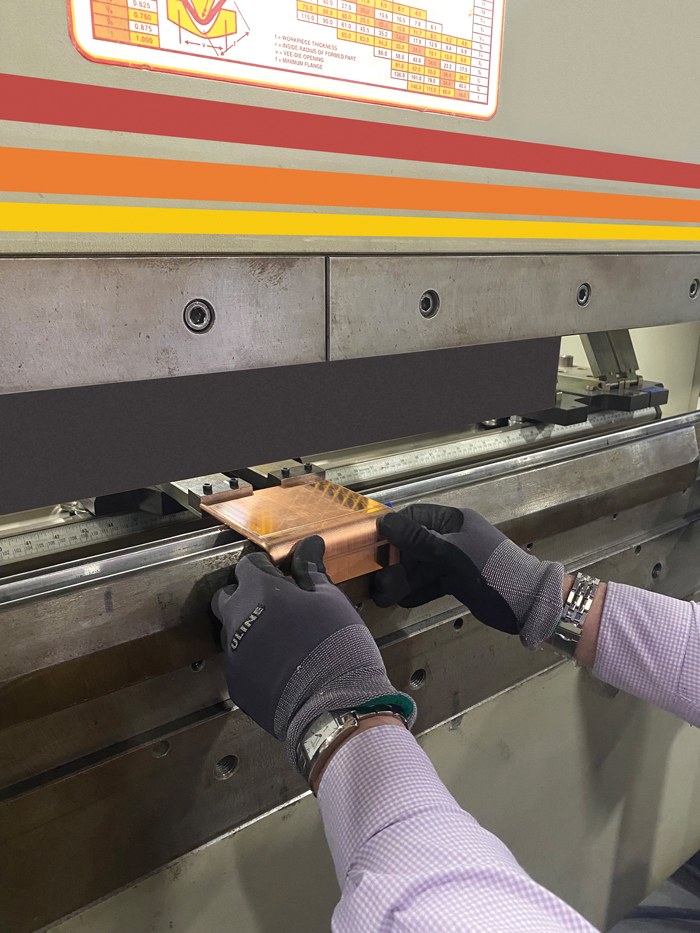
A machine operator is shown fabricating a custom copper busbar. Dielectric Manufacturing Group sources its copper from U.S.-based suppliers. (Photo courtesy Dielectric Manufacturing Group)
When potential customers in the data center industry need a source for electric busbars, what do they look for in a contract manufacturing partner? And what types of problems is Dielectric Manufacturing Group best able to solve for them?
Benter said that while price is always a factor, DMG’s customers are looking for short lead times and high-quality parts. All of Dielectric Manufacturing Group’s locations are set up to reliably deliver “the highest quality parts at some of the fastest delivery times in the industry.”
“Our customers keep coming back because we are very responsive to their needs,” he said. “Because we are integrated across the DMG organization, we serve as a one-stop shop for all the parts they need, including busbars. It allows us to produce and deliver parts quickly and they only have to work with one provider.”
Benter emphasized that for customers to achieve the most cost-effective and manufacturable busbar system, it’s critical that they get involved with Dielectric Manufacturing Group early in the design stage.
“We have a team of experts who can make recommendations on items such as material, dimensions, plating and coating. When we get involved early, we can help improve manufacturability, quality, turnaround time, and overall cost.”
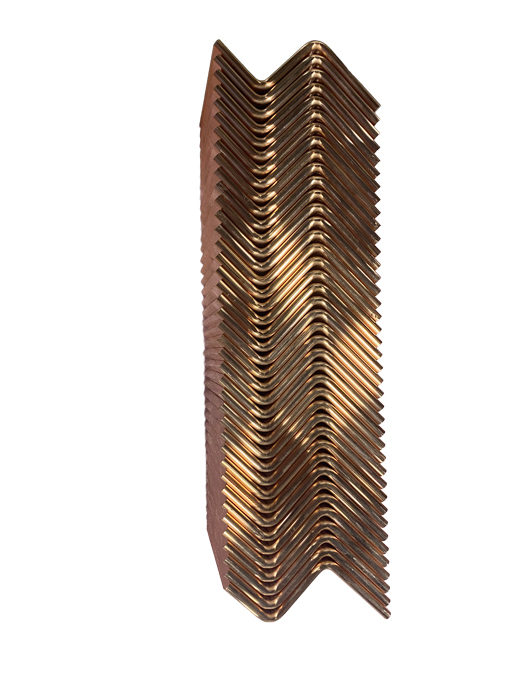
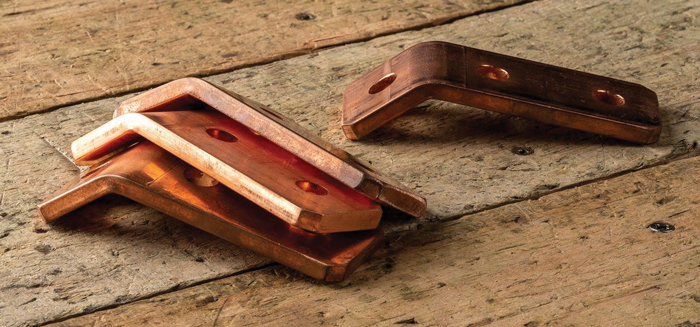
Copper busbars produced by Dielectric Manufacturing Group. (Photo courtesy Dielectric Manufacturing Group)
Integrating Broad Capabilities Across Facilities Is Key
The Partner Companies (TPC) is a global and diversified manufacturing company that supports innovators in the aerospace, defense, clean energy, medical, and technology industries. The company was founded in 2010 and has since grown to include 11 specialty manufacturers in the United States, China, Wales, and Mexico.
Three of these specialty manufacturing companies—L&T Precision, Pinnacle Precision, and UPG—are overseen by TPC Group President Luis Gomez. The companies offer manufacturing expertise in areas spanning injection molded plastic parts, sheet metal fabrication, precision machining, finishing, total integrated assembly, quality assurance, and more. Their capabilities support industries such as medical, data centers, energy systems, aerospace, and defense, as well as other commercial businesses.
Known for its work in designing and manufacturing high-precision plastic injection molded components and assemblies, UPG has also been expanding its capabilities in precision CNC and sheet metal fabrication. The company recently confirmed its ability to meet rigorous aerospace quality requirements by achieving AS9100 certification for its CNC precision machining operations at its Houston facility.
Pinnacle Precision operates an ISO 9001 and AS9100 certified, 73,000-square-foot manufacturing facility in Anaheim, California, where it provides precision sheet metal fabrication, CNC machining, finishing, and assembly for customers in high-growth industries, including data centers.
“We are experts in full-service Total Assembly, with a comprehensive process that meticulously joins and integrates metal parts, machined components, and wire harnesses into accurate, functional, and seamless electro-mechanical assemblies,” Pinnacle Precision’s website states.
L&T Precision is based in Anaheim, California, with a facility in Mexico. The company joins forces with data center customers to design and fabricate metal parts, components, and assemblies using its wealth of capabilities in CNC machining, sheet metal fabrication, finishing, and assembly services.
“The average enterprise-level data center houses 500 to 5,000 servers, while larger facilities can include up to 1,000,000,” according to L&T Precision’s website. “Those servers need racks, assemblies, and precisely manufactured parts to ensure reliable operation.”
Gomez told Design-2-Part in a phone interview that data center infrastructure is a growing market not only on the UPG side, but also at Pinnacle Precision and L&T Precision.
“We’re seeing an increase in interest, demand, quoting, engineering, and collaboration with our customers, not just in plastics, but in metals as well—sheet metal fabrication and precision machining.”
Server racks and large chiller units for data centers are among the projects recently awarded to TPC by its customers. Gomez said the company is providing machining, fabrication, and complete assembly for both. Other projects they’re working on include assemblies for power and thermal management. One customer recently asked them about the possibility of doing harness assembly.
“Certainly, the data center has been a big growth vehicle for us,” Gomez said. “It just opens the door for all types of work.”
A key factor in TPC’s ability to support the data center industry is its breadth of capabilities and ability to integrate numerous processes across facilities. In addition to its core capabilities of plastic injection molding, sheet metal fabrication, and precision machining, TPC offers engineering, assembly, testing, and supply chain management.
By successfully integrating these processes, the companies serve customers as a one-stop shop—not just from a capability perspective, but also from a geographical perspective. They service one customer from within five different facilities, Gomez said.
“We have this breadth of capabilities, but we also have a footprint,” he said, referring to the group’s facilities—and people—on three different continents. “It helps us provide that service and adjust to our customers’ needs. We’re able to pivot and provide a safety net to our customers, and it’s very valuable to them.”
Collaborating with customers
The data center industry is no different from any other demanding industry that requires complex parts and assemblies, in the sense that engineering is vital to helping customers overcome their specific design and manufacturing obstacles. In each of the facilities overseen by Gomez (UPG, Pinnacle Precision, and L&T Precision), TPC’s engineers play a critical role in collaborating with customers.
At one end of the engineering services spectrum, the team might take a customer’s CAD file and manufacture a product from that file, if that’s all the customer wants. At the other end, a customer might explain what they want, and the engineering team designs the product from scratch. It’s most common, however, for the team to receive engineering drawings from its customers, and then work with them to improve the design.
“We work with them to design for manufacturability. We work with them sometimes to change materials. It runs the gamut in terms of our collaboration with our customers,” Gomez said.
He added that TPC’s engineers are not just engineering the part itself; they’re also working to improve the processes used to make the part. Their goal is to hold tolerances, increase uptime, and make the process cost-competitive. They’ve been able to achieve this by focusing on creating automated processes that make the part as efficiently as possible, with repeatability to the highest quality standards.
By creating automated processes, TPC’s engineers have helped make UPG, Pinnacle Precision, and L&T Precision more competitive by removing the cost of labor for certain types of jobs. In many cases, Gomez said, customers have been able to keep projects in the states that they had previously been doing overseas in low-cost countries.
“We’ve never fired anybody because of automation,” he said. “We’re hiring high-level, well-paying jobs. Some people may think [automation] is a way to reduce head count. I see it as a way to grow and bring more business, bring more jobs into the U.S. at a faster pace.”
All three companies—UPG, Pinnacle Precision, and L&T Precision—serve multiple industries that require their suppliers to be certified to stringent quality management system standards, such as ISO 9001, ISO 13485 (medical), or AS9100 (aerospace). Gomez believes the companies’ ability to meet aerospace, defense, and medical requirements—all of which are very strict—helps them in the data center arena.
“I think it gives us a leg up in terms of quality, our processes, our policy, the way we go about servicing our customers,” he said. “We serve our data center customers the same way we serve our defense customers, our aerospace customers. We don’t change our processes because of the different parts or markets they’re going into.”
As data centers have become workhorses for AI, machine learning, and data analytics, their needs for power and heat management systems have skyrocketed. As a result, companies that serve the industry are fielding more inquiries and requests related to heat exchangers and the like. TPC is no exception.
“We’re working, for example, on a thermal solution for a customer,” Gomez said.” We’re doing most of the engineering for that. It’s essentially a heat exchanger, but very specific for their needs.”
Another trend he’s observed is also an outgrowth of the tremendous demand within the data center industry. Today, many customers are focused on a prospective partner’s manufacturing capacity, which is not as simple as it may sound.
“There’s so much demand, at this moment and in the foreseeable future, that they want to make sure that their supplier has the capacity required to flex with them because it requires a ramp-up,” Gomez explained. “Some of these units are very large in size, they’re very complex, and they require a lot of capacity.”
The capacity that Gomez is referring to applies to more than floor space. Customers may require a level of capacity in regard to people, their ability to do the work required, and the machinery available for the project. They want to make sure that their supplier has the financial means to buy the machinery and equipment necessary.
“There is a supply chain aspect to this that is really interesting, and it’s becoming a lot more prevalent in this space,” Gomez said. “It’s always been the case that they (customers) want to make sure that they’re working with a reputable company that has enough financial backing to buy enough material ahead of time, because of capacity. We’re talking about millions of dollars’ worth of purchasing that we have to do ahead of time.
“We’re okay because we have the wherewithal to do that. A lot of companies can’t flow that in their balance sheet, but we can, and that’s important.”